 Ali Kamaly
Tektronix vs Rigol Oscilloscopes in 2026 (Is the Premium Worth It?)
A direct comparison of the premium and value oscilloscope brands: where the price difference buys real measurement quality, where it buys nothing, and how to decide for your bench.
Rigol oscilloscopes are frequently good enough for general debug work, and Tektronix earns its premium on noise floor, trigger sophistication, probes, and calibration infrastructure. The honest comparison is not "which is better", it is "which measurements do you make, and do they touch the axes where the premium is real".
This post covers where the money genuinely goes, where it does not, and how to decide.
Where the premium is real
Front-end noise floor
The biggest genuine difference and the least visible on a spec sheet.
Set both scopes to 1 mV per division with nothing connected and look at the trace thickness. A premium front end shows a thin line. A budget front end shows a band. That band is the noise floor, and it sets the smallest signal you can meaningfully measure.
This matters enormously for power rail ripple measurement, low-level analog work, and anything where you are looking at millivolts. It matters not at all for looking at a 3.3 V logic edge.
Test it during evaluation. Short the input, set the most sensitive vertical scale, and measure the RMS noise. That single number tells you more than the datasheet.
Trigger capability
Premium scopes have more trigger types and, more importantly, triggers that work reliably at the edges of their specification. Runt, setup and hold, timeout, and serial-pattern triggers are where debugging time is actually saved.
If you spend your days hunting a rare fault, trigger capability is worth more than bandwidth.
Memory depth at full sample rate
Vendors quote maximum memory and maximum sample rate separately, and they are often not simultaneously available. Check the memory available at the sample rate you need, per channel, with all channels active. Budget scopes commonly degrade sharply here.
Probes
Underappreciated. A scope is only as good as what is attached to it, and premium probes have better bandwidth, lower loading, and more reliable compensation. The probe shipped with a budget scope is often the weakest element in the measurement chain.
Budget for good probes regardless of scope brand. A mid-range scope with excellent probes frequently outperforms a premium scope with poor ones.
Calibration and support
Traceable calibration, a service network, and long-term parts availability. For accredited labs and regulated work this is not optional and it is where Rigol's infrastructure is thinnest.
Where the premium buys nothing
Bandwidth on paper. A 100 MHz Rigol and a 100 MHz Tektronix are both 100 MHz. For looking at a 10 MHz clock, both work.
Basic measurements. Frequency, period, rise time, and peak-to-peak on a clean signal are the same number on both.
Serial decode for debugging. If you want to see what is on an I2C bus while bringing up a board, budget decode is adequate. It is not adequate for compliance testing, which is a different job.
Screen and interface. Rigol's interfaces have improved considerably. This is no longer a strong differentiator at the entry tier.
SCPI automation. Both automate well. Once tests run from a script, front panel differences stop mattering entirely.
Automating each
Rigol's command tree follows the colon-prefixed style, which makes Rigol scripts resemble Keysight scripts more than Tektronix ones.
Rigol:
scope.write(":TIMebase:MAIN:SCALe 1E-3")
scope.write(":CHANnel1:SCALe 0.5")
scope.write(":TRIGger:MODE EDGE")
scope.write(":TRIGger:EDGe:SOURce CHANnel1")
scope.write(":TRIGger:EDGe:LEVel 1.5")
scope.write(":RUN")
vpp = float(scope.query(":MEASure:VPP? CHANnel1"))
Tektronix:
scope.write("HORIZONTAL:SCALE 1E-3")
scope.write("CH1:SCALE 0.5")
scope.write("TRIGGER:A:TYPE EDGE")
scope.write("TRIGGER:A:EDGE:SOURCE CH1")
scope.write("TRIGGER:A:LEVEL:CH1 1.5")
scope.write("ACQUIRE:STATE RUN")
scope.write("MEASUREMENT:IMMED:TYPE PK2PK")
scope.write("MEASUREMENT:IMMED:SOURCE CH1")
vpp = float(scope.query("MEASUREMENT:IMMED:VALUE?"))
Different, and neither is harder. Wrap each in a small class with common methods and the test code stops caring, which is what makes a future purchase a price decision rather than a migration.
See automating a Rigol oscilloscope and automating a Tektronix oscilloscope.
Comparison table
| Rigol | Tektronix | |
|---|---|---|
| Entry price | Low | Two to five times higher |
| Bandwidth per pound | Excellent | Moderate |
| Noise floor | Moderate | Excellent |
| Trigger types | Adequate | Extensive |
| Memory at full rate | Check carefully | Generally better |
| Probes included | Basic | Better |
| Serial decode | Available, adequate | Available, compliance-grade |
| SCPI automation | Good | Good |
| Software ecosystem | Basic utilities | OpenChoice, TekScope, tm_devices |
| Calibration network | Limited | Extensive |
| Support | Limited | Strong |
| Resale value | Low | Holds value |
How to decide
Buy Rigol when
- •The work is general debug, bring-up, and digital timing
- •Budget is genuinely constrained and the alternative is no scope
- •You need several scopes and coverage matters more than any single instrument's quality
- •The measurements are not going into a formal report
A common and sensible pattern in small labs: buy Rigol scopes for the general benches and one premium instrument for the measurements that need it.
Buy Tektronix when
- •You measure low-level signals where noise floor limits you
- •You hunt rare events and need sophisticated triggers
- •Results go into formal reports or to customers
- •You need accredited calibration
- •The scope will be in service for a decade, where support and parts matter
Spend the difference here instead
If you save money on the scope, the highest-value places to put it:
- 1
Better probes. Improves every measurement you take.
- 2
A 6.5-digit bench DMM. Affects accuracy on far more tests than the scope does, and a good DMM outlives several scopes.
- 3
A decent programmable supply with good readback. See programmable DC power supply.
- 4
Automation time. An automated mid-range bench produces more and better data than a manual premium bench, every time.
That last point is the one most labs underweight. The instrument's specification sets the ceiling on a single measurement. Automation sets how many measurements you actually take, and for most validation work the second is the binding constraint.
The measurements where the difference shows
Concrete cases, so the comparison is not abstract.
Power rail ripple on a 1.8 V rail, expecting 10 mVpp. You are measuring 10 mV on a scope whose noise floor may be several millivolts at that sensitivity. The premium front end resolves it. The budget front end reports a number that is mostly its own noise, and the number will be consistently pessimistic. This is the clearest case where the premium is real.
A 3.3 V logic edge, checking rise time. Both scopes give the same answer within the accuracy anyone cares about. No difference.
Hunting a glitch that appears once a minute. Waveform update rate and trigger sophistication decide whether you find it today or next week. Premium wins clearly.
I2C bus debug during board bring-up. Budget decode is fine. You are reading addresses and data, not qualifying compliance.
Switching node on a converter, 50 V with fast edges. Probe quality and bandwidth dominate, and the scope brand matters less than whether you have an appropriate high-voltage differential probe.
Automated overnight characterisation, 500 captures. Neither brand's front panel matters. Waveform transfer speed and SCPI reliability decide the run time, and both are adequate. Measure transfer time on your record length before deciding.
The pattern: the premium shows up on small signals and rare events. On everything else, the difference is much smaller than the price.
What to check before buying either
- 1
Measure the noise floor yourself. Short the input, most sensitive vertical setting, read RMS noise. Compare that number to the smallest signal you need to measure. This single test predicts more of your future frustration than any datasheet line.
- 2
Check memory depth at your sample rate, all channels active. Not the headline maximum.
- 3
Time a waveform transfer of your actual record length, in binary, 100 iterations. This sets your automated run time.
- 4
Verify the probes. Compare what ships with the scope against what you need, and price the difference.
- 5
Confirm the SCPI commands you need exist and behave. Both vendors have quirks and evaluation is the free time to find them.
- 6
Check calibration availability in your region if it matters to you.
Steps 1 and 3 are the ones almost nobody does and the ones that actually differentiate. Bandwidth, channel count, and screen size are visible on a comparison table and are rarely what limits a real measurement.
The five-year cost, including the things nobody quotes
Purchase price is the visible number and rarely the deciding one.
| Line | Tektronix (MSO series) | Rigol (MSO5000 / DHO series) |
|---|---|---|
| Instrument | Mid four to five figures | Low four figures |
| Options and licences | Frequently separate, four figures each | Often bundled, or a cheap upgrade |
| Probes, differential and current | Premium, and vendor-matched | Cheaper, and third-party works |
| Annual calibration | Higher, more service centres | Lower, fewer centres |
| Support response | Contracted, fast | Community-first, slower |
| Resale after five years | Holds value | Falls faster |
| Firmware and SCPI stability | Very stable | Improving, occasionally changes |
The row that surprises people is options. A Tektronix scope quoted at a good price and then optioned up for jitter analysis and protocol decode can end up at double the sticker, whereas Rigol tends to bundle more into the base unit. Check *OPT? on both during the evaluation, not the quote.
The row that matters most for automation is the last one. A SCPI command set that shifts between firmware revisions costs you a debugging session at exactly the wrong moment. Tektronix is the safer bet there, and if your sequences are going into production that is worth real money.
Automating both from one codebase
If the honest answer is "we will own both", write the abstraction on day one rather than after the second scope arrives.
class Scope:
    def measure_vpp(self, ch): raise NotImplementedError
    def set_timebase(self, s_per_div): raise NotImplementedError

class Tek(Scope):
    def measure_vpp(self, ch):
        self.io.write("MEASUrement:IMMed:TYPe PK2PK")
        self.io.write(f"MEASUrement:IMMed:SOUrce CH{ch}")
        return float(self.io.query("MEASUrement:IMMed:VALue?"))
    def set_timebase(self, s):
        self.io.write(f"HORizontal:SCAle {s:g}")

class Rigol(Scope):
    def measure_vpp(self, ch):
        return float(self.io.query(f":MEASure:ITEM? VPP,CHANnel{ch}"))
    def set_timebase(self, s):
        self.io.write(f":TIMebase:MAIN:SCALe {s:g}")

def open_scope(io):
    idn = io.query("*IDN?").upper()
    return Tek(io) if "TEKTRONIX" in idn else Rigol(io)
Dispatching on *IDN? means the sequence never names a vendor. Swapping the bench becomes a hardware change rather than a code change, which is the whole point. See automate a Rigol oscilloscope with Python and its Tektronix equivalent for the per-vendor detail behind each method.
Common mistakes
- •Comparing sticker prices with different option sets. Query
*OPT?on both loaners and compare like for like. - •Assuming the cheap scope is fine because the bandwidth matches. Update rate, memory depth, and ADC bits decide whether you see a rare glitch. Bandwidth alone does not.
- •Buying premium and using it as a 4-channel voltage viewer. If nobody uses the analysis packages, the premium bought nothing.
- •Ignoring probe cost. A pair of differential probes can exceed the price difference between the two instruments.
- •Hardcoding one vendor's SCPI. See the abstraction above.
- •Skipping the loan. Both vendors will lend you one. Run your actual measurement, at your actual record length, over your actual interface.
- •Judging the user interface in a showroom. Front-panel ergonomics matter enormously for debug work and not at all for automated runs. Weight that by how you will actually use it: a scope that lives in a rack and is driven over LAN never needs a nice knob.
- •Forgetting who repairs it. Service turnaround and local support differ sharply between the two. On a single-scope bench, a four-week repair is a four-week outage.
Related reading
- •Keysight vs Tektronix oscilloscopes
- •Automate a Rigol oscilloscope with Python
- •Automate a Tektronix oscilloscope with Python
- •SCPI command cheat sheet
- •Tektronix OpenChoice alternatives
- •Tektronix TekScope alternatives, the analysis software side
- •Instrument control with VISA and SCPI, the layer both share
- •GPIB vs USB vs LAN, which interface to standardise on
- •pyVISA tutorial, the foundation for the abstraction above
- •Python instrument control libraries compared, what to build on
- •Free instrument control software, the zero-cost stack
- •Automated test report generation, what the captures feed
- •Best data acquisition system, if channel count is the real need
- •NI TestStand alternatives, sequencing either scope in a test
Where TestFlow fits
Instrument choice becomes permanent when tests are written against one vendor's command set. Keeping automation vendor-neutral is what makes the price comparison a real choice each time.
- 1
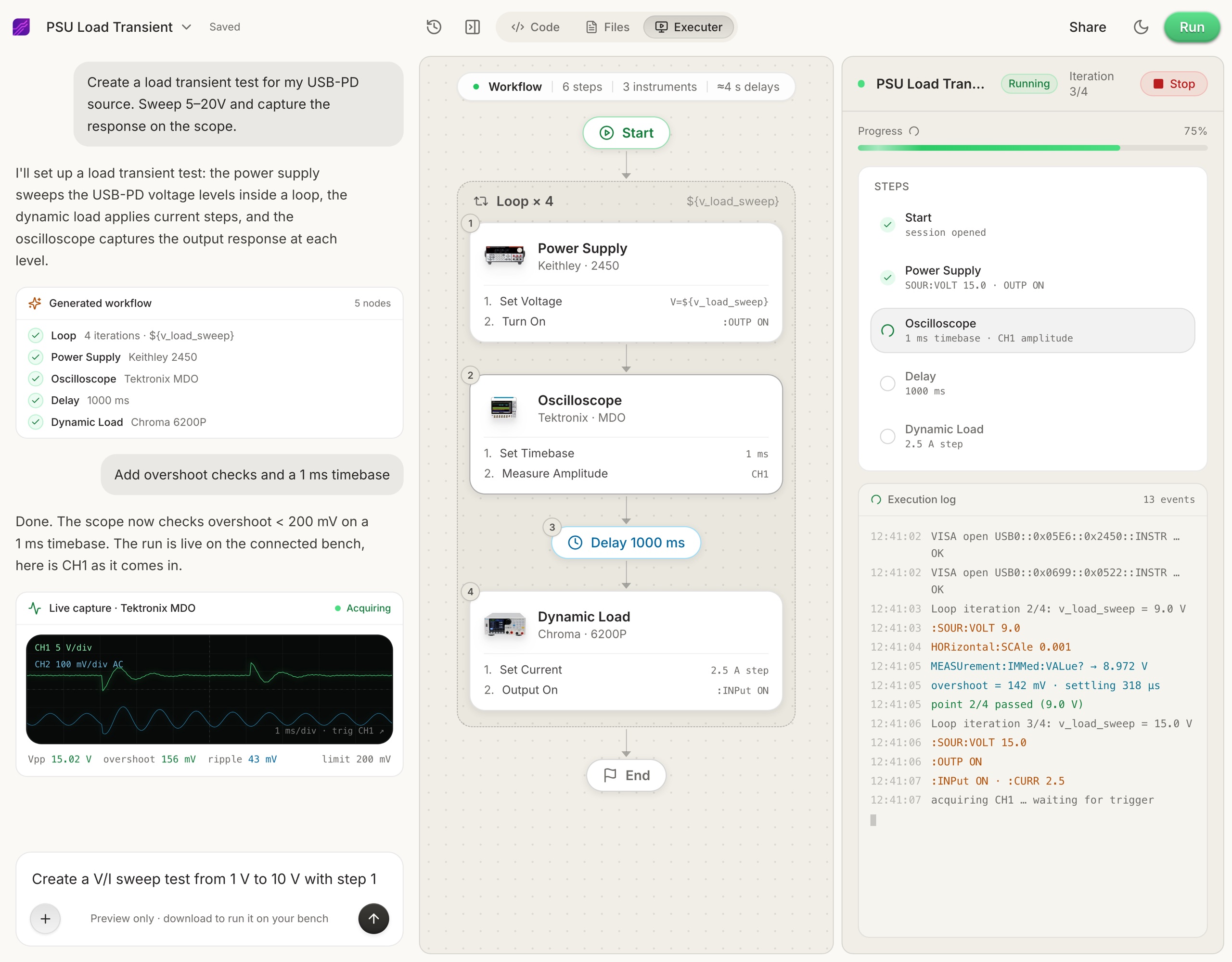
Connect your instruments. Pick the manufacturer and model, paste the VISA address (USB, LAN, GPIB, or serial), and the agent knows what is on your bench. No bench yet? Use a placeholder address, build the full automation, and swap in the real address when you are in the lab.
- 2
Tell the agent what to test, in plain English. For example, "run a VI sweep from 1 to 10 V in 1 V steps at 0.5 A load current," or "suggest the tests for a power-management device."
- 3
The agent builds the complete workflow in seconds. Instrument-aware automation appears on the canvas, with the generated scripts visible in a code panel you can inspect and edit.
- 4
Run it in your lab. Click Run and the status panel streams results step by step, with measured values inline (VOUT = 3.301 V, asserted 3.2 to 3.4 V, PASS). One click exports a structured PDF report, or the raw results as CSV.
- Vendor-neutral by design. One workflow drives Keysight, Tektronix, Rohde & Schwarz, NI, Rigol, Keithley, Anritsu, and more over standard VISA and SCPI.
- Browser-based and shareable. Workflows live in your workspace, so a sequence built in one lab runs the same way in another.
- Free version to start. Sign in at app.testflowinc.com and build your first workflow today; plans and quotes are on the pricing page.
The step-by-step walkthrough, VISA address formats, and Test Planner prompts are all in the TestFlow product guide.
Frequently asked questions
Is Rigol as good as Tektronix?
For basic timing, amplitude, and digital work at moderate bandwidth, a Rigol scope is often good enough and costs far less. Tektronix leads on noise floor, trigger sophistication, front-end quality, probes, support, and long-term calibration infrastructure.
Is a Rigol oscilloscope good enough for professional work?
It depends on the measurement. Many professional labs use Rigol for general debug and reserve premium instruments for measurements where noise floor and accuracy matter, such as power integrity and compliance work.
Can you automate a Rigol oscilloscope?
Yes. Rigol scopes speak SCPI over USB and LAN, and a Rigol script closely resembles a Keysight one because Rigol follows a similar colon-prefixed command tree. PyVISA drives them without any vendor software.
What is the main difference between a cheap and expensive oscilloscope?
Front-end quality and noise floor, trigger capability, waveform update rate, memory depth at full sample rate, probe quality, and calibration and support infrastructure. Bandwidth alone is a poor comparison because it says nothing about signal fidelity.
Do Rigol scopes hold calibration?
They can be calibrated, but the service network and traceable calibration infrastructure are less developed than for Tektronix or Keysight. For regulated or accredited work this can be decisive.
Should I buy Rigol for a startup lab?
Often yes for general-purpose debug, spending the saved budget on a good DMM and power supply, which affect measurement quality on more tests than the scope does.
Ready to automate your lab?
Connect your instruments, describe a test in plain English, and TestFlow builds and runs it in minutes.
Tags
Put it on your bench this week
A new way for testing, from specs to automated sequences, capture clean data, and accelerate your validation cycle.