 Ali Kamaly
GPIB vs USB vs LAN for Instrument Control in 2026 (Which to Use)
The practical differences between GPIB, USB, LAN, and serial for instrument control, measured in latency and throughput rather than marketing, and a clear recommendation per situation.
For SCPI command traffic, the interface barely matters, because instrument response time dominates. For large waveform transfers and for remote access, LAN wins clearly. That is the short answer, and most interface debates are about the cases where it does not apply.
This post covers the real differences in latency and throughput, the cost and reliability trade-offs, and which to choose for each situation.
The four interfaces
| Interface | VISA resource string | Typical use |
|---|---|---|
| LAN (LXI) | TCPIP0::192.168.1.42::inst0::INSTR | Racks, shared instruments, remote access |
| USB (USBTMC) | USB0::0x2A8D::0x1301::MY57200001::INSTR | Single instrument at a desk |
| GPIB (IEEE 488) | GPIB0::22::INSTR | Legacy instruments, established racks |
| Serial (RS-232) | ASRL3::INSTR | Older or simple instruments |
Latency, which is what actually matters
A typical validation script sends thousands of short commands. Each one is a round trip, so per-command latency multiplied by command count is your run time, not bandwidth.
Rough order of magnitude for a short command and response:
| Interface | Typical round trip |
|---|---|
| GPIB | 1 to 3 ms |
| USB (USBTMC) | 1 to 3 ms |
| LAN (TCP) | 1 to 5 ms |
| Serial at 115200 baud | 5 to 20 ms |
The spread between GPIB, USB, and LAN is small and is usually swamped by the instrument's own processing time. A DMM at NPLC 10 takes 200 ms to produce a reading, which makes a 2 ms difference in transport irrelevant.
The practical conclusion: if your script is slow, the cause is almost never the interface. It is settling delays, per-command round trips that could be combined, or ASCII transfers that should be binary. See the speed section in automating a Keysight power supply.
Throughput, which matters for waveforms
Here the interfaces genuinely differ.
| Interface | Practical throughput |
|---|---|
| GPIB (IEEE 488.1) | ~1 MB/s |
| GPIB (HS488) | up to ~8 MB/s |
| USB 2.0 (USBTMC) | ~10 to 30 MB/s practical |
| LAN gigabit | ~50 to 100 MB/s practical |
| Serial | ~11 KB/s at 115200 |
Transferring a 10 million point waveform record at 2 bytes per point is 20 MB. Over GPIB that is 20 seconds. Over gigabit LAN it is under a second.
Two caveats. Many instruments cannot source data at their interface's rate, so the instrument becomes the limit rather than the cable. And always use binary transfer regardless of interface, because ASCII inflates the same data roughly fivefold.
Reliability and practical annoyances
GPIB
- •Genuinely robust once working. The cables are heavy, locking, and industrial.
- •Address conflicts are a classic failure: two instruments set to the same primary address produce baffling behaviour.
- •Bus length is limited, roughly 20 metres total with a device every 2 metres.
- •Adapters and cards are expensive relative to the alternatives.
- •Absolutely does not care about network configuration, which in some corporate environments is a genuine advantage.
USB
- •Simplest for a single instrument, no configuration at all.
- •The resource string contains the serial number, so replacing an instrument changes every script that names it. Discover by
*IDN?rather than hardcoding where you can. - •Cable length limited to about 5 metres without a hub or active cable.
- •Hubs introduce enumeration problems, and a bus reset can drop every instrument on the hub at once.
- •Windows occasionally reassigns and confuses USBTMC devices after a sleep cycle.
LAN
- •The only sensible choice for shared or racked instruments.
- •Remote access without sitting at the bench, which changed how many labs work.
- •Web interface on most LXI instruments for configuration and diagnostics.
- •Requires network configuration, which means IT involvement in some organisations.
- •DHCP will change an instrument's address unless you reserve it. Fix addresses statically or by DHCP reservation, or scripts break weekly.
- •Firewalls block VISA traffic in some corporate environments.
Serial
- •Slow, and fine for instruments that only produce a reading a second.
- •Needs baud rate, parity, stop bits, and flow control matched, and a mismatch produces silence rather than an error.
- •Termination characters matter more than on other interfaces.
Cost
| Interface | Cost to add to a PC |
|---|---|
| LAN | Free, already present |
| USB | Free, already present |
| GPIB | $300 to $1,000 for an adapter or card |
| Serial | $10 to $50 for a USB adapter |
GPIB is the only one with a real cost, and it is per computer.
Which to choose
Use LAN when
- •The instrument is in a rack or shared between engineers
- •You want remote access, which is now normal rather than exotic
- •You transfer large waveform records
- •You are building a new bench and have the choice
Set a static IP or a DHCP reservation. This is the single most important operational detail. An instrument that changes address breaks every script silently, and the symptom looks like a broken instrument.
Use USB when
- •One instrument, one computer, one engineer
- •You want zero network configuration
- •The instrument is portable and moves between benches
Discover rather than hardcode the resource string, because it contains the serial number.
Use GPIB when
- •The instrument has nothing else, which is the honest main reason
- •You are extending an existing GPIB rack and consistency is worth more than modernity
- •Corporate network policy makes LAN instruments impractical
Use serial when
- •The instrument has nothing else
- •Data rates are low
Writing transport-agnostic code
This is the part that matters most and takes the least effort. Keep the address in configuration, never in the test.
# instruments.yaml
# psu:  TCPIP0::192.168.1.42::inst0::INSTR
# dmm:  USB0::0x2A8D::0x1301::MY57200001::INSTR
# load: GPIB0::8::INSTR

import yaml, pyvisa

def open_bench(config_path: str) -> dict:
    config = yaml.safe_load(open(config_path))
    rm = pyvisa.ResourceManager()
    bench = {}
    for name, address in config.items():
        inst = rm.open_resource(address)
        inst.timeout = 10000
        idn = inst.query("*IDN?").strip()
        print(f"{name}: {idn}")
        bench[name] = inst
    return bench
Now moving an instrument from USB to LAN, or replacing a unit with a different serial number, is a one-line configuration change rather than a search across every script.
Also worth doing: record the *IDN? response of every instrument into the test results. When a result looks wrong six months later, knowing exactly which serial number produced it is the difference between an answer and a guess. See automated test report generation.
A mixed bench is normal
There is no requirement to standardise. A typical working bench runs the scope and supply on LAN because they are racked, the DMM on USB because it sits on the desk, and a twenty-year-old source on GPIB because that is all it has.
PyVISA handles all three identically, and with the addresses in configuration the test code cannot tell the difference. That is the correct outcome.
Diagnosing a connection that does not work
A structured order, fastest checks first. This resolves most problems in under five minutes.
LAN
- 1
ping 192.168.1.42. No reply means networking, not instruments. - 2
Open
http://192.168.1.42in a browser. Most LXI instruments serve a page, which confirms the instrument is up and reachable. - 3
Raw socket to port 5025 and send
*IDN?. This bypasses VISA entirely, so if it works and PyVISA does not, the problem is your VISA layer. - 4
Check the instrument's front panel for its actual IP. DHCP may have moved it.
USB
- 1
Check the operating system sees the device at all. Device Manager on Windows,
lsusbon Linux. - 2
Confirm the driver is USBTMC rather than a vendor-specific one. Some vendor software installs a driver that claims the device and blocks VISA.
- 3
rm.list_resources()and look for aUSB0::string. - 4
Unplug, wait, replug. USBTMC enumeration genuinely does get stuck, particularly after a sleep cycle.
- 5
Try a different port, avoiding hubs.
GPIB
- 1
Confirm the adapter appears in NI-MAX or Keysight Connection Expert.
- 2
Check the instrument's GPIB address on its front panel, and check no two instruments share it.
- 3
Check cabling and termination. GPIB needs devices powered on to pass the bus through.
- 4
Scan for instruments from the adapter's utility, which is faster than guessing addresses.
Serial
- 1
Confirm the COM port number.
- 2
Match baud rate, data bits, parity, and stop bits to the instrument's front panel settings. A mismatch produces silence, not an error.
- 3
Set
read_terminationandwrite_terminationexplicitly, usually"\n"or"\r\n".
The single most useful diagnostic across all four is step 3 for LAN: a raw socket. It removes every software layer between you and the instrument, so a working raw socket and a failing PyVISA call localises the fault immediately.
Instruments on a shared network
Once instruments are on LAN, they are on a network with other things, and that has consequences worth planning for.
- •Reserve addresses. Static IPs or DHCP reservations by MAC. An instrument that moves breaks every script.
- •Separate the subnet where possible. A dedicated instrument VLAN keeps corporate broadcast traffic away from measurement traffic and removes an entire class of intermittent timeouts.
- •Document the address map. A file in the repository listing every instrument, its address, its model, and its serial number. This is the first thing a new engineer needs and the last thing anyone writes down.
- •Do not put instruments on WiFi. Latency varies and packets drop, and the resulting intermittent timeouts are almost impossible to distinguish from an instrument fault.
Picking an interface per instrument class
The general answer is LAN. The exceptions are worth knowing, because they are the cases where the general answer costs you.
| Instrument class | Best interface | Why |
|---|---|---|
| DMM in a logging role | LAN | Long runs, remote access, no host dependency |
| Oscilloscope pulling full-depth records | LAN, or USB for a single bench | Throughput dominates, and LAN scales |
| Power supply | LAN | Set-and-forget, and remote power control is genuinely useful |
| Function generator | LAN or USB | Low data volume, either is fine |
| Switch matrix or scanner | LAN | Often lives in a rack, away from the host |
| Legacy instrument, pre-2005 | GPIB | Frequently the only option |
| Anything in a shielded chamber | LAN over fibre, or GPIB | Cable routing and ground isolation |
| A temporary bring-up on a laptop | USB | Zero configuration, plug in and go |
The shielded-chamber row is the one that catches RF teams: a copper LAN cable through a chamber wall is a ground path and an antenna. Fibre media converters solve it and GPIB opto-isolators are the older answer.
Configuring a LAN instrument so it stays findable
The one real disadvantage of LAN is that an instrument can move. Three settings, done once, remove the problem.
- 1
Reserve the address by MAC on your DHCP server, or set a static IP outside the DHCP pool. An instrument whose address changes breaks every script that names it.
- 2
Set the hostname on the instrument and use it in the resource string.
TCPIP0::psu-bench3::inst0::INSTRsurvives a re-address; a hard-coded IP does not. - 3
Record the mDNS name if the instrument advertises one. Most LXI instruments do, which makes discovery work without any server configuration at all.
import pyvisa
rm = pyvisa.ResourceManager()
for res in rm.list_resources():
    try:
        with rm.open_resource(res, open_timeout=2000) as inst:
            inst.timeout = 2000
            print(f"{res:45} {inst.query('*IDN?').strip()}")
    except Exception as exc:
        print(f"{res:45} unreachable ({type(exc).__name__})")
Run that after any bench change and paste the output into your bench README. It takes ten seconds and answers the "which instrument is which" question that otherwise costs an afternoon.
Common mistakes
- •Hard-coding IP addresses. Use hostnames and reserve the lease. See above.
- •Putting instruments on the corporate network. They have weak or no authentication, they get scanned, and IT will eventually notice. A separate subnet or a dedicated switch is the right answer, and it is also faster.
- •Assuming USB is faster because it is local. For large waveform transfers, gigabit LAN usually wins. Measure it on your own instruments rather than assuming.
- •Mixing GPIB addresses. Two instruments on the same primary address is a silent, confusing failure. Keep an address map.
- •Long USB cable runs. USB is specified to five metres. Beyond that you need a powered hub or an extender, and the failures are intermittent rather than clean.
- •Ignoring timeout settings. The default VISA timeout is too short for a long acquisition and too long for a discovery loop. Set it per operation.
- •Forgetting the termination character on raw sockets. VISA handles it, raw sockets do not, which is why the same command works in one place and hangs in the other.
Related reading
- •Instrument control with VISA and SCPI
- •PyVISA tutorial
- •Keysight IO Libraries, the backend that provides these interfaces
- •SCPI command cheat sheet
- •Free instrument control software
- •Automate a Rigol oscilloscope with Python, where transfer speed shows
- •Automate multimeter measurements with Python, where latency shows
- •Keysight vs Tektronix oscilloscopes, vendor differences over the same transport
- •Python instrument control libraries compared, the layer above
- •Best data acquisition system, when channel count drives the choice
- •Automate a Keysight power supply with Python, a LAN-first instrument
- •Keysight Command Expert alternatives, diagnosing over raw sockets
- •Test sequencer comparison, where the transport stops mattering
- •NI TestStand alternatives, the layer that stops caring about transport
Where TestFlow fits
The interface should be an implementation detail. It becomes a project when tests are written against one transport and the bench later changes.
- 1
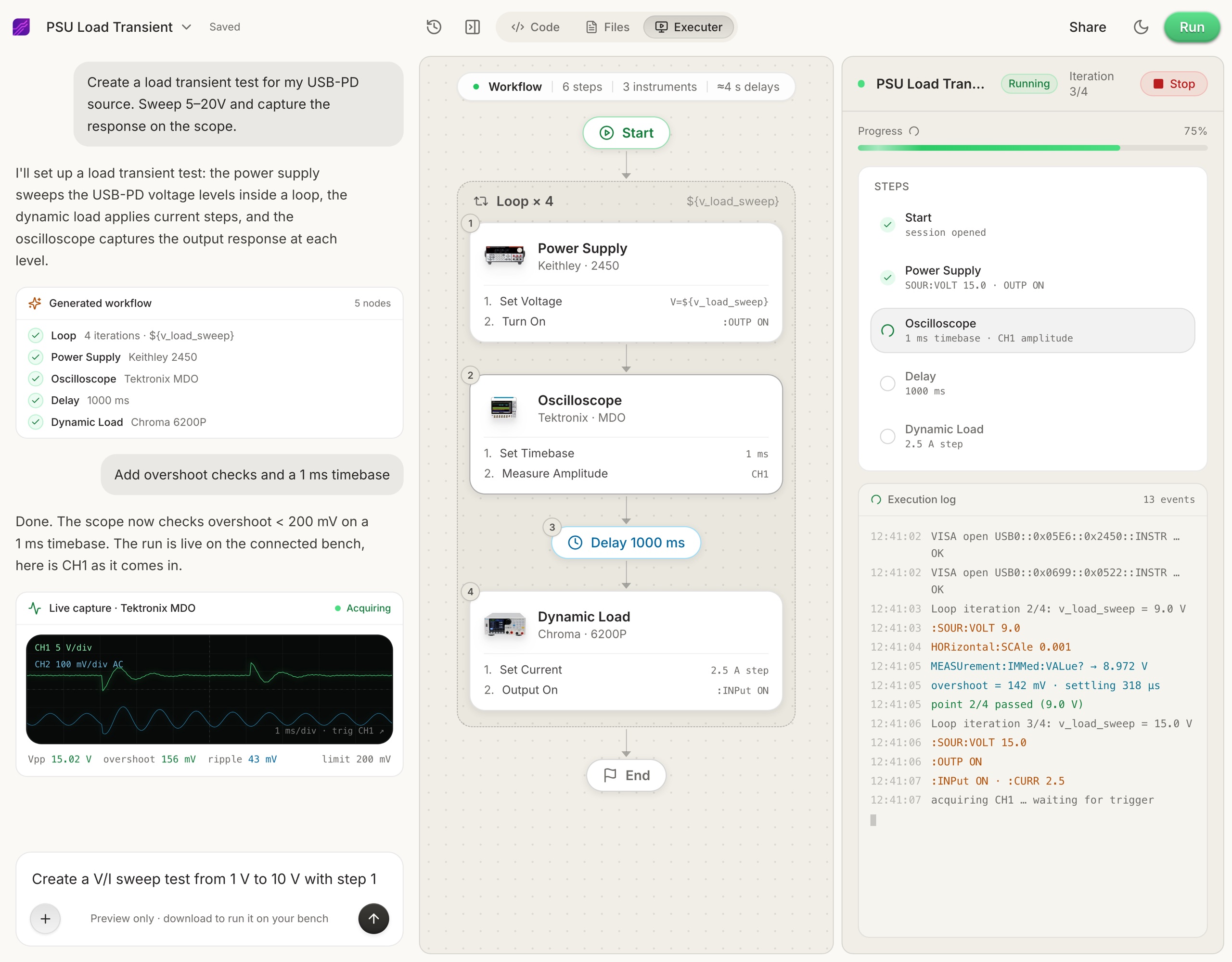
Connect your instruments. Pick the manufacturer and model, paste the VISA address (USB, LAN, GPIB, or serial), and the agent knows what is on your bench. No bench yet? Use a placeholder address, build the full automation, and swap in the real address when you are in the lab.
- 2
Tell the agent what to test, in plain English. For example, "run a VI sweep from 1 to 10 V in 1 V steps at 0.5 A load current," or "suggest the tests for a power-management device."
- 3
The agent builds the complete workflow in seconds. Instrument-aware automation appears on the canvas, with the generated scripts visible in a code panel you can inspect and edit.
- 4
Run it in your lab. Click Run and the status panel streams results step by step, with measured values inline (VOUT = 3.301 V, asserted 3.2 to 3.4 V, PASS). One click exports a structured PDF report, or the raw results as CSV.
- Vendor-neutral by design. One workflow drives Keysight, Tektronix, Rohde & Schwarz, NI, Rigol, Keithley, Anritsu, and more over standard VISA and SCPI.
- Browser-based and shareable. Workflows live in your workspace, so a sequence built in one lab runs the same way in another.
- Free version to start. Sign in at app.testflowinc.com and build your first workflow today; plans and quotes are on the pricing page.
The step-by-step walkthrough, VISA address formats, and Test Planner prompts are all in the TestFlow product guide.
Frequently asked questions
Is GPIB still used in 2026?
Yes, widely, because instruments last decades and a great deal of installed equipment has only GPIB. New instruments almost always offer USB and LAN as well, but GPIB persists in established labs and in racks built around it.
Which is faster, USB or LAN, for instrument control?
For small SCPI commands both are dominated by instrument response time and the difference is negligible. For large waveform transfers, gigabit LAN typically wins, though many instruments do not saturate either interface.
What is LXI?
LAN eXtensions for Instrumentation, a standard defining how instruments behave on Ethernet, including discovery, web interfaces, and triggering. An LXI instrument is a LAN instrument that follows agreed conventions.
Do I need a GPIB controller card?
You need a GPIB interface on the computer, either a PCIe card or a USB-to-GPIB adapter. Adapters are more common now and work well, though they add a small latency compared with a card.
Can I control instruments over WiFi?
Technically yes if the instrument is on a wireless network, but it is not recommended for test. Latency varies and packets drop, which produces intermittent timeouts that are extremely difficult to distinguish from instrument faults.
Which interface should I use for a new bench?
LAN for anything that will be shared, racked, or accessed remotely. USB for a single instrument on a single engineer's desk. GPIB only when the instrument has nothing else.
Ready to automate your lab?
Connect your instruments, describe a test in plain English, and TestFlow builds and runs it in minutes.
Tags
Put it on your bench this week
A new way for testing, from specs to automated sequences, capture clean data, and accelerate your validation cycle.