 Ali Kamaly
Keysight vs Tektronix Oscilloscopes in 2026 (Which to Buy)
A practical comparison of Keysight and Tektronix oscilloscopes for validation work: the real differences in update rate, licensing, serial decode, and automation, and how to decide.
Keysight and Tektronix build oscilloscopes of comparable quality, and the choice for a validation lab turns on software licensing and automation rather than on raw hardware specifications. Both vendors offer strong instruments in every band from entry benchtop to high-performance real-time. Where they differ materially is in how options are sold, how the SCPI interface is structured, and how their own software locks you in.
This post compares them on the terms that actually matter once the scope lands on a bench and goes into a script.
The product lines
| Band | Keysight | Tektronix |
|---|---|---|
| Entry bench | InfiniiVision 1000 X, 2000 X | TBS2000B, 2 Series MSO |
| Mainstream validation | InfiniiVision 3000T X, 4000 X | 3 Series MDO, 4 Series MSO |
| High performance | Infiniium S, V, UXR | 5 Series, 6 Series MSO |
| Mixed signal focus | InfiniiVision with MSO option | MSO across the range |
Both cover the range. Both have credible instruments in each band. If your requirement is "200 MHz, 4 channels, serial decode", you can meet it from either catalogue.
Where they genuinely differ
Waveform update rate
Keysight's InfiniiVision series uses a dedicated ASIC and has historically led on update rate, reaching a million waveforms per second on some models. Tektronix models are slower in raw update terms on comparable tiers.
Does it matter? Only if you are hunting infrequent glitches. If you are looking for a runt pulse that happens once every ten seconds, update rate is the whole game. For power rail characterisation and timing measurements, it is irrelevant.
Be honest about which you are doing. Update rate is the headline spec Keysight markets and it is genuinely better, but it is decisive for a minority of validation work.
User interface
Tektronix's newer touch interface on the 4, 5, and 6 Series is better. The waveform-per-channel display model, the drag-and-drop measurement badges, and the general responsiveness are ahead.
Does it matter? Only until you automate. On a bench where engineers drive the scope by hand daily, it matters a lot. On a station running scripted sequences, nobody touches the front panel and this advantage evaporates entirely.
Serial decode and options
Both charge for decode packages, advanced maths, jitter, and power analysis. Both bundle differently depending on the promotion running that quarter.
This is where the money is. A base scope at $8,000 with four decode options and a power analysis package can land at $15,000. The option list is not a detail, it is often half the purchase.
Price the configuration, never the model.
SCPI implementation
Keysight's InfiniiVision command set is more consistent across models. A script written for a 3000T X usually runs on a 4000 X with minimal change.
Tektronix has more variation between families, though tm_devices, their supported Python library, smooths a lot of that over and their documentation and example code are good.
Both are workable. Neither is a reason to buy.
Waveform transfer speed
Underrated, and it matters more than update rate for automated work. If your test captures a 1 million point record on every one of 500 iterations, transfer time dominates the run.
Both support binary transfer formats which are far faster than ASCII. Use them.
# Binary is 5 to 20 times faster than ASCII for large records
scope.write("DATA:ENC RIBINARY")       # Tektronix
scope.write(":WAVEFORM:FORMAT BYTE")   # Keysight
Measure this on your actual record length before committing to a model, because vendor specifications rarely quote it.
Automating each
The command sets differ enough that scripts are not portable. Here is the same operation on both.
Keysight InfiniiVision:
scope.write(":AUTOSCALE")
scope.write(":TIMEBASE:SCALE 1E-3")
scope.write(":CHANNEL1:SCALE 0.5")
scope.write(":TRIGGER:MODE EDGE")
scope.write(":TRIGGER:EDGE:SOURCE CHANNEL1")
scope.write(":TRIGGER:EDGE:LEVEL 1.5")
scope.write(":DIGITIZE CHANNEL1")
vpp = float(scope.query(":MEASURE:VPP? CHANNEL1"))
Tektronix MSO:
scope.write("AUTOSET EXECUTE")
scope.write("HORIZONTAL:SCALE 1E-3")
scope.write("CH1:SCALE 0.5")
scope.write("TRIGGER:A:TYPE EDGE")
scope.write("TRIGGER:A:EDGE:SOURCE CH1")
scope.write("TRIGGER:A:LEVEL:CH1 1.5")
scope.write("ACQUIRE:STATE RUN")
scope.write("MEASUREMENT:IMMED:TYPE PK2PK")
scope.write("MEASUREMENT:IMMED:SOURCE CH1")
vpp = float(scope.query("MEASUREMENT:IMMED:VALUE?"))
Same measurement, entirely different commands. This is the practical cost of a mixed bench, and it is why an abstraction layer is worth building on day one:
class Scope:
    def peak_to_peak(self, channel: int) -> float:
        raise NotImplementedError

class KeysightScope(Scope):
    def peak_to_peak(self, channel: int) -> float:
        return float(self.inst.query(f":MEASURE:VPP? CHANNEL{channel}"))

class TektronixScope(Scope):
    def peak_to_peak(self, channel: int) -> float:
        self.inst.write("MEASUREMENT:IMMED:TYPE PK2PK")
        self.inst.write(f"MEASUREMENT:IMMED:SOURCE CH{channel}")
        return float(self.inst.query("MEASUREMENT:IMMED:VALUE?"))
Write this once and the vendor decision stops being permanent.
The software lock-in question
This is the part that costs more than the hardware over five years.
- •Keysight pushes BenchVue and the PathWave portfolio. Good software, licensed per application, and it drives Keysight instruments best.
- •Tektronix ships free OpenChoice utilities and sells TekScope for analysis. Same shape of arrangement.
Both vendors' software drives their own instruments well and other vendors' instruments poorly or not at all. So the software choice quietly becomes a hardware choice, and the next scope purchase gets decided by what your automation already speaks.
The way out is to automate at the SCPI or platform layer rather than in vendor software. See Keysight PathWave alternatives and Tektronix OpenChoice alternatives.
How to decide
- 1
Write down the measurement that justifies the purchase. Not "general purpose". The specific signal, bandwidth, and what you need to see.
- 2
Price the full configuration from both, including every option that measurement needs. This alone decides many purchases.
- 3
If you are hunting rare events, weight Keysight's update rate heavily.
- 4
If engineers will drive it by hand daily, weight the Tektronix interface heavily.
- 5
If it goes on an automated station, weight neither. Weight SCPI completeness and binary transfer speed.
- 6
Check what is already on the bench. A second scope from the vendor you already automate is worth a modest premium in saved integration time, unless you have already built the abstraction layer above, in which case it is worth nothing and you should buy on price.
The honest summary
For most validation labs in 2026 the two are close enough that option pricing and existing bench composition should decide it, not the datasheet. Where one clearly wins:
- •Buy Keysight for glitch hunting, for very high performance work in the Infiniium and UXR range, and for consistency if you already run InfiniiVision scripts.
- •Buy Tektronix for hands-on benches where interface quality compounds daily, for mixed-signal work where the MSO integration is genuinely strong, and where their Python tooling suits your team.
- •Price Rigol and Siglent too at the entry tier. See Tektronix vs Rigol.
What to test during an evaluation loan
Both vendors will lend an instrument. Most teams use the loan to check the front panel feels nice, which tells you almost nothing about how it will perform in a test rack. Better use of two weeks:
- 1
Transfer your real record length, timed. Not their demo waveform. Capture what you actually capture, transfer it in binary, and time 100 iterations. This number varies by more between models than any datasheet spec and it directly sets your run time.
- 2
Run your worst trigger case. The rare glitch, the runt, the setup-and-hold violation. This is where update rate and trigger sophistication separate the instruments.
- 3
Script the ten commands you will actually use and check the SCPI behaves as documented. Both vendors have quirks. Finding them during evaluation is free; finding them during integration is not.
- 4
Check the option licences you were quoted are the ones installed. Loan units frequently arrive fully loaded, which makes the base model look better than the one you will buy.
- 5
Leave it running for 72 hours taking measurements on a loop. Thermal drift and memory leaks in instrument firmware are both real and neither appears in a two-hour demo.
Point 4 catches more bad purchases than the rest combined.
Total cost over five years
The purchase price is roughly half the story. A fairer comparison:
| Line | Typical five-year cost |
|---|---|
| Instrument | Base purchase |
| Software options | 30 to 100 percent of the base |
| Calibration | Annual, per instrument |
| Vendor software licences | Per application, recurring |
| Integration effort | One-off per vendor introduced to the bench |
| Probe replacement | Higher than expected, probes fail |
The line that favours consolidation is integration effort, and the line that favours competition is option pricing. Building the vendor abstraction layer described above neutralises the first, which is what lets you buy on the second.
That is the practical argument for spending a day on an abstraction class: it converts a strategic lock-in into a per-purchase price decision.
The SCPI difference, concretely
The automation section above says the command sets differ. Here is exactly how, because this is the detail that decides how much work a mixed bench costs you.
| Task | Keysight (InfiniiVision / Infiniium) | Tektronix (MSO / MDO) |
|---|---|---|
| Reset | *RST | *RST |
| Autoscale | :AUToscale | AUTOSet EXECute |
| Timebase | :TIMebase:SCALe 1E-3 | HORizontal:SCAle 1E-3 |
| Vertical scale | :CHANnel1:SCALe 0.5 | CH1:SCAle 0.5 |
| Trigger level | :TRIGger:LEVel 1.5 | TRIGger:A:LEVel 1.5 |
| Single acquisition | :SINGle | ACQuire:STOPAfter SEQuence;:ACQuire:STATE ON |
| Measure Vpp | :MEASure:VPP? CHANnel1 | MEASUrement:IMMed:TYPe PK2PK;:MEASUrement:IMMed:SOUrce CH1;:MEASUrement:IMMed:VALue? |
| Waveform source | :WAVeform:SOURce CHANnel1 | DATa:SOUrce CH1 |
| Waveform format | :WAVeform:FORMat WORD | DATa:WIDth 2;:DATa:ENCdg RIBinary |
| Get the data | :WAVeform:DATA? | CURVe? |
The pattern: the first four rows are near-identical, the measurement and waveform-transfer rows are not. Tektronix uses an immediate-measurement model where you set type and source then read the value; Keysight takes the source as a parameter. Waveform transfer differs in both the command and the preamble format you need to scale the returned integers back to volts.
Practical consequence: a thin abstraction layer with one class per vendor and a shared interface is about a day's work and saves that back within a month on a mixed bench. Do not scatter model-specific strings through your sequences. The SCPI command cheat sheet covers the same split across other instrument classes, and instrument control with VISA and SCPI covers the transport underneath.
The questions to ask before the purchase order
Specification comparisons are the easy part. These are the ones that determine whether the instrument is pleasant to own.
- •What is the actual waveform transfer rate over LAN for a full-depth record? Datasheets quote memory depth, not how long it takes to get it out. On a long capture this dominates your cycle time.
- •Is the measurement you care about a licensed option? Jitter analysis, protocol decode, and advanced maths are frequently separate. Query
*OPT?on the loaner. - •Does the segmented memory or fast-frame mode work over SCPI, or only from the front panel? Some capabilities are GUI-only, which is discovered late and painfully.
- •What happens to the SCPI interface on a firmware update? Ask for the release notes history. Silent command changes between firmware revisions are rare but not unknown.
- •How many of these will be on the bench in three years? If the answer is "some of each", the abstraction layer above is not optional, and neither vendor's software suite is the right automation choice.
- •What is the calibration interval and cost? It recurs, and it rarely appears in the purchase comparison.
Common mistakes
- •Comparing bandwidth and nothing else. Sample rate, memory depth, ADC resolution, and update rate all matter, and the last one is invisible on a datasheet.
- •Buying the vendor software suite to avoid learning SCPI. It works for one vendor and stops at the second, which is the lock-in described above. See Keysight BenchVue vs LabVIEW.
- •Hardcoding vendor commands in sequences. One abstraction layer, one day, and the bench can change without a rewrite.
- •Ignoring the probe budget. Differential and current probes routinely cost more than the difference between the two scopes you are comparing.
- •Assuming the loaner is the shipping configuration. Evaluation units often arrive fully optioned. Check
*OPT?and compare it against the quote. - •Testing only the happy path during the loan. Try the transfer at full memory depth, the measurement you actually need, and the automation route. That is what the loan is for.
Related reading
- •Automate a Tektronix oscilloscope with Python
- •Automate a Rigol oscilloscope with Python
- •Tektronix vs Rigol oscilloscopes
- •Keysight BenchVue alternatives
- •SCPI command cheat sheet
- •Instrument control with VISA and SCPI, the transport layer
- •Tektronix TekScope alternatives, the Tektronix software side
- •Keysight BenchVue vs LabVIEW, the software lock-in question
- •GPIB vs USB vs LAN, which interface to standardise on
- •pyVISA tutorial, the vendor-neutral automation route
- •Python instrument control libraries compared, building the abstraction layer
- •Free instrument control software, avoiding both suites
- •Tektronix OpenChoice alternatives, the legacy Tektronix tooling
- •NI TestStand alternatives, sequencing captures across a mixed bench
Where TestFlow fits
The automation layer is where vendor choice usually hurts, because each vendor's own software only drives its own instruments. Being vendor-neutral at that layer makes the hardware decision reversible.
- 1
Connect your instruments. Pick the manufacturer and model, paste the VISA address (USB, LAN, GPIB, or serial), and the agent knows what is on your bench. No bench yet? Use a placeholder address, build the full automation, and swap in the real address when you are in the lab.
- 2
Tell the agent what to test, in plain English. For example, "run a VI sweep from 1 to 10 V in 1 V steps at 0.5 A load current," or "suggest the tests for a power-management device."
- 3
The agent builds the complete workflow in seconds. Instrument-aware automation appears on the canvas, with the generated scripts visible in a code panel you can inspect and edit.
- 4
Run it in your lab. Click Run and the status panel streams results step by step, with measured values inline (VOUT = 3.301 V, asserted 3.2 to 3.4 V, PASS). One click exports a structured PDF report, or the raw results as CSV.
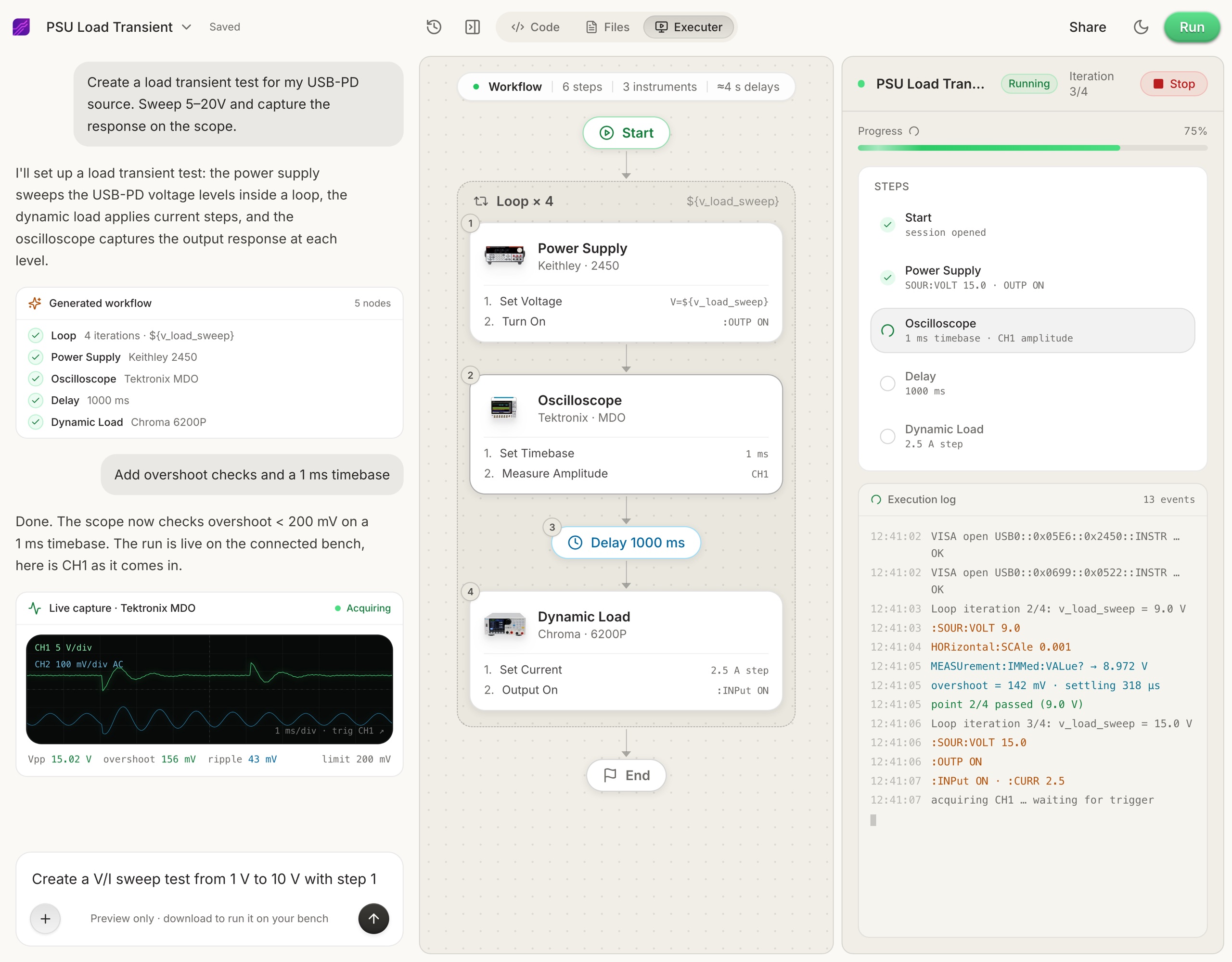
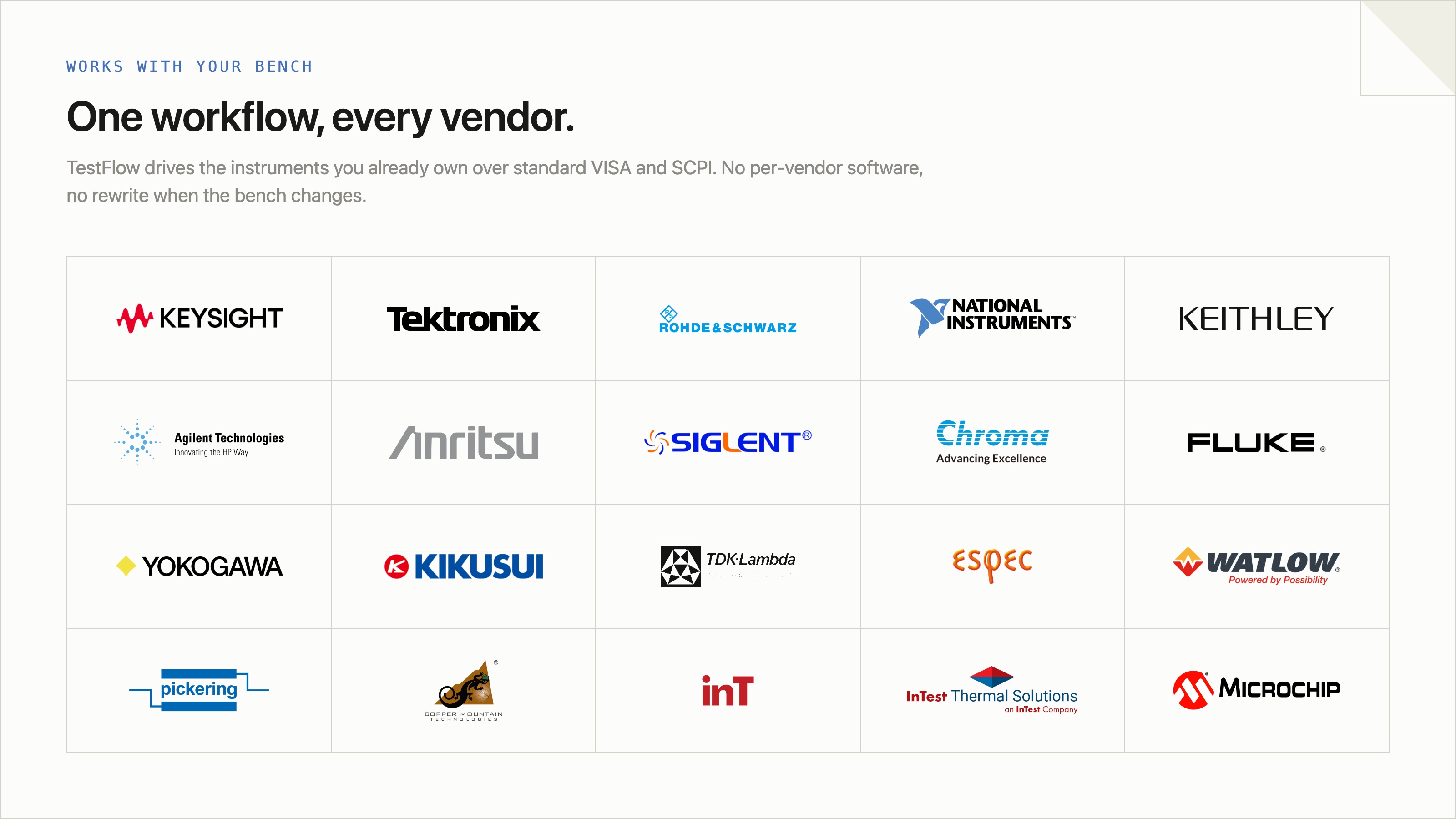
- Vendor-neutral by design. One workflow drives Keysight, Tektronix, Rohde & Schwarz, NI, Rigol, Keithley, Anritsu, and more over standard VISA and SCPI.
- Browser-based and shareable. Workflows live in your workspace, so a sequence built in one lab runs the same way in another.
- Free version to start. Sign in at app.testflowinc.com and build your first workflow today; plans and quotes are on the pricing page.
The step-by-step walkthrough, VISA address formats, and Test Planner prompts are all in the TestFlow product guide.
Frequently asked questions
Is Keysight or Tektronix better for oscilloscopes?
Neither is universally better. Keysight InfiniiVision leads on waveform update rate and has a cleaner SCPI implementation. Tektronix leads on user interface, touch workflow, and the 4, 5, and 6 Series analysis features. Pick on your specific measurement and your existing bench.
Which oscilloscope brand is easier to automate?
Both automate well over SCPI. Keysight's InfiniiVision command set is slightly more consistent across models, while Tektronix has excellent Python examples and the tm_devices library. In practice the difference is small compared to the effort of the surrounding test.
Do Keysight and Tektronix charge for oscilloscope software options?
Both do. Serial decode, advanced maths, jitter analysis, and higher bandwidth are commonly licensed options rather than included. Always price the options with the scope, because they frequently exceed the base instrument cost.
Can I use one script for both Keysight and Tektronix scopes?
Only with an abstraction layer. The SCPI command sets differ, so a script written for one will not run on the other unaltered. Wrapping each in a small class with common methods is the usual approach.
Which is better value for a small validation lab?
For a general-purpose bench under 200 MHz, both vendors have competitive entry models and the decision often comes down to which options you need. Rigol and Siglent are worth pricing against them at this tier.
Does the brand matter if I automate everything?
Less than people expect. Once tests run from a script, the front panel quality stops mattering and what matters is SCPI completeness, transfer speed for waveform data, and option licensing.
Ready to automate your lab?
Connect your instruments, describe a test in plain English, and TestFlow builds and runs it in minutes.
Tags
Put it on your bench this week
A new way for testing, from specs to automated sequences, capture clean data, and accelerate your validation cycle.