 Ali Kamaly
Programmable DC Power Supply: How Remote Control and Sequencing Actually Work
How a programmable DC power supply works: remote control, sequencing, and SCPI, plus how TestFlow automates supply test steps without writing code.
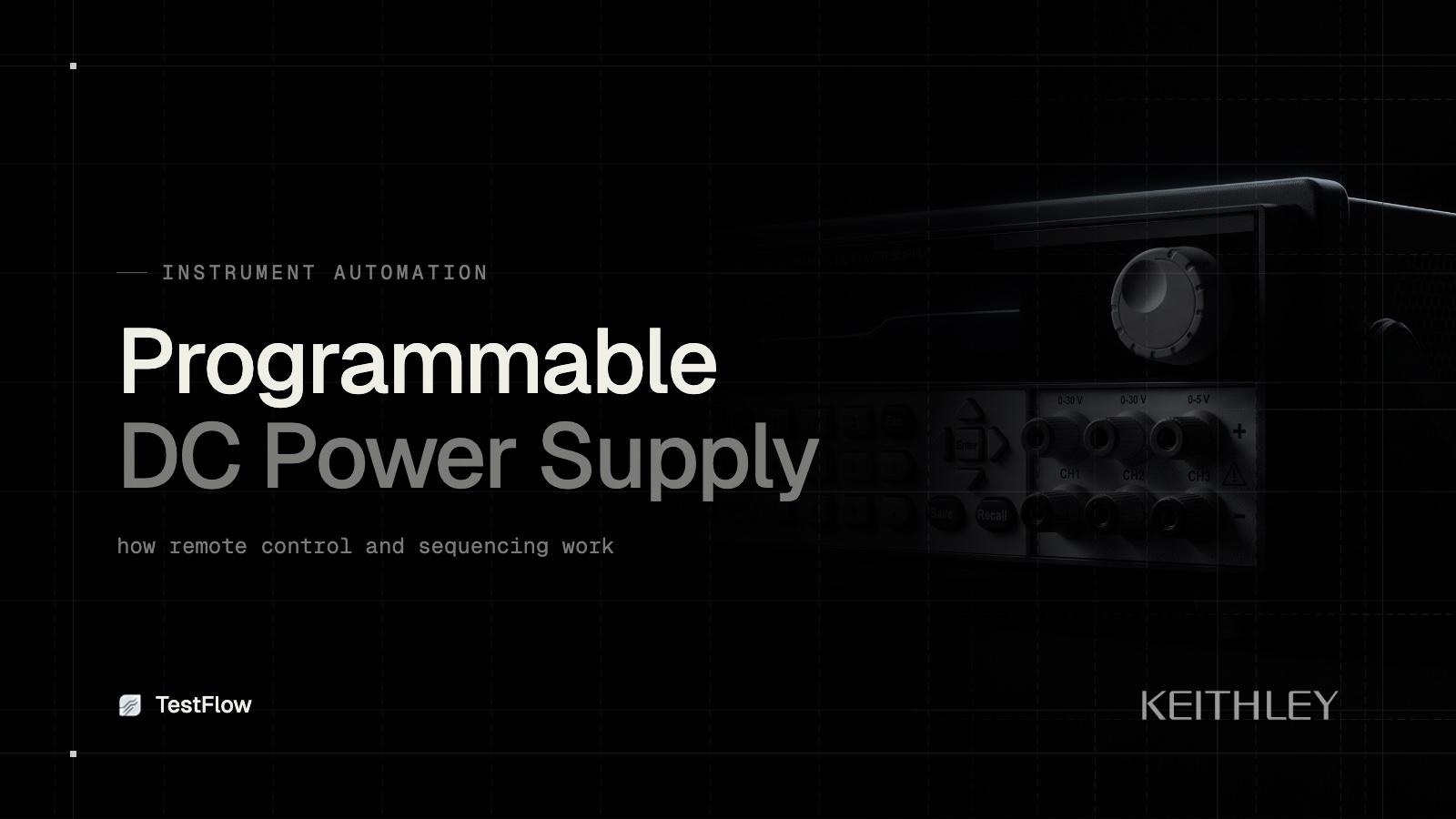
A programmable DC power supply is a supply you can drive from software instead of the front panel knobs. That single capability turns a power supply into a test instrument: you can step voltage, limit current, sequence levels, and measure, all automatically. This guide explains how remote control and sequencing on a programmable DC power supply actually work, and how TestFlow automates supply test steps without writing code.
What makes a power supply programmable
A programmable DC power supply, also called a programmable DC source, exposes a remote interface, usually USB, LAN, or GPIB, and accepts SCPI commands. Through that interface you can:
- •Set output voltage and current limit.
- •Turn outputs on and off.
- •Read back actual voltage and current.
- •Step through a list of values automatically.
- •Protect the device under test with over-voltage and over-current limits.
The same hardware that sits idle under manual control becomes a programmable element in an automated test.
How remote control works
Remote control is a request and response loop. Your software opens a connection to the supply and sends commands such as setting a voltage, setting a current limit, and enabling the output, then queries the actual values back. A typical SCPI exchange sets VOLT, sets CURR, sends OUTP ON, then reads MEAS:VOLT? and MEAS:CURR?. The supply does exactly what it is told, repeatably, which is the whole point.
How sequencing works
Sequencing is stepping the supply through levels under program control. Two common approaches:
- 1
Software-driven stepping: your program loops through a list of voltages, sets each, waits to settle, measures, and moves on.
- 2
Onboard list mode: many supplies have a built-in list or sequence feature where you load voltage, current, and dwell-time points and the supply steps through them on a trigger.
Sequencing is what lets you characterize a device across its operating range without an engineer turning knobs.
The cost of building it yourself
Done in raw SCPI or PyVISA, remote control and sequencing work and become code you maintain. The script is specific to your supply and the instruments measuring alongside it, error handling is on you, and any change to the sequence means editing and re-testing.
Automating the supply with TestFlow
TestFlow generates and runs the supply control and sequencing for you.
- •Datasheet to sequence. Upload the supply datasheet and TestFlow builds the voltage and current steps and the measurement sequence.
- •No SCPI by hand. TestFlow produces and executes the commands, so there is no script to maintain.
- •Vendor-neutral. Drive the supply together with a DMM, scope, or load from any vendor in one workflow.
- •Repeatable and shareable. The sequence runs identically every time and can be shared across a team.
Make the supply part of the test, automatically
A programmable DC power supply is only as useful as the software driving it. Instead of scripting the sequence, let TestFlow build and run it from the datasheet.
Start free at app.testflowinc.com, upload your power supply datasheet, and get an automated supply test sequence in minutes.
Ready to automate your lab?
Connect your instruments, describe a test in plain English, and TestFlow builds and runs it in minutes.
Tags
Put it on your bench this week
A new way for testing, from specs to automated sequences, capture clean data, and accelerate your validation cycle.