 Ali Kamaly
Keysight BenchVue vs LabVIEW in 2026 (Which One Does Your Bench Need)
Two very different tools that get compared constantly. Where each genuinely fits, what both cost, and why most benches end up needing something neither one is.
BenchVue and LabVIEW are not really competitors: one is a set of finished applications and the other is a programming environment. They get compared because they are the two things a Keysight-equipped engineer is offered, and choosing between them is really choosing between speed with a ceiling and flexibility with a build cost.
This post covers what each genuinely does, what both cost, and the gap that neither fills, which is where most benches actually live.
What each one is
BenchVue is a collection of applications, one per instrument class. A DMM app, a scope app, a power supply app, a data logger. You connect an instrument, configure through a UI, press run, and export to CSV or Excel. No code.
LabVIEW is a graphical programming environment. You build the application, including the acquisition, the sequencing, the display, and the output. Nothing is finished until you finish it.
The distinction matters because it determines what "does it support X" means. BenchVue supports what its applications support. LabVIEW supports anything you are willing to build.
Time to first result
The clearest difference, and the reason BenchVue exists.
Task: log the voltage on a rail every second for six hours, with a plot and a CSV.
- •BenchVue: open the data logger app, select the DMM, set the interval, set the duration, press start. Five minutes, no code.
- •LabVIEW: create a VI, drop VISA Open, configure the DMM, build a timed loop, add a chart, add file writing, handle errors, handle the stop condition. An hour if you know LabVIEW well, half a day if you do not.
For that task BenchVue wins decisively, and pretending otherwise wastes people's time.
Task: step a supply through nine conditions, measure at each, apply limits, retry on failure, and produce a pass or fail report.
- •BenchVue: its Test Flow feature covers simple sequences and this is at the edge of it. Retry logic and custom reporting are beyond what it was built for.
- •LabVIEW: entirely achievable, and it is a real development task.
For that task LabVIEW wins, and BenchVue users hit a wall.
Cost
BenchVue is licensed per application. Some basic functionality is free, and full capability per instrument class is typically low to mid three figures. The arithmetic that surprises people:
| Bench | Applications needed | Rough cost |
|---|---|---|
| DMM only | 1 | Modest |
| DMM, supply, scope | 3 | Three applications |
| Full bench with load and generator | 5 | Five applications |
Per seat, and per bench if engineers do not share.
LabVIEW is per seat per year, roughly $500 for Base up to around $5,000 for Professional. See LabVIEW pricing.
Neither is obviously cheaper. A single engineer with three BenchVue applications may pay less than a LabVIEW Full seat. A team of five needing full bench coverage may pay more.
The mixed-vendor problem
This is where the comparison usually resolves in practice, and it resolves against BenchVue.
BenchVue is a Keysight product designed around Keysight instruments. Some third-party support exists and it is not the point of the product. A typical validation bench has:
- •A Keysight DMM
- •A Rigol or Tektronix scope
- •A supply that could be anything
- •An electronic load from a fourth vendor
BenchVue covers the first properly and the rest poorly or not at all. So the workflow splits across tools and someone correlates the results by hand, which is the exact cost that automation was meant to remove. See NI FlexLogger alternatives for the same pattern from the NI side.
LabVIEW does not have this problem, because VISA is vendor-neutral and LabVIEW will drive anything that speaks SCPI. That flexibility is what you are paying the build cost for.
Comparison table
| BenchVue | LabVIEW | |
|---|---|---|
| Model | Finished applications | Programming environment |
| Requires coding | No | Graphical programming |
| Time to simple logging | Minutes | An hour or more |
| Custom sequencing | Limited (Test Flow) | Unlimited |
| Pass and fail logic | Basic | Whatever you build |
| Third-party instruments | Limited | Any SCPI instrument |
| Operator interface | The app itself | Front panels, build them |
| Reporting | CSV and Excel export | Report Generation Toolkit |
| Real-time and FPGA | No | Yes, with modules |
| Cost model | Per application | Per seat per year |
| Version control | Not applicable | Poor, binary VIs |
| Ceiling | The applications | None |
Which to choose
Choose BenchVue if
- •Your bench is predominantly Keysight
- •The tasks are logging and simple measurement, not sequenced tests with verdicts
- •Nobody on the team wants to write code, and that is a firm constraint
- •You need results today
Choose LabVIEW if
- •You need custom sequencing, retries, branching, or pass and fail logic
- •The bench is mixed-vendor
- •You need a real-time or FPGA target, where LabVIEW has no competitor here
- •You already have LabVIEW code and skills, which is the most common real reason
Choose neither if
- •The bench is mixed-vendor and nobody wants to write LabVIEW
That combination is extremely common and it is exactly the gap. BenchVue cannot see half your instruments and LabVIEW is a development project. Teams in this position typically end up with a half-finished LabVIEW application maintained by one person, or a folder of CSV exports being correlated in Excel.
The options that fill it:
- •Python with PyVISA, free and vendor-neutral, if anyone can code. See the PyVISA tutorial.
- •TestFlow, if the no-code property is the constraint that pushed you to BenchVue in the first place, since it keeps that property without the single-vendor limit.
The honest recommendation
Most benches should not be choosing between these two at all.
BenchVue is a good product for a Keysight bench doing straightforward measurements, and it is worth its modest cost for that. Keep it for what it does well.
LabVIEW is worth its cost when you need real-time, FPGA, or you already have a working codebase and a team that knows it. Outside those cases, the build cost is high and the hiring pool is shrinking, and Python covers the same ground for free.
The comparison people should actually be running is BenchVue against a vendor-neutral tool, because that is the axis where their bench will hurt them, not the no-code against code axis.
What each looks like for the same task
The task: sweep a supply from 3.0 V to 3.6 V in 0.1 V steps, measure the regulator output at each point, flag anything outside 1.76 to 1.84 V, and save the results.
In BenchVue. The supply app steps the voltage and the DMM app logs readings, and the two are separate applications with separate exports. BenchVue Test Flow can sequence simple actions across apps, and applying a limit to produce a verdict per point is beyond its intent. Realistic outcome: two CSV files and a manual correlation, or a partially manual run.
In LabVIEW. A for loop with a VISA write to the supply, a wait, a VISA read from the DMM, an in-range comparison, an array build, and a file write. Perhaps forty nodes on the block diagram. An experienced LabVIEW engineer builds this in an hour or two, and it does exactly what was asked.
In Python, for reference, it is about twenty lines and shown in how to automate a VI curve sweep.
The point is not that LabVIEW is slow. It is that this task, a sweep with limits, is the most common shape of real validation work, and it sits precisely in the gap: past what BenchVue's applications cover, and squarely a development task in LabVIEW.
Signs you have outgrown BenchVue
Worth naming, because the transition is usually gradual and nobody marks the moment.
- •You are exporting from two or more applications and combining them in Excel
- •You want a pass or fail verdict and are deciding it by eye
- •You need the test to repeat identically next month and are relying on someone's memory of the settings
- •You want to run overnight and there is a manual step in the middle
- •Someone asked for the results in a report and you are formatting it by hand
- •You have started keeping a written procedure describing which buttons to press
Any two of those together means the bench has moved from measurement to testing, and the tool needs to move with it. Staying past that point is where the hidden cost lives, because the manual correlation work is invisible in every budget and it recurs on every run.
The third option neither vendor mentions
The BenchVue versus LabVIEW framing is a false binary, because both vendors are selling you their own answer to a problem the standards layer already solves. Underneath both is VISA and SCPI, and both instruments answer the same commands whether the caller is BenchVue, LabVIEW, or forty lines of Python.
| BenchVue | LabVIEW | Code over pyVISA | |
|---|---|---|---|
| Licence | Per app, per instrument class | Per seat, four figures per year | Zero |
| Bench scope | Keysight, well | Any, with driver work | Any, with SCPI |
| Time to first reading | Minutes | Hours | Under an hour |
| Time to a repeatable sweep | Hours, if the app supports it | Days | Hours |
| Version control | No | Awkward, binary VIs | Native |
| Runs unattended on a schedule | Awkward | Yes | Yes |
| Survives the author leaving | N/A, it is a GUI | Poor | Good, if reviewed |
The reason this option gets skipped is that it looks like "learn to program" when the alternative looks like "install software". For a single ad-hoc measurement that is a fair reading and BenchVue wins. For anything that runs more than a handful of times, the arithmetic reverses, and it reverses fastest on a mixed bench. See free instrument control software for the full zero-cost stack and the pyVISA tutorial for the starting point.
Which one for which job
Match the tool to the actual task rather than to the bench brand.
- 1
A one-off measurement you will never repeat. BenchVue, or the instrument's front panel. Do not automate this.
- 2
A logged measurement over hours, single Keysight instrument. BenchVue's data logger app. This is exactly its case.
- 3
A parametric sweep across two or more instruments. Neither vendor GUI does this well. Code, or a tool that generates the sequence.
- 4
A production sequence with operator interaction and pass/fail records. LabVIEW with TestStand, or a proper test sequencer.
- 5
A mixed-vendor characterisation run that repeats every silicon revision. Code, every time. This is the case that makes vendor GUIs painful.
- 6
Anything that has to run in CI or overnight without a person. Code. GUIs assume a human.
Common mistakes
- •Buying BenchVue apps per instrument on a mixed bench. Three vendors means three toolchains and three UIs for one test. This is the failure mode described above, and it compounds every time procurement buys on price.
- •Choosing LabVIEW for a task BenchVue does in five minutes. A single logged measurement does not need a development environment.
- •Choosing BenchVue for a task it structurally cannot do. Stimulus plus measurement plus limits across instruments is not what the apps are for, and forcing it produces a manual process wearing an automation costume.
- •Ignoring the export format. Both routes produce data. Neither produces a document a customer signs off. Decide that separately, see automated test report generation.
- •Assuming LabVIEW's driver coverage is free. The drivers are, the seat is not, and the add-ons stack on top.
- •Forgetting the person. Whichever route you pick, ask who maintains it in three years. That question eliminates more options than any feature comparison.
A five-year view
Both products are sold annually, which frames the decision as a small recurring cost. Over the horizon a bench actually lives on, the numbers separate.
| BenchVue apps | LabVIEW seat | Code over pyVISA | |
|---|---|---|---|
| Year 1 | Three to four figures per app | Four figures, plus add-ons | Zero, plus 1 to 3 weeks build |
| Years 2 to 5 | Same, per app, per year | Same, plus annual uplift | Zero |
| Adding a second vendor | Buy their suite too | Driver work, same seat | Add a module |
| Adding a third engineer | Another set of app licences | Another seat | Zero |
| If the author leaves | Nothing to inherit, it is a GUI | The VIs, and good luck | Reviewable code |
The row that decides it for most teams is the fourth. GUI and per-seat models scale with headcount; a code route does not. That is also why the answer changes as a team grows: BenchVue is genuinely the right call for one engineer doing occasional measurements, and genuinely the wrong one for four engineers running characterisation every week.
Related reading
- •Keysight BenchVue alternatives
- •LabVIEW alternatives
- •Keysight IO Libraries, the free driver layer under both
- •Best test automation software
- •Free instrument control software
- •LabVIEW pricing, the seat cost on one side of this comparison
- •pyVISA tutorial, the third option in practice
- •Instrument control with VISA and SCPI, the layer under both tools
- •Test sequencer comparison, for production sequences
- •Automated test report generation, the output stage
- •Keysight data logger software, BenchVue's strongest case
- •LabVIEW vs Python, the same decision stated differently
- •SCPI command cheat sheet, the commands underneath everything here
- •NI TestStand alternatives, the sequencing layer above both
Where TestFlow fits
The trade between these two is configuration speed against flexibility. Generating the automation removes the trade, because you get a working sequence without building one.
- 1
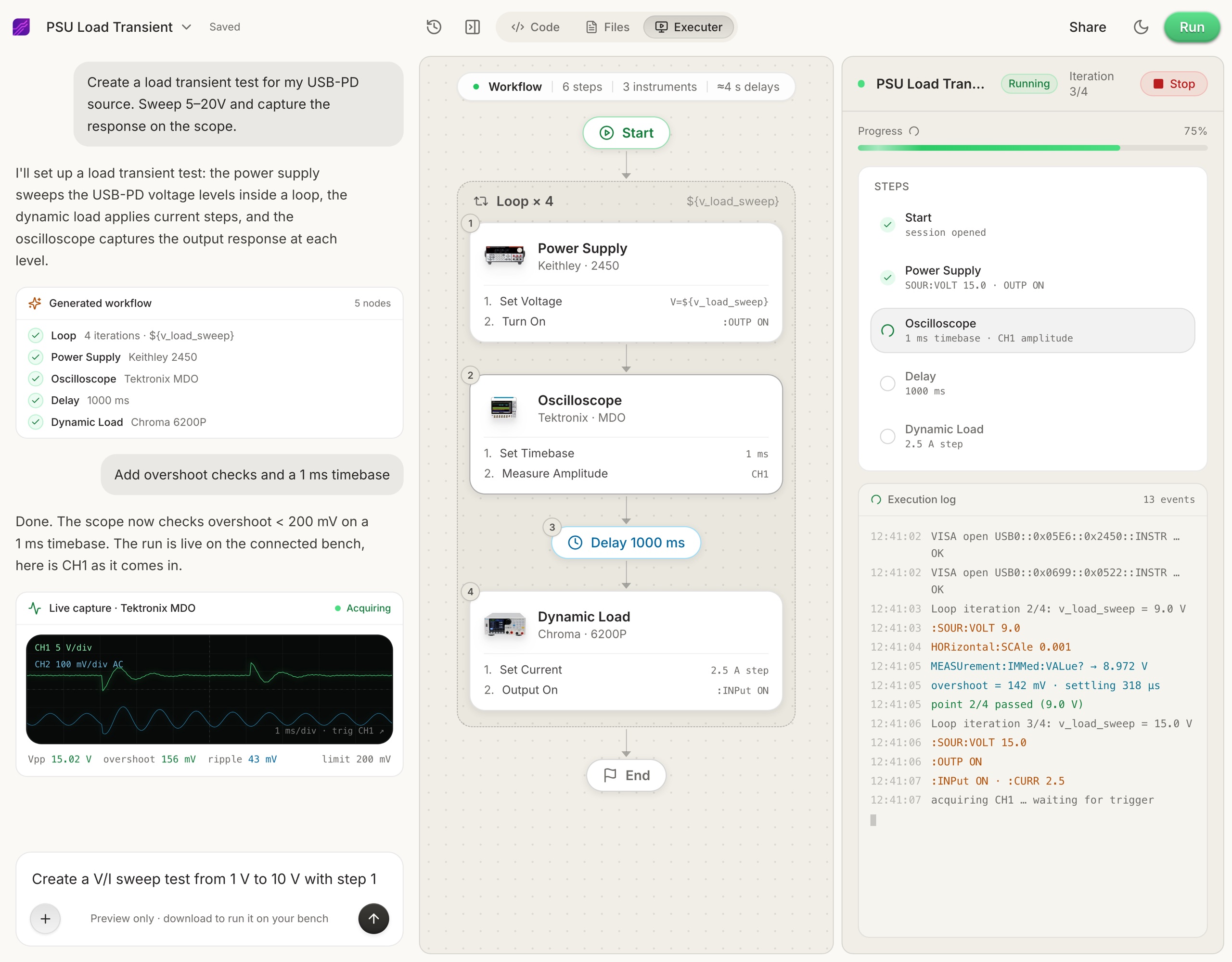
Connect your instruments. Pick the manufacturer and model, paste the VISA address (USB, LAN, GPIB, or serial), and the agent knows what is on your bench. No bench yet? Use a placeholder address, build the full automation, and swap in the real address when you are in the lab.
- 2
Tell the agent what to test, in plain English. For example, "run a VI sweep from 1 to 10 V in 1 V steps at 0.5 A load current," or "suggest the tests for a power-management device."
- 3
The agent builds the complete workflow in seconds. Instrument-aware automation appears on the canvas, with the generated scripts visible in a code panel you can inspect and edit.
- 4
Run it in your lab. Click Run and the status panel streams results step by step, with measured values inline (VOUT = 3.301 V, asserted 3.2 to 3.4 V, PASS). One click exports a structured PDF report, or the raw results as CSV.
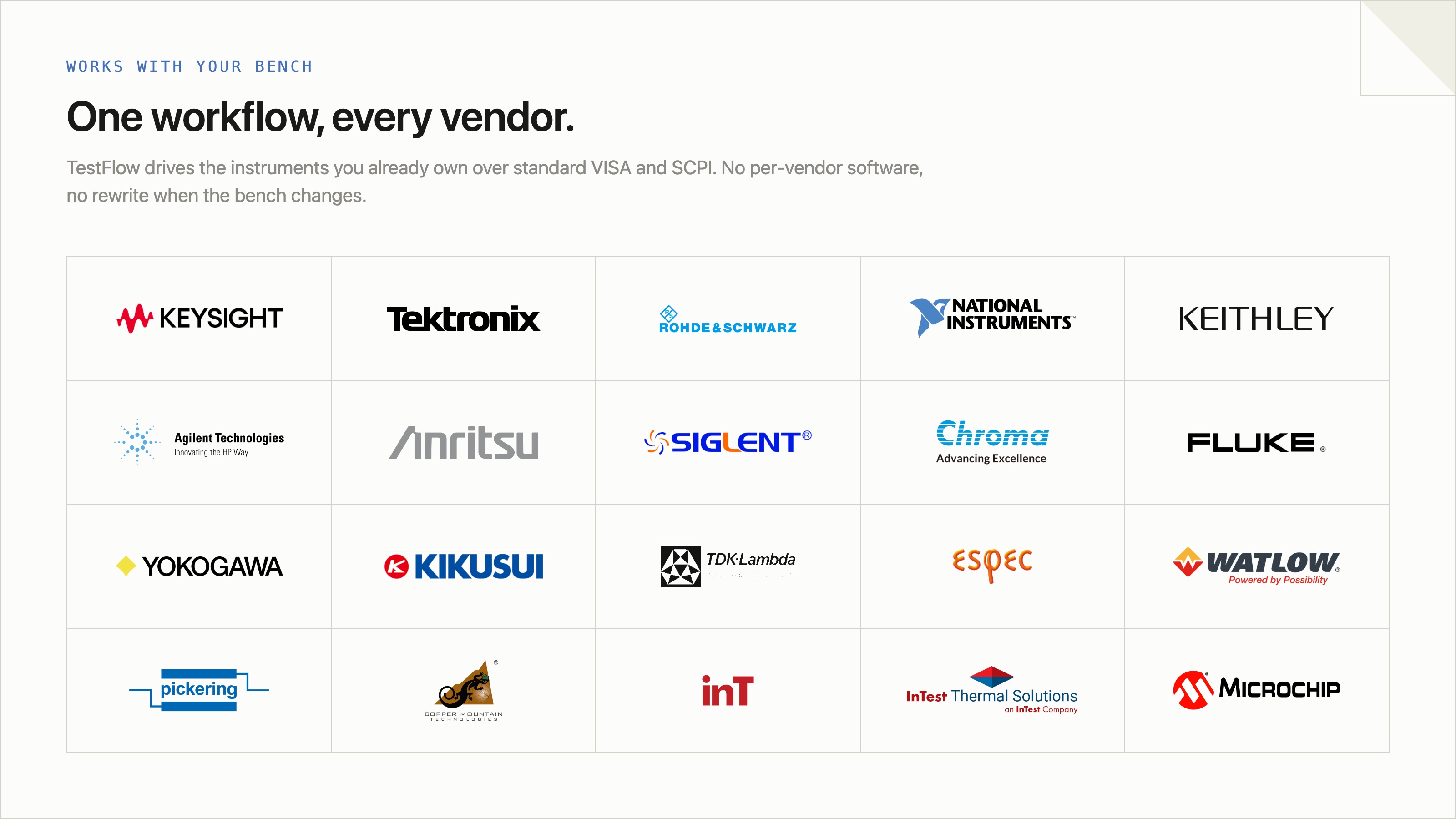
- Vendor-neutral by design. One workflow drives Keysight, Tektronix, Rohde & Schwarz, NI, Rigol, Keithley, Anritsu, and more over standard VISA and SCPI.
- Browser-based and shareable. Workflows live in your workspace, so a sequence built in one lab runs the same way in another.
- Free version to start. Sign in at app.testflowinc.com and build your first workflow today; plans and quotes are on the pricing page.
The step-by-step walkthrough, VISA address formats, and Test Planner prompts are all in the TestFlow product guide.
Frequently asked questions
What is the difference between BenchVue and LabVIEW?
BenchVue is a suite of no-code applications that configure through a UI and drive mainly Keysight instruments. LabVIEW is a graphical programming environment that can build any test application on any instrument, and requires you to build it.
Is BenchVue easier than LabVIEW?
Far easier for the tasks it covers. Logging a voltage takes minutes in BenchVue and an hour or more in LabVIEW. BenchVue stops at what its applications were designed to do, where LabVIEW has no such ceiling.
Does BenchVue work with non-Keysight instruments?
Partially. Some third-party support exists, but the applications are designed around Keysight hardware and coverage of other vendors is limited and uneven. A genuinely mixed bench will run into gaps.
How much does BenchVue cost?
It is licensed per application rather than as a suite, typically low to mid three figures per application, with some basic functionality available free. A bench needing several applications accumulates cost quickly.
Can BenchVue replace LabVIEW?
For data logging and simple bench measurement on Keysight instruments, often yes. For custom sequencing, pass and fail logic, operator interfaces, and anything involving non-Keysight hardware, no.
What is BenchVue Test Flow?
A feature within BenchVue for building simple sequences from the individual instrument applications. It is useful for straightforward flows and is not a full test sequencer in the sense that TestStand or OpenTAP are.
Ready to automate your lab?
Connect your instruments, describe a test in plain English, and TestFlow builds and runs it in minutes.
Tags
Put it on your bench this week
A new way for testing, from specs to automated sequences, capture clean data, and accelerate your validation cycle.