 Ali Kamaly
Best Test Automation Software for Electronics Labs 2026 (8 Compared)
Eight tools for automating an electronics lab, what each is genuinely good at, what it costs, and a decision path that starts from your bench rather than from a feature list.
There is no single best test automation software, and the choice is decided by three things: whether your bench is single-vendor, whether operators or engineers run the tests, and whether writing tests or running them is your bottleneck. Feature comparisons rarely surface those, so this post starts from them.
Eight tools, what each is genuinely for, and a decision path.
The eight
1. LabVIEW
Graphical dataflow programming, the incumbent in test and measurement for thirty years.
For: teams with existing LabVIEW code, NI DAQ hardware, and engineers trained in it. FPGA and real-time targets, where it has no real competition.
Against: subscription cost, a shrinking hiring pool, and VIs that do not diff in version control.
Cost: roughly $500 to $5,000 per seat per year by tier.
See LabVIEW alternatives.
2. TestFlow
AI-native and vendor-neutral. You describe the measurement in plain English and the agent generates the automation and the structured test plan, runs it on your instruments, and produces the report.
For: mixed-vendor benches where the bottleneck is the time to write a test rather than to run one.
Against: not a production-floor operator sequencer with multi-UUT parallel models, and not a real-time platform.
Cost: free version, then paid plans.
3. NI TestStand
Test sequencing and result management, aimed at production.
For: high-volume production test with operators, multi-UUT parallel testing, and regulated environments.
Against: deployment licences on every station, and a sequence format that resists code review.
Cost: mid four figures per development seat, plus per-station deployment.
4. OpenTAP
Free, open-source sequencer from the Keysight ecosystem.
For: teams who want a real sequencer without licence cost, with C# capability in house.
Against: plugins are C#, the editor is less polished than commercial options, and instrument coverage outside Keysight is your own work.
Cost: free, including deployment.
See OpenTAP vs TestStand.
5. Python with PyVISA
The general-purpose answer, and where most new work starts.
For: any bench, any vendor, any team that can write code. Free, enormous ecosystem, runs in CI, and the analysis lives in the same language as the test.
Against: you build the sequencing, the reporting, and the operator interface. That build is real and is usually underestimated.
Cost: free.
See the PyVISA tutorial.
6. Keysight BenchVue
No-code application suite, strongest on Keysight instruments.
For: Keysight-heavy benches where engineers want a UI rather than code, and for quick data logging.
Against: per-application licensing that adds up, and limited coverage of other vendors.
Cost: per application, low to mid three figures each.
See Keysight BenchVue alternatives.
7. Keysight PathWave Test Automation
Commercial layer on top of OpenTAP.
For: Keysight benches wanting a supported sequencer with maintained plugins and a support contract.
Against: you are paying for the editor, the plugins, and support, since the engine underneath is free.
Cost: commercial, quote-based.
See Keysight PathWave alternatives.
8. pytest
Not built for hardware, and it works anyway.
For: engineering validation where results go to CI, fixtures handle instrument setup and teardown, and parameterisation expresses test matrices in a few lines.
Against: no operator interface, and limits live in code rather than configuration.
Cost: free.
Comparison table
| LabVIEW | TestStand | OpenTAP | Python | BenchVue | PathWave | pytest | TestFlow | |
|---|---|---|---|---|---|---|---|---|
| Cost | $500 to $5k/seat/yr | Commercial + deployment | Free | Free | Per app | Commercial | Free | Free version, then paid |
| Requires coding | Graphical | Configuration | C# plugins | Yes | No | Configuration | Yes | No |
| Vendor neutral | Yes | Yes | Yes | Yes | Keysight-leaning | Yes | Yes | Yes |
| Sequencing | Build it | Excellent | Excellent | Build it | Limited | Excellent | Good | Generated |
| Operator interface | Build it | Excellent | Limited | Build it | Yes | Yes | None | Browser |
| Reporting | Toolkit | Built in | Listeners | Build it | Export | Built in | JUnit XML | Built in |
| Version control | Poor | Poor | Good | Excellent | None | Good | Excellent | Stored |
| CI integration | Awkward | Awkward | Good | Excellent | No | Good | Excellent | Yes |
| Real-time | Yes, with modules | No | No | No | No | No | No | No |
| Time to first result | Days | Days | Days | Days | Hours | Days | Hours | Minutes |
The decision path
Answer in order.
1. Do you need hard real-time or FPGA?
Yes means LabVIEW with the Real-Time or FPGA modules, or a dedicated HIL platform. Nothing else here qualifies, and this decision is made for you. See HIL testing software compared.
2. Who runs the tests?
Production operators need a supported operator interface, which means TestStand, PathWave, or BenchVue.
Engineers do not, and the free options open up.
This question eliminates half the field and is skipped more often than any other.
3. Is your bench single-vendor?
All Keysight? BenchVue and PathWave become genuinely convenient, because the plugins and apps cover your hardware out of the box.
Mixed? Vendor tools stop helping and you want something neutral: Python, OpenTAP, or TestFlow.
Most benches are mixed, and most teams discover this after buying a vendor tool.
4. Does your team write code?
Yes opens Python and pytest, which are free and powerful.
No narrows it to configuration-driven tools, and the free options thin considerably. This is the honest constraint that pushes teams toward paid tools, and the one that a generative approach changes.
5. What is actually slow?
If running tests is slow, a better sequencer helps.
If writing tests is slow, a better sequencer does nothing, because all of them assume a human authors every step.
Measure this before choosing. Most validation teams are in the second case and buy for the first, which is why the tool arrives and the timeline does not improve.
Common combinations that work
Teams rarely use one tool, and these pairings are common for good reasons.
- •pytest for engineering validation, TestStand on the production floor. Different audiences, different needs, no conflict.
- •Python for instrument drivers, OpenTAP for sequencing. Write the drivers where hiring is easy, sequence where the structure is provided.
- •BenchVue for quick logging, Python for anything repeated. Use the UI for one-offs, script the rest.
- •LabVIEW for the FPGA and real-time parts only, Python for the bench. Keeps the expensive licences on the work that needs them.
The mistake is insisting on one tool for everything, which usually means paying real-time prices for bench work or writing an operator interface from scratch.
What each tool costs over five years
Purchase price hides the shape of the bill. A rough five-year total for a lab with three engineers and four test stations:
| Tool | Five-year order of magnitude | Where the cost sits |
|---|---|---|
| LabVIEW Professional | ~$75,000 | Three seats, renewed |
| TestStand | ~$90,000 | Two dev seats plus four deployments, renewed |
| BenchVue | ~$10,000 | Applications per bench |
| PathWave | Quote-based | Seats plus support |
| OpenTAP | $0 licence | Plugin development, C# capability |
| Python | $0 licence | Build time, one to four weeks per station |
| pytest | $0 licence | Included in the Python build |
| TestFlow | Plan-based | No per-station cost |
The free options are not free, they are prepaid in engineering time. The honest comparison is licence cost against build and maintenance time, and the answer depends on what an engineer-week costs you and whether you have the capacity at all.
Where the free options win outright is per-station cost, which is zero for all of them. A growing lab pays that difference every year, forever.
The mistake that costs the most
Choosing on the demo rather than on the second year.
Every tool demos well, because a demo is a simple measurement on a clean bench with an expert driving. The problems arrive later and they are consistent across the category:
- •The instrument that has no driver. Always exists. Ask, during evaluation, what the process is for adding one, and how long it took the last customer.
- •The engineer who wrote it leaves. Ask how readable the sequences are to someone new. A binary file that only opens in the vendor's editor answers this badly.
- •The bench changes. A new instrument, a new vendor, a replaced unit with a different serial number. Ask what breaks.
- •The report format changes because a customer asked. Ask how the report is defined and whether it is under version control.
- •Someone wants the results in a dashboard. Ask where results go and in what schema.
Score candidates on those five rather than on how quickly the demo produced a plot. The demo is the same in every case and the second year is not.
Matching the tool to the team, not the bench
The comparison table sorts by capability. In practice the constraint that decides the outcome is usually the team, and it is worth being explicit about it.
| Team situation | What actually works |
|---|---|
| One engineer, occasional measurements | Vendor bench software. Do not build a platform |
| Two to five engineers, weekly characterisation | Python with pyVISA, structured properly, or a tool that generates the sequence |
| Strong software capability, CI culture | pytest with pyVISA, results into a database |
| No coding capacity, mixed bench | A tool that removes the coding requirement without locking the bench |
| Production floor with operators | A formal sequencer with an operator interface. TestStand or OpenTAP |
| Regulated environment, audit trail required | A sequencer with traceable versioning, plus a real report pipeline |
The mismatch that costs the most is the fourth row solved with the third row's answer: buying a code-first stack for a team with no maintainer. It works while the one person who wrote it is there, and it becomes a liability the week they leave. That is the same failure described in LabVIEW alternatives, and it is not specific to any language.
The questions that pick the tool faster than a feature matrix
- 1
What is on the bench, and what will be on it in three years? Single vendor now and single vendor later means vendor software is fine. Anything else and vendor lock-in is a cost you will pay repeatedly.
- 2
Who maintains this in two years? If there is no answer, choose the option that survives the author leaving.
- 3
Does it have to run without a person? Overnight and CI runs eliminate every GUI-first tool immediately.
- 4
What does the output have to be? A CSV, a signed PDF, or rows in a database. This decides more than the sequencer does, see automated test report generation.
- 5
Is there a hard real-time requirement? If yes, that constraint outranks everything else, see HIL testing software compared.
- 6
What is the budget shape? Capital once, or subscription forever. The five-year table above is the honest comparison.
Common mistakes
- •Choosing a platform before writing down the test. The sequence, the limits, and the required output on one page first. Half the time the answer shrinks dramatically.
- •Optimising for the demo, not the tenth run. Every tool looks good on the first measurement. Ask what the hundredth looks like.
- •Buying per-vendor software for a mixed bench. Three suites, three UIs, one test.
- •Treating "free" as free. Build time and maintenance are real. Count them, then compare honestly.
- •Ignoring the report until the end. It is consistently the most underestimated part of the project.
- •Picking a code-first stack with no maintainer. See the table above.
- •Rebuying the same capability at every layer. Acquisition, sequencing, and reporting are three decisions, and buying one vendor's answer to all three is how the NI bill gets to where it gets.
- •Evaluating without your own instruments. Every tool demos well against a simulator. The questions that matter are whether it drives your exact models, over your interface, at your record length. Borrow the software, not the hardware.
- •Letting the evaluation run past a month. Tool evaluations expand to fill the time available. Set a one-week box: build the same real measurement in each candidate, then decide. A week of building tells you more than a quarter of reading feature lists.
Related reading
- •Test sequencer software compared
- •LabVIEW alternatives
- •Free instrument control software
- •PyVISA tutorial
- •NI software licensing costs
- •OpenTAP vs TestStand, the two main sequencers head to head
- •Automated test report generation, the output stage
- •HIL testing software compared, when real-time is the constraint
- •Python instrument control libraries compared, building the stack
- •Instrument control with VISA and SCPI, the layer under everything
- •Keysight PathWave alternatives, the Keysight platform
- •MATLAB vs LabVIEW, if MATLAB is in the building
- •Hardware testing best practices, the discipline around the tool
- •NI TestStand alternatives, the incumbent commercial sequencer
Where TestFlow fits
The comparison below sorts on cost and capability. The variable that actually decides project timelines is how long it takes to get from a specification to a running test.
- 1
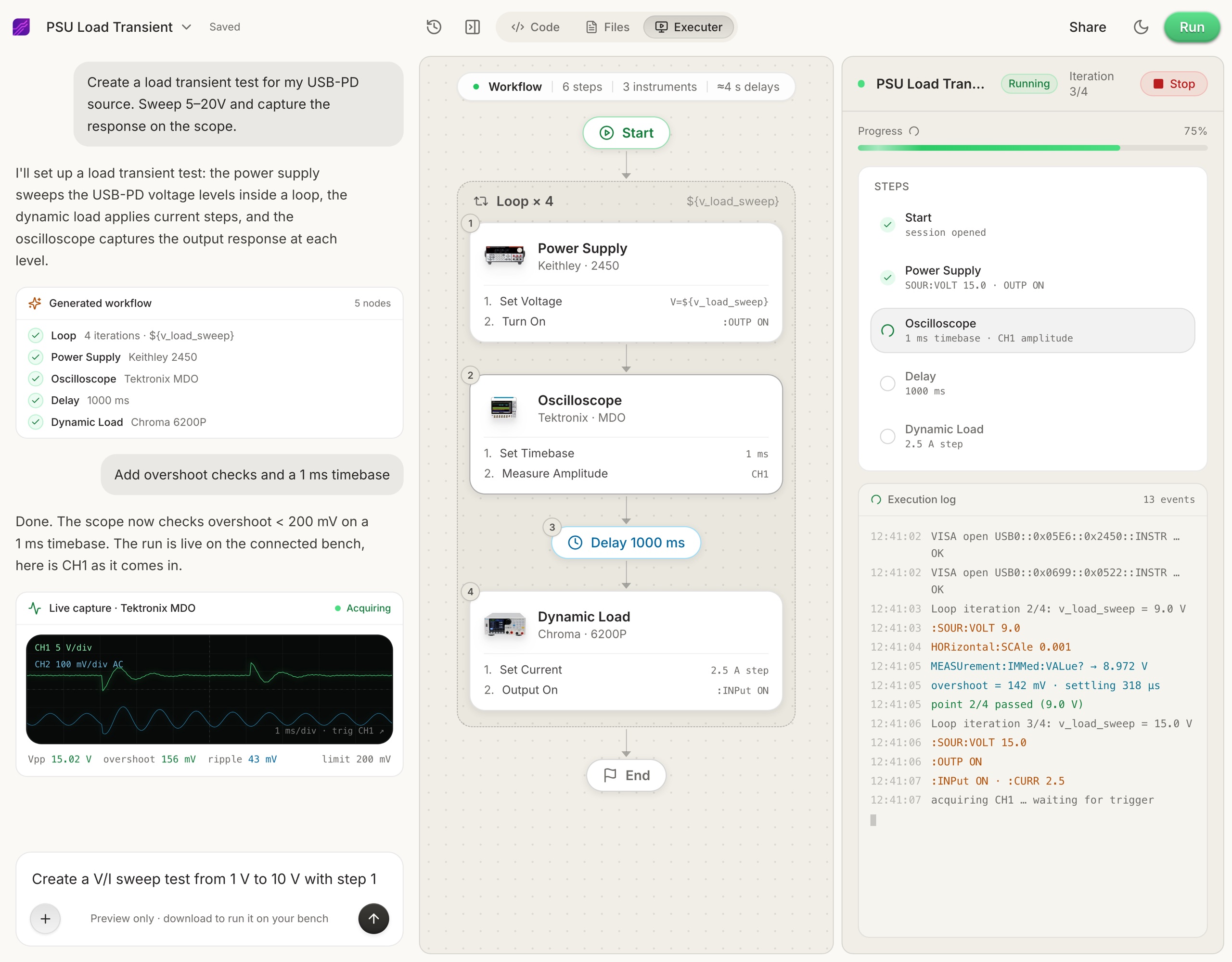
Connect your instruments. Pick the manufacturer and model, paste the VISA address (USB, LAN, GPIB, or serial), and the agent knows what is on your bench. No bench yet? Use a placeholder address, build the full automation, and swap in the real address when you are in the lab.
- 2
Tell the agent what to test, in plain English. For example, "run a VI sweep from 1 to 10 V in 1 V steps at 0.5 A load current," or "suggest the tests for a power-management device."
- 3
The agent builds the complete workflow in seconds. Instrument-aware automation appears on the canvas, with the generated scripts visible in a code panel you can inspect and edit.
- 4
Run it in your lab. Click Run and the status panel streams results step by step, with measured values inline (VOUT = 3.301 V, asserted 3.2 to 3.4 V, PASS). One click exports a structured PDF report, or the raw results as CSV.
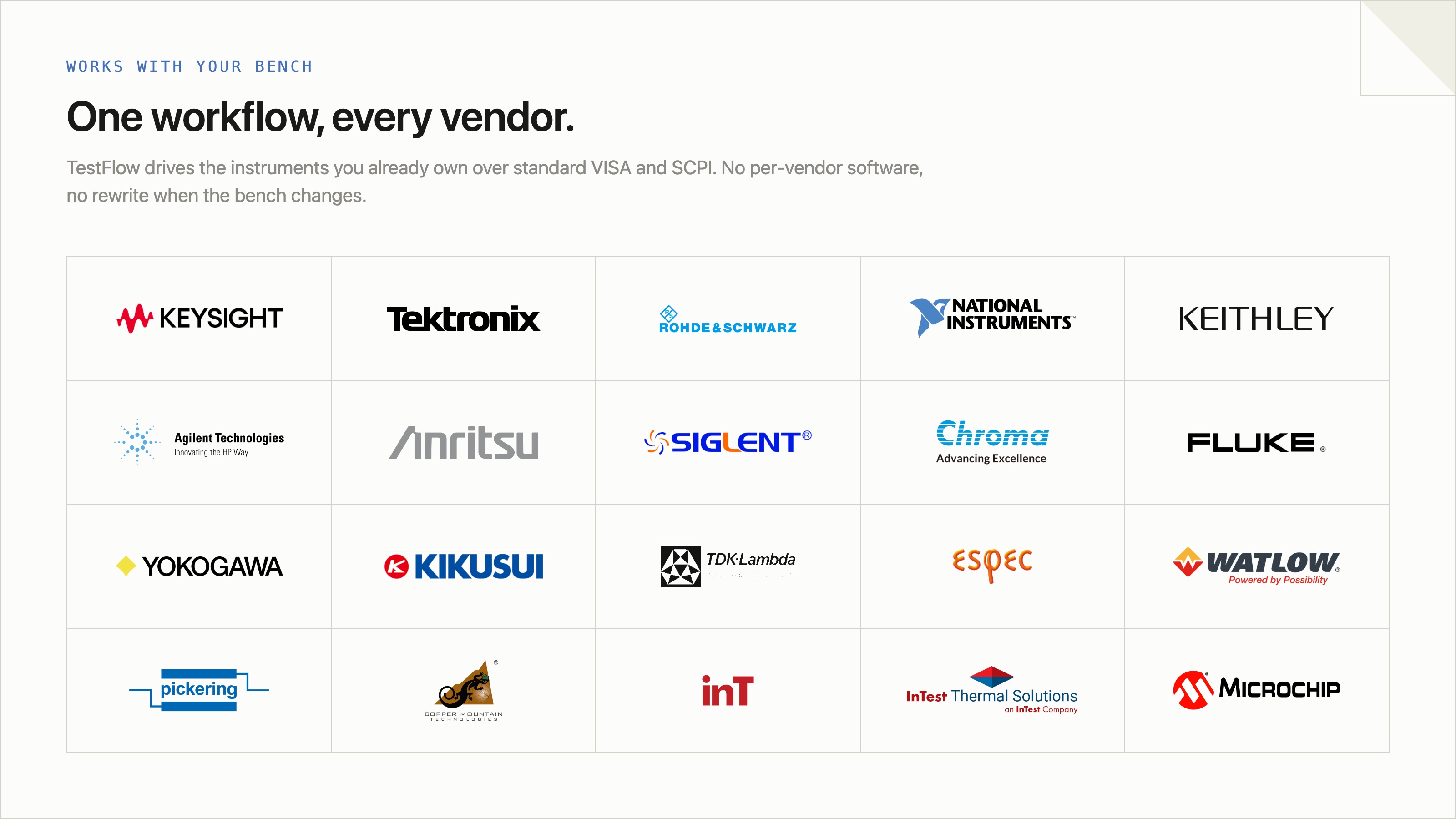
- Vendor-neutral by design. One workflow drives Keysight, Tektronix, Rohde & Schwarz, NI, Rigol, Keithley, Anritsu, and more over standard VISA and SCPI.
- Browser-based and shareable. Workflows live in your workspace, so a sequence built in one lab runs the same way in another.
- Free version to start. Sign in at app.testflowinc.com and build your first workflow today; plans and quotes are on the pricing page.
The step-by-step walkthrough, VISA address formats, and Test Planner prompts are all in the TestFlow product guide.
Frequently asked questions
What is the best software for automating lab instruments?
For a mixed-vendor bench with engineers who code, Python with PyVISA. For production sequencing with operators, NI TestStand or OpenTAP. For teams who want the automation generated rather than written, TestFlow. There is no single answer independent of the bench and the audience.
Is there free test automation software?
Yes. Python with PyVISA, OpenTAP, pytest, and Robot Framework are all free and production-capable. Keysight Command Expert and IO Libraries are free. TestFlow has a free version.
Do I need LabVIEW to automate test equipment?
No. LabVIEW is one option among many and is not required by any instrument. Every SCPI instrument can be driven from Python, C, C#, or any language with a VISA binding.
What is the difference between test automation software and a test sequencer?
A sequencer runs steps in order with limits and results handling. Test automation software is the broader category, including instrument drivers, the sequencer, and often the reporting layer. Many products cover more than one of these.
How long does it take to automate a test bench?
For a single station with a handful of instruments, days to a couple of weeks depending on the tool and the team's experience. The instrument layer is quick, the sequencing and reporting layers are where time goes.
Should I pick software based on my instrument brand?
Only for the vendor's own utilities. Anything that speaks VISA and SCPI is vendor-neutral, and choosing a general tool keeps future hardware purchases open rather than locking them to one brand.
Ready to automate your lab?
Connect your instruments, describe a test in plain English, and TestFlow builds and runs it in minutes.
Tags
Put it on your bench this week
A new way for testing, from specs to automated sequences, capture clean data, and accelerate your validation cycle.