 Ali Kamaly
Test Sequencer Software Compared in 2026 (TestStand, OpenTAP, pytest)
What a test sequencer actually does, the five real options in 2026, and the four questions that decide which one fits, including the results question most teams ask too late.
A test sequencer runs test steps in order, applies pass and fail limits, handles branching and retries, records results, and presents an operator interface. It is the layer between your instrument drivers and your test report, and it is the piece teams most often build badly by hand before buying one.
This post compares the five real options in 2026 on the terms that decide the choice: cost, results handling, operator model, and who has to maintain it.
What a sequencer actually gives you
Worth being concrete, because "we have a Python script that loops" covers some of this and not the rest.
- •Ordered execution with defined failure behaviour. Does a failed step stop the run, skip to cleanup, or continue? Hand-rolled scripts get this wrong.
- •Limits as data, not code. Upper and lower bounds live in configuration so a test engineer can change them without a code review.
- •Result recording with a schema. Every step produces a named measurement with units and a verdict, in a consistent shape.
- •Cleanup that always runs. Outputs disabled, loads disconnected, even when a step throws.
- •Operator interface. Somebody who is not an engineer starts a run, scans a serial number, and reads pass or fail.
- •Deployment. The same sequence runs on twelve stations identically.
If you need fewer than four of those, you may not need a sequencer.
The five options
1. NI TestStand
The incumbent in production test. Mature, capable, and expensive.
Strengths: the deepest step type library, genuinely good operator interfaces, parallel and batch models for multi-UUT testing, and decades of production deployment behind it. Calls LabVIEW, C, .NET, and Python modules.
Weaknesses: cost, and specifically deployment licences per station, which scale with your success. Sequences are stored in a proprietary format that does not diff well in version control.
Pick it if: you run high-volume production test with operators, you are already in the NI stack, or you need the multi-UUT parallel models.
See NI TestStand alternatives for the deeper treatment.
2. TestFlow
Changes the input rather than the engine. You describe the measurement in plain English, the agent generates the sequence and the instrument automation, and it runs and reports.
Strengths: removes the authoring step, which is the actual bottleneck in validation work. Vendor-neutral instrument control, structured report as an output, free version to start.
Weaknesses: not a production-floor operator sequencer with multi-UUT parallel models. It targets validation and characterisation, not high-volume manufacturing test.
Pick it if: writing the test is what takes the time, and the bench is mixed-vendor.
3. OpenTAP
Free, open source, originally from Keysight, now an OSI-licensed project.
Strengths: production-grade engine at zero cost, no deployment licences, plugin architecture, pluggable result listeners, CLI-driven so it fits CI. The same engine underneath commercial PathWave Test Automation.
Weaknesses: plugins are C#-centric, which is a barrier for Python teams. The community editor is less polished than commercial offerings. Instrument coverage outside Keysight requires your own plugin work.
Pick it if: you want a real sequencer without licence cost and have C# capability.
4. pytest
Free, and not designed for hardware, which turns out not to matter much.
import pytest

@pytest.fixture(scope="module")
def bench():
    psu, dmm = PowerSupply(PSU_ADDR), Dmm(DMM_ADDR)
    yield psu, dmm
    psu.output(False)          # cleanup always runs
    psu.close(); dmm.close()

@pytest.mark.parametrize("vin", [3.0, 3.3, 3.6])
@pytest.mark.parametrize("temp_c", [25, 85])
def test_regulation(bench, vin, temp_c):
    psu, dmm = bench
    psu.set_voltage(vin)
    vout = dmm.dc_volts()
    assert 1.76 <= vout <= 1.84, f"VOUT {vout:.4f} at VIN {vin}, {temp_c} C"
That is a six-point test matrix with setup, teardown, limits, and reporting, in fifteen lines.
Strengths: free, enormous ecosystem, fixtures handle setup and teardown properly, parameterisation expresses test matrices cleanly, JUnit XML output that every CI system reads, and every Python developer already knows it.
Weaknesses: no operator interface. Production operators do not run pytest. Limits live in code, so changing one is a code change.
Pick it if: the audience is engineers, the results go to CI, and there is no production floor involved.
5. Robot Framework
Free, keyword-driven, with a tabular syntax readable by non-programmers.
*** Test Cases ***
LDO Regulation At Nominal
    Set Supply Voltage    3.3
    Enable Output
    ${vout}=    Measure DC Voltage
    Should Be True    1.76 <= ${vout} <= 1.84
Strengths: genuinely readable by test engineers who do not code, excellent built-in reporting, strong in telecom and integration testing, extensible in Python.
Weaknesses: the keyword layer is another abstraction to maintain, performance is modest for tight loops, and hardware library coverage is thinner than OpenTAP's.
Pick it if: the sequence needs to be readable and editable by people who will not write Python.
Comparison table
| TestStand | OpenTAP | pytest | Robot | TestFlow | |
|---|---|---|---|---|---|
| Cost | Commercial + deployment | Free | Free | Free | Free version, then paid |
| Plugin language | LabVIEW, C, .NET, Python | C# | Python | Python | None needed |
| Operator interface | Excellent | Limited | None | Limited | Browser workspace |
| Multi-UUT parallel | Yes | Possible | Awkward | Limited | No |
| CI integration | Awkward | Good | Excellent | Excellent | Yes |
| Limits as configuration | Yes | Yes | In code | In tables | Generated |
| Results schema | Built in | Pluggable listeners | JUnit XML | Built in | Structured report |
| Version control friendly | Poor | Good | Excellent | Excellent | Workflows stored |
| Deployment licences | Yes | None | None | None | None |
The four questions that decide it
1. Who runs the test?
Engineers means pytest or OpenTAP. Operators means TestStand or a real operator interface. This single question eliminates half the field and is the one most often skipped.
2. Where do results go, and who reads them?
Ask this before choosing, not after. Teams pick on step authoring and discover the results model afterwards, then write a custom listener, which erases the difference between the options.
- •File per run, read by an engineer? Anything works.
- •Database, trended across thousands of units? You need a schema, and OpenTAP result listeners or TestStand's database logging.
- •Signed document for a customer or auditor? You need report generation, not just logging.
- •CI dashboard? JUnit XML, so pytest is native.
3. Is the bottleneck running tests or writing them?
If running is slow, a better sequencer helps. If writing is slow, a better sequencer does nothing, because they all assume a human authors each step.
Most validation teams are in the second case and buy for the first.
4. What does a station cost to add?
With TestStand, a new station is a deployment licence, forever. With OpenTAP, pytest, or Robot Framework, it is zero. Over a five-year horizon on a growing lab this is frequently the largest line in the comparison and it does not appear in the initial quote.
A pragmatic recommendation
- •Production floor, operators, high volume: TestStand, and negotiate the deployment licences hard.
- •Engineering validation, Python team: pytest. It is free, everyone knows it, and CI integration is a real advantage.
- •Want a proper sequencer without licence cost, have C# skills: OpenTAP.
- •Sequence must be readable by non-programmers: Robot Framework.
- •Writing the tests is the bottleneck: TestFlow, and keep whichever sequencer you already run for the production side.
These are not exclusive. A common and sensible arrangement is pytest for engineering validation and TestStand on the production floor, because the two audiences genuinely need different things.
What a sequencer costs to own, not to buy
Purchase price is the visible number. The recurring costs are what decide the five-year comparison.
| Cost | TestStand | OpenTAP | pytest | TestFlow |
|---|---|---|---|---|
| Licence renewal | Annual per seat | None | None | Plan-based |
| Per new station | Deployment licence | None | None | None |
| Plugin or step maintenance | Per code module | Per C# plugin | Per fixture | None |
| Version upgrade effort | Sequence migration | Plugin recompile | Usually none | Managed |
| Training a new engineer | Days to weeks | Days | Hours | Hours |
| Losing the person who wrote it | High risk | Moderate | Low | Low |
The last row is the one nobody budgets and the one that hurts. A TestStand sequence with custom LabVIEW step modules, written by someone who has left, is an asset nobody wants to touch. A pytest suite is readable by any Python developer you hire tomorrow.
Weigh that against the operator interface, which is the genuine thing the commercial tools provide and the free ones do not.
Running two sequencers on purpose
Teams often treat this as a single choice and it usually should not be. The two audiences want opposite things.
Engineering validation wants code, version control, CI, fast iteration, and results in a format that a developer can query. pytest is close to ideal and costs nothing.
Production test wants an operator interface, deployment to many identical stations, locked-down sequences, and auditable records. That is TestStand's home ground.
Trying to serve both from one tool means either engineers fighting a production sequencer for daily work, or a production floor running something with no operator interface. Both outcomes are common and both are avoidable.
The one thing to share between them is the instrument layer. Write the instrument classes once, in Python, and call them from pytest directly and from the production sequencer through its Python step type. The expensive, hardware-specific knowledge then lives in one place regardless of which sequencer is running.
The results back end, which outlives the sequencer
The decision with the longest tail and the one most often deferred. Whichever sequencer you pick, results have to land somewhere, and that somewhere determines what questions you can answer in two years.
| Destination | Good for | Breaks down when |
|---|---|---|
| CSV per run, in a folder | Getting started, single station | You want to compare across runs |
| One SQLite file per station | Small teams, no infrastructure | Two people query it at once |
| Postgres or a time-series database | Cross-run analysis, dashboards | Nobody owns the schema |
| Vendor results back end | It comes configured | You leave the vendor |
| Parquet files in object storage | Large volumes, analytics tooling | You need live queries |
The questions to design against are the ones you will actually be asked: how did this parameter drift across the last fifty units, did yield change after the process update, and show me every run that used firmware 1.2. A folder of CSVs cannot answer any of them; a table with a run ID, a DUT ID, a parameter, a value, and a timestamp answers all three.
Design the schema before choosing the sequencer, not after. It is portable across every option on this page, and it is the artefact that survives a tool migration. See automated test report generation for the fields a result row has to carry.
Do you need a sequencer at all
Worth asking directly, because a sequencer is infrastructure and infrastructure has a maintenance cost.
You do not need one if: one engineer runs the tests, the sequence is short, there is no operator, nothing runs unattended, and results go into one file per run. A Python script is a better answer, and adding a sequencer to that situation buys complexity.
You do need one when at least two of these are true: a technician who is not an engineer runs the test, sequences share steps across many products, results must be queryable across runs, execution has to be traceable and versioned, or the sequence branches on results in more than a trivial way.
The middle ground, which is where most validation teams actually sit, is a structured Python project with pytest as the runner. It gives you parameterisation, fixtures for instrument setup and teardown, reporting plugins, and CI integration, without the operator model you do not need. See best test automation software for how that compares against the commercial options.
Common mistakes
- •Buying a sequencer to solve a scripting problem. See above. One engineer and a short sequence does not need infrastructure.
- •Deferring the results schema. It outlives the tool. Design it first.
- •Choosing on step-type libraries. You will write your own for anything specific to your product regardless.
- •Ignoring who runs the test. Engineer or technician decides more than any feature.
- •Forgetting per-station licensing. The commercial options charge per deployment, and it is invisible in the budget. See NI software licensing costs.
- •Piloting on the easy sequence. Pilot on one with real limits, real instruments, and a real report.
- •Assuming the sequencer handles instrument control well. It orchestrates. The instrument layer is still VISA and SCPI underneath, and it is still your code unless a plugin already exists.
Related reading
- •OpenTAP vs NI TestStand, the two main options head to head
- •NI TestStand alternatives, the full field
- •Keysight PathWave alternatives, the Keysight platform
- •Best test automation software, the wider decision
- •Automated test report generation, the results layer
- •pyVISA tutorial, the instrument layer underneath
- •Instrument control with VISA and SCPI, the protocol foundation
- •NI software licensing costs, the per-station maths
- •Python instrument control libraries compared, building the layer below
- •Free instrument control software, the zero-cost route
- •HIL testing software compared, when real-time changes the answer
- •Optimizing test coverage, what the sequence should contain
- •Hardware testing best practices, the surrounding discipline
- •LabVIEW alternatives, if the sequencer sits on an NI estate
Where TestFlow fits
Sequencers compete on how well they run steps. None of them help you write the steps, which is where validation teams actually lose time.
- 1
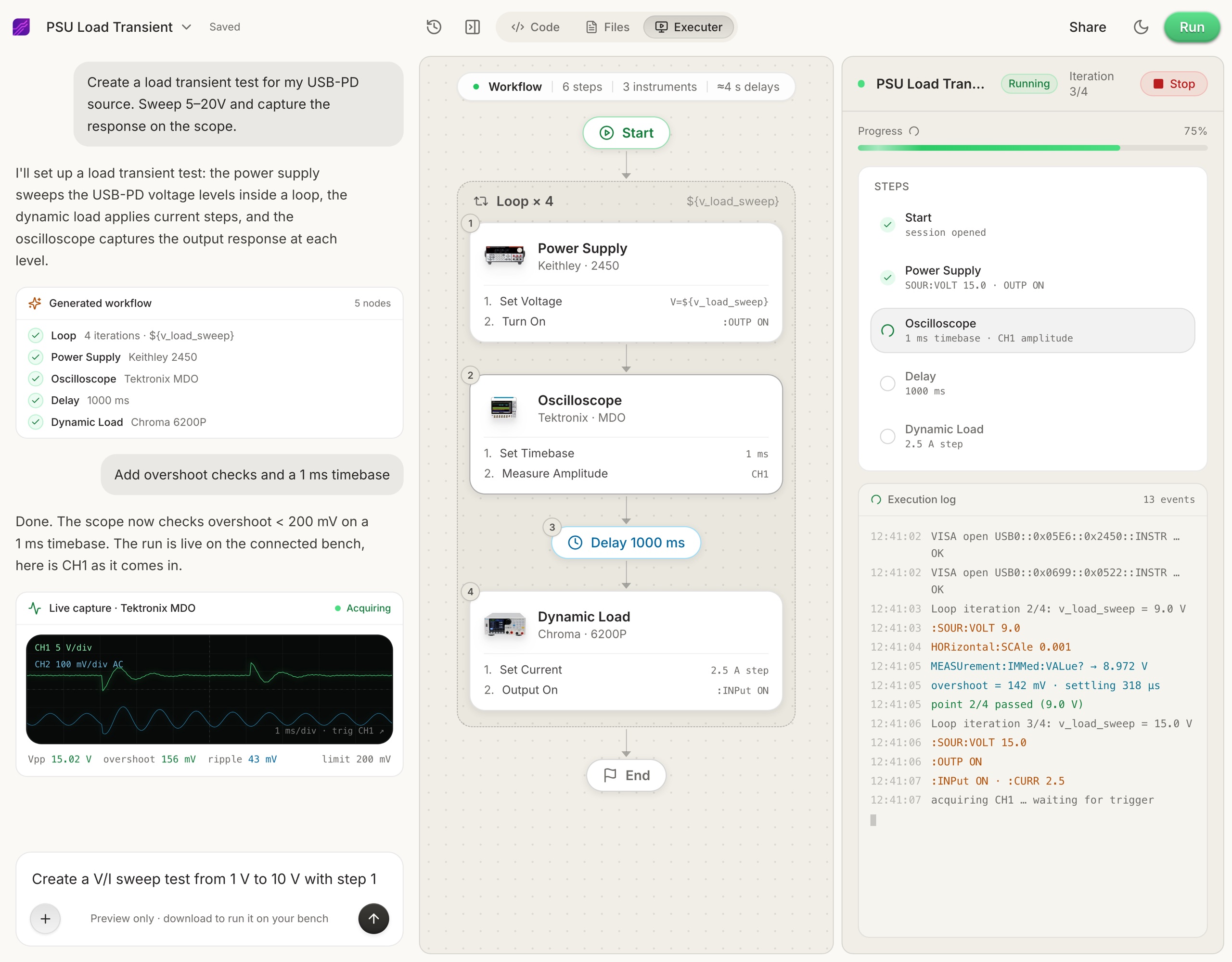
Connect your instruments. Pick the manufacturer and model, paste the VISA address (USB, LAN, GPIB, or serial), and the agent knows what is on your bench. No bench yet? Use a placeholder address, build the full automation, and swap in the real address when you are in the lab.
- 2
Tell the agent what to test, in plain English. For example, "run a VI sweep from 1 to 10 V in 1 V steps at 0.5 A load current," or "suggest the tests for a power-management device."
- 3
The agent builds the complete workflow in seconds. Instrument-aware automation appears on the canvas, with the generated scripts visible in a code panel you can inspect and edit.
- 4
Run it in your lab. Click Run and the status panel streams results step by step, with measured values inline (VOUT = 3.301 V, asserted 3.2 to 3.4 V, PASS). One click exports a structured PDF report, or the raw results as CSV.
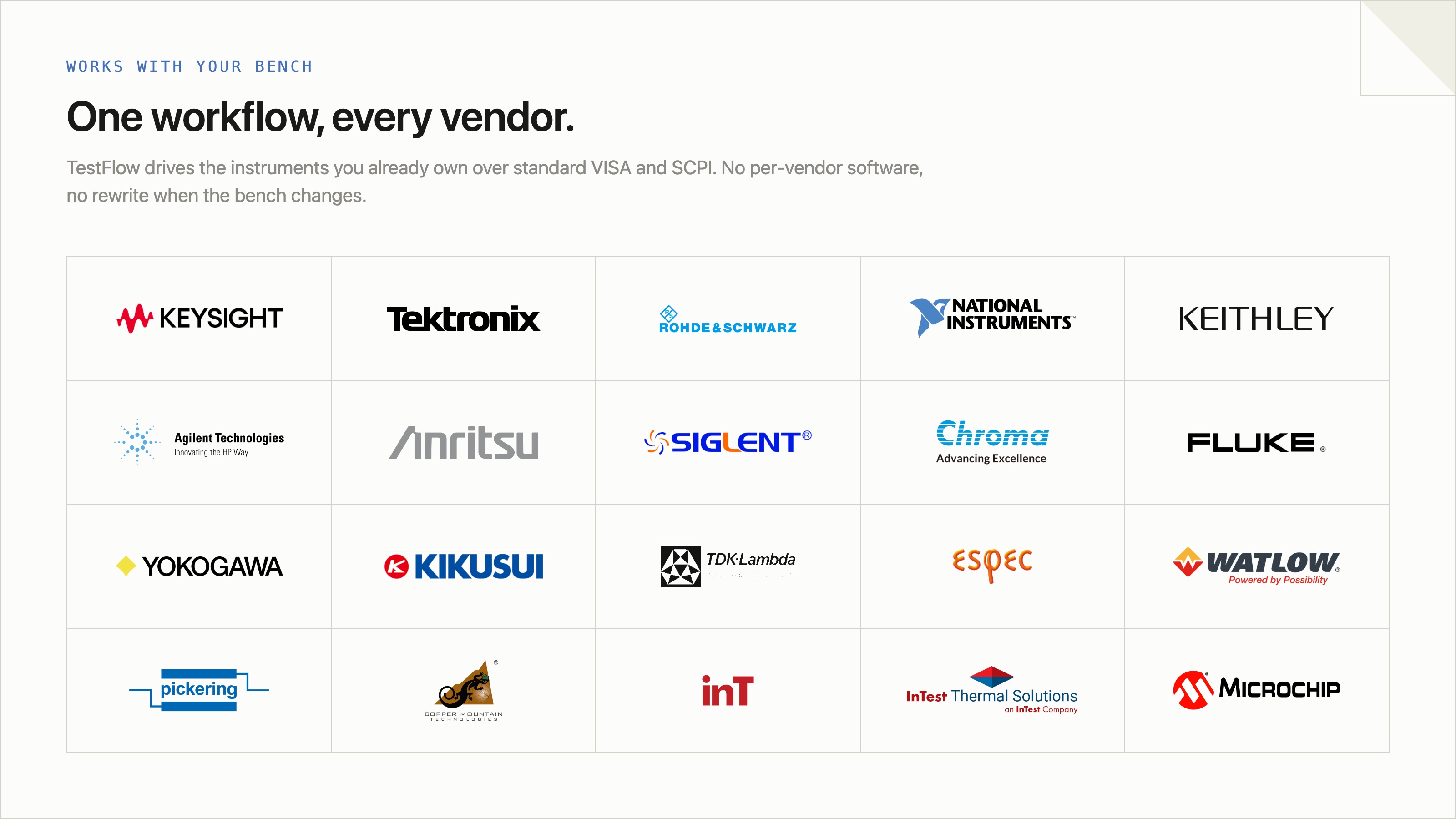
- Vendor-neutral by design. One workflow drives Keysight, Tektronix, Rohde & Schwarz, NI, Rigol, Keithley, Anritsu, and more over standard VISA and SCPI.
- Browser-based and shareable. Workflows live in your workspace, so a sequence built in one lab runs the same way in another.
- Free version to start. Sign in at app.testflowinc.com and build your first workflow today; plans and quotes are on the pricing page.
The step-by-step walkthrough, VISA address formats, and Test Planner prompts are all in the TestFlow product guide.
Frequently asked questions
What is a test sequencer?
Software that runs test steps in a defined order, handles pass and fail limits, manages branching and retries on failure, records results, and usually provides an operator interface. It is the layer above individual instrument drivers.
What is the best free test sequencer?
OpenTAP is the strongest free option, being a production-grade engine originally from Keysight with a plugin ecosystem. For Python-first teams, pytest covers most sequencing needs with excellent CI integration.
Is OpenTAP as good as TestStand?
For the sequencing engine itself, largely yes. TestStand has a more mature operator interface, deeper step type library, and a longer track record in regulated production. OpenTAP costs nothing and has no deployment licences.
Can pytest be used for hardware testing?
Yes, and it works well. Fixtures manage instrument setup and teardown, parameterisation covers test matrices, and the reporting plugins produce JUnit XML that CI systems read. It is not suited to a production operator interface.
Do I need a test sequencer at all?
If you run more than a handful of tests, need consistent pass and fail handling, or must produce auditable results, yes. For a single characterisation script, a plain Python file is simpler and honest.
What is the difference between a sequencer and a test framework?
Largely marketing. Sequencers emphasise operator interfaces, deployment to production stations, and step configuration. Frameworks emphasise code, fixtures, and CI. The functional overlap is large.
Ready to automate your lab?
Connect your instruments, describe a test in plain English, and TestFlow builds and runs it in minutes.
Tags
Put it on your bench this week
A new way for testing, from specs to automated sequences, capture clean data, and accelerate your validation cycle.