 Ali Kamaly
NI VeriStand Alternatives in 2026 (Open Source & AI-Native Options)
What VeriStand actually does, where its licence cost stops making sense, and the realistic alternatives for real-time test and HIL work in 2026, including what each one gives up.

NI VeriStand is a configuration-based environment for building and running real-time test systems, most often hardware-in-the-loop rigs where a simulated plant model runs against real hardware in a deterministic loop. You map channels, load models, define stimulus profiles, and get operator screens without writing the real-time application by hand.
It is also one of the most expensive pieces of software in a typical validation budget, and a large number of teams who own it are using a narrow slice of it. This post covers what VeriStand genuinely does well, the four realistic alternatives in 2026, and how to tell which part of your workload actually needs a real-time licence.
Where VeriStand earns its licence
Be honest about this before shopping for alternatives, because if you need these things, most of the alternatives below will not work.
- •Deterministic execution. Models run on an NI Linux Real-Time or PXI target with loop rates typically from 100 Hz to 10 kHz and jitter bounded in microseconds. A general-purpose OS cannot promise that.
- •Model integration. Simulink models compiled to a real-time target, plus support for FMI/FMU, C models, and NI's own model interface. Swapping a plant model is a configuration change, not a rewrite.
- •Channel mapping at scale. A mid-size HIL rig has thousands of channels across DAQ, CAN, LIN, FlexRay, and analog fault-insertion hardware. VeriStand's mapping and aliasing layer is genuinely good at this.
- •Stimulus profiles and test sequencing against the running model, with real-time triggers.
- •Operator workspace screens that non-programmers can drive.
If your work is a powertrain HIL cell or an ADAS sensor rig, this is the job VeriStand is built for, and the honest answer is that no free tool matches it. See HIL testing explained and ADAS testing with HIL for where that boundary sits.
Where it stops making sense
The pattern worth checking: VeriStand bought for one HIL programme, then used as the default for everything.
A team buys VeriStand for a genuine real-time rig. Two years later, bench characterisation, production line checkout, and thermal soak testing all run through the same licence pool, because it is what is installed and what people know. None of those workloads need deterministic microsecond loops. All of them are paying for them.
Symptoms that you are in this position:
- •Your loop rate requirement is under 100 Hz, or you cannot say what it is
- •Your "HIL rig" is a power supply, a DMM, a load, and a DUT
- •The last time anyone loaded a Simulink model was during the original programme
- •Deployment licences outnumber development seats by a wide margin, and most stations run one fixed sequence
If three of those are true, you are paying real-time prices for bench automation.
What VeriStand costs
NI does not publish a single list price. VeriStand is quote-based and the sticker is only part of the bill.
| Cost line | What it covers | Typical order of magnitude |
|---|---|---|
| Development seat | The VeriStand environment itself | Five figures per year |
| Deployment licence | Each real-time target you run on | Low-to-mid four figures per target per year |
| Real-time hardware | PXI controller, chassis, modules | Five figures per rig |
| LabVIEW (often needed) | Custom devices, workspace objects | See LabVIEW pricing |
| Model interface add-ons | Simulink, FMI, third-party model support | Quote-based |
The number that catches teams out is deployment. Development seats are visible in the budget. Deployment licences multiply with the number of stations, and they renew.
Ask for a written quote that names the deployment count explicitly. If the quote only prices development seats, it is not a quote for your system.
The alternatives
1. OpenTAP
Free and open source, originally from Keysight, now an OSI-licensed project with an active plugin ecosystem. It is a test sequencer and orchestration engine, not a real-time environment.
Good for: replacing the sequencing and result-handling half of VeriStand on non-real-time benches. Plugins exist for many instrument families, results listeners write to databases and files, and the whole thing is scriptable from C# and Python.
Gives up: determinism, model execution, channel mapping at HIL scale, and the operator workspace. There is no real-time target.
Verdict: the strongest free option if your workload is sequencing rather than simulation. Compare it directly against NI TestStand, which occupies the same slot commercially.
2. TestFlow
AI-native and vendor-neutral. You connect the instruments already on your bench, describe the test in plain English, and an agent generates the automation and the structured test plan, then runs it and produces the report.
Good for: the bench validation workload that ended up on a VeriStand licence by accident. Parametric sweeps, characterisation runs, pass/fail limits, and audit-ready reporting across mixed-vendor hardware.
Gives up: real-time determinism and plant-model execution. TestFlow does not pretend to be a HIL platform, and if you need a 5 kHz deterministic loop it is the wrong answer.
Verdict: the option that removes the most cost from the most common failure mode, which is bench work running on real-time licences.
3. Python with pyVISA and friends
Free, and the default answer for engineers who can code. pyVISA drives anything speaking SCPI over USB, LAN, GPIB, or serial. python-can covers CAN bus. nidaqmx gives you NI DAQ hardware directly, without LabVIEW.
Good for: bench characterisation, data logging, parametric sweeps, and anything where "fast enough" is measured in milliseconds rather than microseconds.
Gives up: hard real-time, the entire configuration layer, and the operator UI. You are building the sequencing, reporting, and screens yourself, and that build is not small. Budget weeks, not days.
Verdict: excellent for the bench half, poor value if you are rebuilding a workspace UI from scratch. See LabVIEW vs Python for the same trade in the LabVIEW context.
4. dSPACE
The other serious commercial HIL platform, strongest in automotive. SCALEXIO hardware with ControlDesk and AutomationDesk on the software side.
Good for: automotive HIL where dSPACE is often already the customer requirement. Model integration and the toolchain around it are mature.
Gives up: nothing technically, but nothing on price either. This is a lateral move, not a cost reduction. Pick it for ecosystem fit, not savings.
Verdict: the real competitor to VeriStand at the high end. Evaluate it if you are re-platforming a HIL programme anyway.
5. Vector CANoe
Bus-centric. If your "HIL" is mostly CAN, LIN, and FlexRay with residual bus simulation, CANoe does that specific job better than VeriStand does.
Good for: network simulation, ECU testing, restbus simulation, diagnostics over UDS.
Gives up: general analog and mixed-signal instrument control, and plant-model execution beyond what CANoe's own simulation nodes provide.
Verdict: the right tool if the bus is the system under test. The wrong tool if you are sweeping analog parameters.
Comparison table
| VeriStand | OpenTAP | Python | dSPACE | TestFlow | |
|---|---|---|---|---|---|
| Cost | Five figures/yr | Free | Free | Five figures+/yr | Free version, then paid |
| Hard real-time | Yes | No | No | Yes | No |
| Plant models | Yes | No | Via libraries | Yes | No |
| Instrument control | Via NI stack | Plugins | pyVISA | Via dSPACE I/O | Built in, any vendor |
| Sequencing | Yes | Yes | You build it | Yes | Generated by agent |
| Operator UI | Yes | Partial | You build it | Yes | Browser workspace |
| Reporting | Yes | Via listeners | You build it | Yes | PDF and CSV built in |
| Vendor lock-in | High (NI hardware) | Low | None | High (dSPACE hardware) | None |
| Time to first result | Weeks | Days | Days to weeks | Weeks | Minutes |
How to choose
Answer these in order and stop at the first "yes".
- 1
Do you need a guaranteed loop rate above 1 kHz with bounded jitter? Stay on a real-time platform. VeriStand or dSPACE. Nothing else on this list qualifies.
- 2
Is the device under test primarily a bus node? Look at Vector CANoe first.
- 3
Is your workload sequencing instruments and recording results? OpenTAP if you want free and are willing to build plugins. TestFlow if you want the sequence generated for you.
- 4
Do you have engineers who would rather own the code than a licence? Python with pyVISA, and accept the build cost.
A realistic migration path
Do not attempt to move a live HIL programme. Move the workload that should never have been there.
- 1
Inventory your deployment licences. For each station, write down the actual loop rate requirement and whether a model is loaded. This one spreadsheet usually pays for the exercise.
- 2
Split the estate. Real-time stations stay. Bench stations move.
- 3
Port one bench station. Pick the one with the simplest instrument set and the most repetitive sequence. Rebuild it on the new tool and run both in parallel for a fortnight.
- 4
Compare the outputs, not the tools. Same DUT, same limits, same numbers. If the reports agree, the port is good.
- 5
Release the licence at renewal. Deployment licences are annual. The saving lands only if you tell NI before the renewal date.
- 6
Then do the rest in batches, keeping one station on the old tool until the last batch is proven.
The teams that get burned are the ones who move everything at once and lose the ability to reproduce a historical result. Keeping one old station alive through the transition costs one licence and removes that risk entirely.
What the bench workload actually looks like
"Bench validation running on a VeriStand licence" is abstract until you count it. Here is the shape it takes in most labs, and what each part needs.
| Workload | Typical rate | Needs real-time? | What it really is |
|---|---|---|---|
| Parametric sweep (VI curve, line/load regulation) | 1 to 20 points/s | No | Set, settle, measure, log |
| Thermal soak | One reading per 10 to 60 s | No | A chamber, a DMM, and a clock |
| Production line checkout | One DUT per 30 to 120 s | No | A fixed sequence with pass/fail limits |
| Efficiency mapping | 50 to 500 points per run | No | A nested sweep with two supplies and a load |
| Load transient response | Microseconds | Scope captures it | A scope trigger, not a control loop |
| Closed-loop plant simulation | 100 Hz to 10 kHz | Yes | The actual HIL job |
Only the last row needs a real-time target. The fifth row is the one that fools people: the *event* is microseconds, but the instrument capturing it is an oscilloscope with its own timebase, so your software only has to arm the scope and read it back. That is a SCPI transaction, not a deterministic loop.
If you want to check your own estate against this, the practical test is the loop-rate question in the HIL testing software comparison: write down the fastest thing your software itself must close a loop on, not the fastest thing that happens in the fixture.
What you actually rebuild when you move
The migration estimates that go wrong are the ones that count only the sequence. Here is the full inventory for a typical bench station, with realistic effort on a Python or OpenTAP rebuild.
| Piece | What it is on VeriStand | Rebuild effort |
|---|---|---|
| Instrument I/O | Channel mapping through the NI stack | 1 to 3 days per instrument family |
| The sequence | Stimulus profile or a TestStand hand-off | 2 to 5 days |
| Limits and pass/fail | Alarm definitions on channels | 1 to 2 days |
| Data logging | TDMS through the workspace | 1 to 3 days, plus a format decision |
| The report | Whatever the team bolted on | 3 to 10 days, and the usual underestimate |
| Operator screen | VeriStand workspace | 5 to 15 days, or you decide you do not need one |
That is roughly four to eight weeks for one station if you build it yourself, which is why the "just use Python" answer is honest about capability and dishonest about schedule. See LabVIEW to Python migration for the same arithmetic on the LabVIEW side, and the Python instrument control libraries comparison for which parts of that stack you do not have to write.
The row that decides the project is the report. Validation output that nobody can hand to a customer is not validation output. If you are rebuilding, decide the report format on day one, not in week six. Automated test report generation covers what the deliverable has to contain.
A worked example: a thermal soak station
A concrete one, because the general advice is easy to nod at and hard to act on.
The station: an ESPEC chamber, a Keysight 34465A reading four thermocouples and one output rail, a programmable DC supply holding the input at 12 V, and a DUT that has to hold regulation from minus 40 to plus 85 degrees C. One reading every 30 seconds, 16 hours per run.
On VeriStand this station holds one deployment licence, roughly low four figures per year, and uses none of the real-time engine. The model slot is empty. The fastest loop is 0.033 Hz.
What it needs instead:
- 1
Chamber control, which is a handful of SCPI or Modbus writes and a wait on a temperature-stable flag.
- 2
A 30 second timer and five measurements per tick.
- 3
Limit checks on the output rail at each setpoint.
- 4
A CSV or TDMS log with a timestamp per row.
- 5
A report with the soak profile, the measured envelope, and the pass/fail line.
That is a day of work on any of the tools in this post, and about an hour if the sequence is generated for you. The saving is the deployment licence, every year, for a station that was never doing real-time work. Multiply by the number of soak, checkout, and characterisation stations in your lab and you have the actual number to take into the renewal conversation.
Common mistakes when replacing VeriStand
- •Treating the whole estate as one decision. It is two estates with one licence pool. Split them first, before you evaluate anything.
- •Benchmarking on the hard case. Teams pilot the migration on the real-time rig, watch it fail, and conclude the alternative is no good. Pilot on the bench station, which is where the saving is.
- •Forgetting the deployment count. Development seats are visible and deployment licences are not. The mapping exercise is the single highest-value hour in this project.
- •Rebuilding the operator workspace by reflex. Ask who actually uses it. On a station that runs one fixed sequence overnight, the answer is often nobody, and you have just saved three weeks.
- •Moving before the report format is decided. See above. This is the step that turns a four-week port into a ten-week one.
- •Cancelling the old licence before the parallel run. Keep one station on VeriStand until the last batch is proven. One licence is cheap insurance against losing the ability to reproduce a historical result.
Questions to put to NI before you renew
Renewal conversations go better when you arrive with specifics.
- •How many deployment licences am I paying for, and which stations do they map to? Ask for the mapping, not the count. The gap between the two is usually the saving.
- •What happens to my existing test system definitions if I do not renew? Get this in writing. The answer affects whether you can keep running while you migrate.
- •Which of my model interfaces require a separate add-on? Simulink, FMI, and third-party model support are not uniformly included.
- •Can development seats be converted to deployment licences, or the reverse? Sometimes yes, and it can cut a line item without changing anything technical.
- •What is the price for a support-only tier? If a station runs one frozen sequence and nobody develops on it, you may not need a full licence.
Related reading
- •NI TestStand alternatives, the sequencing layer that often sits alongside VeriStand
- •LabVIEW alternatives, the broader NI escape route
- •What is HIL testing, if you are still scoping the requirement
- •NI VeriStand explained, the product overview
- •LabVIEW pricing, the licence maths on the rest of the NI stack
- •NI software licensing costs, the full stack priced line by line
- •HIL testing software compared, the real-time platforms side by side
- •Test sequencer comparison, if sequencing is the part you are replacing
- •ADAS testing with HIL, where the real-time requirement is genuine
- •OpenTAP vs TestStand, the free sequencer evaluated properly
- •pyVISA tutorial, if you are taking the Python route
- •Free instrument control software, the zero-cost options in one place
Where TestFlow fits
VeriStand is aimed at real-time HIL simulation. A large share of teams who buy it are using perhaps a fifth of it for ordinary bench validation, and that is exactly the part TestFlow replaces.
- 1
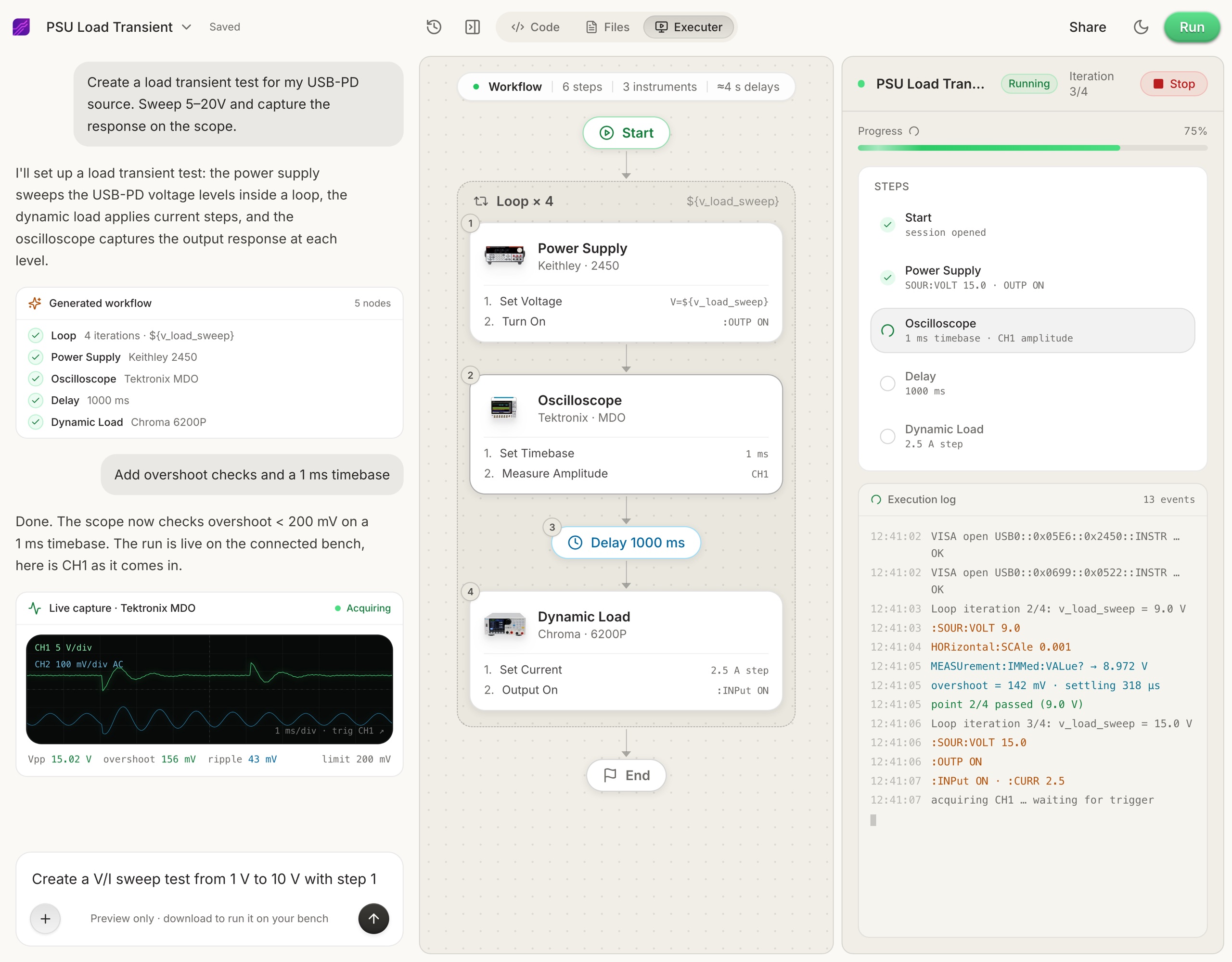
Connect your instruments. Pick the manufacturer and model, paste the VISA address (USB, LAN, GPIB, or serial), and the agent knows what is on your bench. No bench yet? Use a placeholder address, build the full automation, and swap in the real address when you are in the lab.
- 2
Tell the agent what to test, in plain English. For example, "run a VI sweep from 1 to 10 V in 1 V steps at 0.5 A load current," or "suggest the tests for a power-management device."
- 3
The agent builds the complete workflow in seconds. Instrument-aware automation appears on the canvas, with the generated scripts visible in a code panel you can inspect and edit.
- 4
Run it in your lab. Click Run and the status panel streams results step by step, with measured values inline (VOUT = 3.301 V, asserted 3.2 to 3.4 V, PASS). One click exports a structured PDF report, or the raw results as CSV.
- Vendor-neutral by design. One workflow drives Keysight, Tektronix, Rohde & Schwarz, NI, Rigol, Keithley, Anritsu, and more over standard VISA and SCPI.
- Browser-based and shareable. Workflows live in your workspace, so a sequence built in one lab runs the same way in another.
- Free version to start. Sign in at app.testflowinc.com and build your first workflow today; plans and quotes are on the pricing page.
The step-by-step walkthrough, VISA address formats, and Test Planner prompts are all in the TestFlow product guide.
Frequently asked questions
What is NI VeriStand used for?
Configuring and running real-time test systems, mainly hardware-in-the-loop simulation. It handles real-time model execution, channel mapping, stimulus profiles, and operator screens without you writing the real-time application yourself.
Is there a free alternative to NI VeriStand?
For real-time HIL there is no complete free equivalent. For the bench validation and sequencing parts, OpenTAP is free and open source, Python with pyVISA is free, and TestFlow has a free version.
How much does NI VeriStand cost?
VeriStand is quote-based and sits well above LabVIEW, typically five figures per seat per year once the real-time targets, model interfaces, and deployment licences are included. NI does not publish a single list price, so get a written quote covering deployment as well as development.
Do I need LabVIEW to use VeriStand?
Not strictly. VeriStand is configuration-driven and can run models from Simulink, C, and other sources. In practice most deployments also carry LabVIEW for custom devices and workspace objects, which is part of why the total cost surprises people.
What is the difference between VeriStand and TestStand?
VeriStand runs real-time systems and simulations, with deterministic loops measured in microseconds. TestStand sequences discrete test steps and manages results. They solve different problems and are sometimes deployed together.
Can Python replace VeriStand?
For non-deterministic bench work, yes. For hard real-time HIL with guaranteed loop rates, no. Python on a general-purpose OS cannot give you the timing guarantees a real-time target does.
Ready to automate your lab?
Connect your instruments, describe a test in plain English, and TestFlow builds and runs it in minutes.
Tags
Put it on your bench this week
A new way for testing, from specs to automated sequences, capture clean data, and accelerate your validation cycle.