 Ali Kamaly
OpenTAP vs NI TestStand in 2026 (Free Open Source vs the Incumbent)
A direct comparison of the free open-source sequencer and the production incumbent, on cost, capability, and the migration effort in each direction.
OpenTAP is a free, open-source test sequencer originally from Keysight. NI TestStand is the paid incumbent in production test. They occupy the same slot in a test stack, and the honest comparison is that the engines are closer than the price difference suggests, while the surrounding ecosystem is where TestStand still earns its cost.
This post compares them on the points that decide real evaluations, and gives the migration effort in both directions.
The cost difference, stated plainly
| OpenTAP | TestStand | |
|---|---|---|
| Development seat | Free | Mid four figures per year |
| Deployment per station | Free | Low four figures per station per year |
| Plugin development | Free, your time | Free, your time |
| Support | Community, or commercial via PathWave | Included with subscription |
A lab with two developers and twelve production stations pays nothing for OpenTAP and a five-figure annual sum for TestStand, most of it in deployment licences. See NI software licensing costs for how that line behaves over time.
That gap is large enough that the rest of this comparison is really asking: what does TestStand do that is worth it?
Where TestStand is genuinely ahead
Being fair about this matters, because the price difference invites motivated reasoning.
Operator interfaces. TestStand ships production-ready operator interfaces in several languages, with serial number entry, batch handling, and pass/fail display. OpenTAP's story here is weaker and usually means building something.
Multi-UUT parallel models. Testing eight units at once with shared resources and independent sequences is a solved problem in TestStand. In OpenTAP it is achievable and it is work.
Step type library. TestStand arrives with a large library of built-in step types and limit-checking behaviours. OpenTAP's built-in set is smaller and the ecosystem fills the gap unevenly.
Regulated production track record. Decades of deployments in aerospace, defence, and medical, with the audit trail and documentation that implies. This is not a technical property but it decides purchases.
Calling LabVIEW. If your existing tests are LabVIEW VIs, TestStand calls them natively. OpenTAP needs an interop layer.
Where OpenTAP is ahead
Cost. Stated above and it is decisive for many teams.
Version control. OpenTAP test plans are XML and diff meaningfully. TestStand sequence files are a proprietary binary-adjacent format that does not review well in a pull request. For teams with software engineering practice this is a daily annoyance in TestStand and a non-issue in OpenTAP.
CLI and CI. tap run plan.TapPlan is a first-class interface. Running TestStand headless in CI is possible and awkward.
Vendor neutrality in practice. Neither is formally locked to hardware, but TestStand pulls you toward the NI stack through the path of least resistance, and OpenTAP does not pull anywhere in particular.
Modern .NET. Cross-platform, containerisable, and familiar to any C# developer.
Writing a step type in each
The practical difference in daily work.
OpenTAP, C#:
[Display("Measure DC Voltage", Group: "DMM")]
public class MeasureDcVoltage : TestStep
{
    public ScpiInstrument Dmm { get; set; }
    public double Range { get; set; } = 10;
    public double LowerLimit { get; set; }
    public double UpperLimit { get; set; }

    public override void Run()
    {
        Dmm.ScpiCommand($"CONF:VOLT:DC {Range}");
        double v = Dmm.ScpiQuery<double>("READ?");
        Results.Publish("DcVoltage", new List<string> { "Volts" }, v);
        UpgradeVerdict(v >= LowerLimit && v <= UpperLimit ? Verdict.Pass : Verdict.Fail);
    }
}
Compile, drop the DLL in the plugins folder, and the step appears in the editor with its properties exposed.
TestStand does not have a direct equivalent because its model differs: you write a code module in LabVIEW, C, .NET, or Python, then configure a step in the sequence editor to call it, with limits set in the step's properties rather than in code.
The TestStand approach separates limits from code more cleanly, which test engineers like. The OpenTAP approach keeps everything in one reviewable file, which software engineers like. Neither is wrong and the preference usually tracks your team's background.
Results handling
Both are capable, and this is the axis to evaluate carefully because it is expensive to change later.
TestStand has built-in database logging with a defined schema, report generation in several formats, and result processing plugins. It works out of the box.
OpenTAP uses result listeners, which are pluggable. CSV, SQLite, InfluxDB, and custom listeners all exist. More flexible, and you assemble it.
If you need a signed PDF report per unit tomorrow, TestStand is closer. If you need results streaming into a time-series database for trend analysis, OpenTAP's listener model is cleaner.
Migration effort
TestStand to OpenTAP
Effort scales with custom step count, not sequence count.
- 1
Inventory custom code modules. Each becomes a C# step type. Budget half a day to a day each.
- 2
Rebuild sequences. Quick once step types exist, since sequences are mostly structure.
- 3
Replace the operator interface. This is often the largest single item and the one that surprises people.
- 4
Rebuild result handling. Pick listeners, define the schema, verify against historical output.
- 5
Run in parallel on one station for a full production cycle.
A team with twenty custom step types and a simple operator interface should budget one to two months. One with a bespoke operator interface and multi-UUT parallel models should budget considerably more and should question whether the migration is worth it at all.
OpenTAP to TestStand
Less common, and usually driven by a customer or regulatory requirement rather than by capability. Similar shape, similar effort, with the added cost of the licences themselves.
How to decide
- 1
Count your stations. Multiply by the deployment licence cost, times five years. If that number is small, the decision is about capability. If it is large, it is about cost and OpenTAP deserves a serious trial.
- 2
Ask who runs the tests. Operators on a production floor push hard toward TestStand. Engineers do not.
- 3
Ask whether you have C# capability. No C#, and OpenTAP's plugin model becomes a hiring or training decision rather than a software one.
- 4
Check whether your existing tests are LabVIEW VIs. If they are, TestStand's native calling is worth real money.
- 5
Prototype. OpenTAP is free. Rebuild one representative sequence in it over a week. That week answers the question better than any comparison table, including this one.
The question neither answers
Both tools are excellent at running steps in order. Neither helps you write the steps.
In most validation teams the bottleneck is not execution, it is the engineer-weeks spent turning a specification into a working sequence. Measure where your time actually goes before optimising the part that is easy to compare on a spreadsheet.
What the migration actually looks like, week by week
For a team moving a single production station with roughly twenty custom step types.
| Week | Work |
|---|---|
| 1 | Install OpenTAP, rebuild one simple sequence, confirm the engine fits |
| 2 to 4 | Port step types to C#, one instrument family at a time, unit tested |
| 5 | Rebuild the sequences from the ported steps |
| 6 | Build or adapt the operator interface, usually the largest single item |
| 7 | Wire up result listeners, verify output matches the TestStand schema |
| 8 to 11 | Parallel running, both stations, same units, compare results |
| 12 | Cut over, keep the TestStand licence until renewal |
Three months elapsed, of which perhaps five weeks are hands-on. The parallel-running phase is mostly waiting and it is not optional, because it is the only thing that catches the undocumented behaviour every long-lived sequence accumulates.
Scale weeks 2 to 4 by custom step count. Everything else stays roughly constant, which is why the second station takes a fraction of the time.
The trap in comparing them on features
Feature matrices make these look closer than they are for your specific case, in both directions.
TestStand's feature list includes capabilities most teams never touch: multi-UUT batch models, parallel execution with resource locking, and a step type library covering scenarios you may not have. If you do not use them, they are not value.
OpenTAP's feature list looks thinner because the ecosystem fills gaps rather than the core. The engine does less out of the box and the plugin model means anything is reachable.
The comparison that matters is against your own sequence. Take the most complex test plan you actually run, list every capability it depends on, and check each against both tools. That list is usually much shorter than either feature matrix and it answers the question definitively.
The most common finding is that the sequence uses perhaps fifteen percent of TestStand and all of it exists in OpenTAP, with the operator interface as the only real gap.
Operator interfaces, the difference that decides production
The comparison usually turns on this and it rarely gets stated clearly.
TestStand ships a full operator model: a production UI, user levels with logins, a step-in and step-over debugger, and an execution model that assumes a technician who is not an engineer stands in front of it. Two decades of production floors shaped that, and it is genuinely mature.
OpenTAP does not ship an equivalent. The PathWave editor is an engineer's tool, the CLI is an engineer's tool, and building a technician-facing UI on top is your project.
| Need | TestStand | OpenTAP |
|---|---|---|
| Technician runs a fixed sequence, no training | Built in | You build it |
| User accounts and permission levels | Built in | You build it |
| Step-through debugging of a sequence | Mature | Basic |
| Barcode-driven DUT selection | Standard pattern | You build it |
| Headless run from CI | Awkward | Native, tap run |
| Sequence as a reviewable text file | Binary-ish, diffs poorly | XML, diffs cleanly |
The split is clean: TestStand is built for the production floor, OpenTAP is built for engineering automation and CI. Teams who pick against that grain spend the difference in engineering time, either building an operator UI OpenTAP does not have, or fighting TestStand into a pipeline it was not designed for.
Version control, which is a bigger deal than it looks
An OpenTAP test plan is XML. A TestStand sequence file is not designed for diffing. That single difference changes how a team works:
- •Code review of test changes. Possible on OpenTAP, effectively not on TestStand.
- •Merging two engineers' changes. Routine on one, a manual reconciliation on the other.
- •Bisecting when results change. You can find the commit that altered a limit on OpenTAP.
- •Traceability of what produced a result. Both can do it, but one gets it free from git.
If your organisation requires change control on test procedures, this is worth more than any feature in the comparison table above. See automated test report generation for tying a result back to the exact sequence version that produced it.
Common mistakes
- •Choosing on features rather than on who runs the test. Engineer or technician is the question. Everything else follows.
- •Underestimating the operator UI build on OpenTAP. It is weeks, not days, if you genuinely need one.
- •Forgetting TestStand deployment licences. Per station, annually, and invisible in the budget. See NI software licensing costs.
- •Assuming OpenTAP means writing C#. Most of it, yes. Python steps exist but the ecosystem is C#-centric, which matters if your team is Python-first.
- •Migrating step types one for one. The execution models differ. Port the test intent, not the step structure.
- •Ignoring the results back end. Both defer it, both need it, and it is the decision with the longest tail. See test sequencer comparison.
- •Running a pilot on the easiest sequence. Pilot on one with real limits, real instruments, and a real report, or the pilot proves nothing.
Related reading
- •Test sequencer software compared, the wider field
- •NI TestStand alternatives, the full set of options
- •Keysight PathWave alternatives, the commercial layer on OpenTAP
- •NI software licensing costs, the deployment-licence maths
- •Best test automation software, if the decision is wider than sequencing
- •Automated test report generation, the results layer both defer
- •pyVISA tutorial, the instrument layer underneath both
- •Instrument control with VISA and SCPI, the protocol foundation
- •LabVIEW alternatives, if TestStand sits on a LabVIEW estate
- •Free instrument control software, the zero-cost stack
- •Python instrument control libraries compared, for Python-first teams
- •HIL testing software compared, if real-time is also in scope
- •Optimizing test coverage, what the sequence should contain
- •Hardware testing best practices, the discipline around either
Where TestFlow fits
The sequencer debate is about how steps run. The larger cost in most validation teams is writing them, and that is a different problem.
- 1
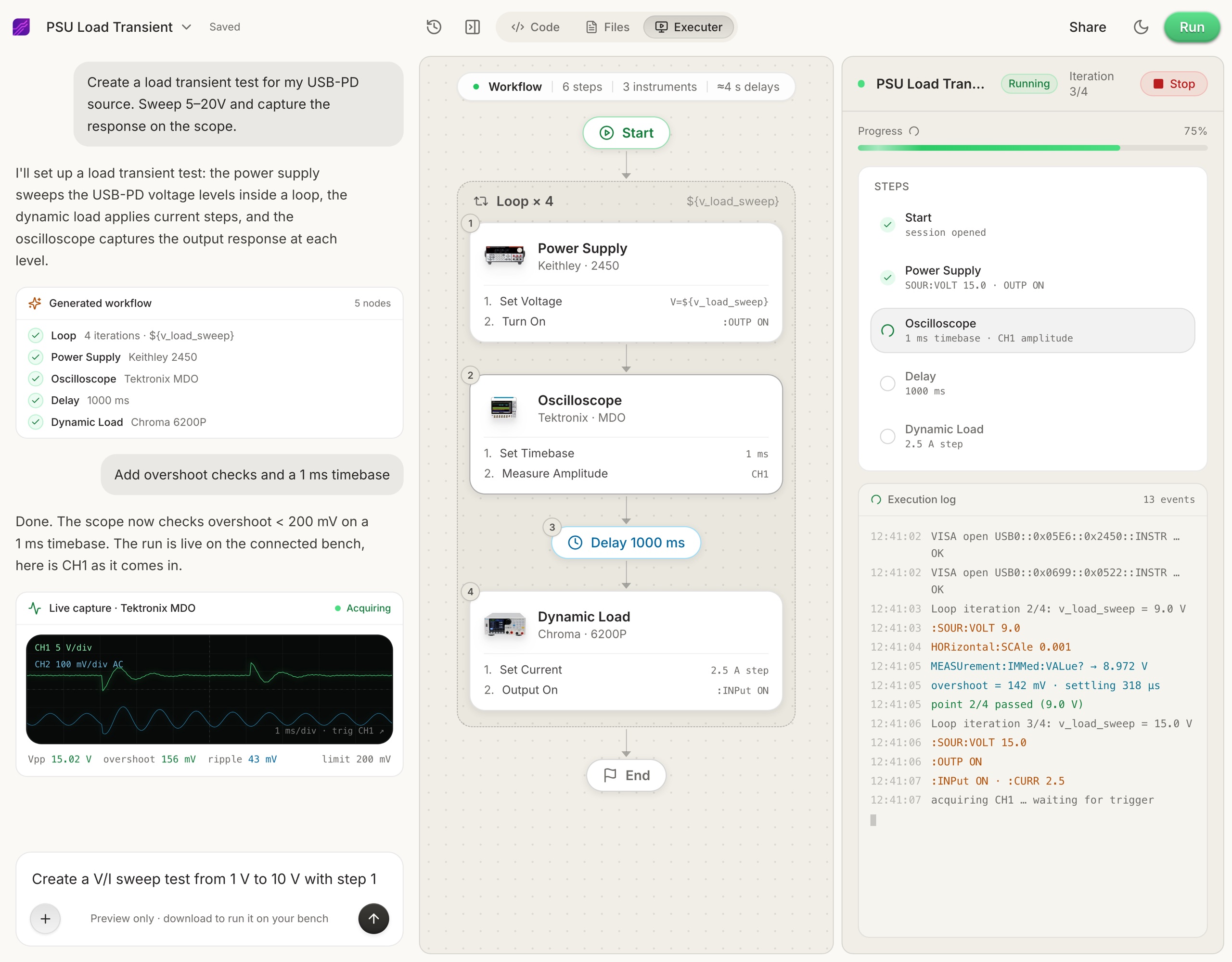
Connect your instruments. Pick the manufacturer and model, paste the VISA address (USB, LAN, GPIB, or serial), and the agent knows what is on your bench. No bench yet? Use a placeholder address, build the full automation, and swap in the real address when you are in the lab.
- 2
Tell the agent what to test, in plain English. For example, "run a VI sweep from 1 to 10 V in 1 V steps at 0.5 A load current," or "suggest the tests for a power-management device."
- 3
The agent builds the complete workflow in seconds. Instrument-aware automation appears on the canvas, with the generated scripts visible in a code panel you can inspect and edit.
- 4
Run it in your lab. Click Run and the status panel streams results step by step, with measured values inline (VOUT = 3.301 V, asserted 3.2 to 3.4 V, PASS). One click exports a structured PDF report, or the raw results as CSV.
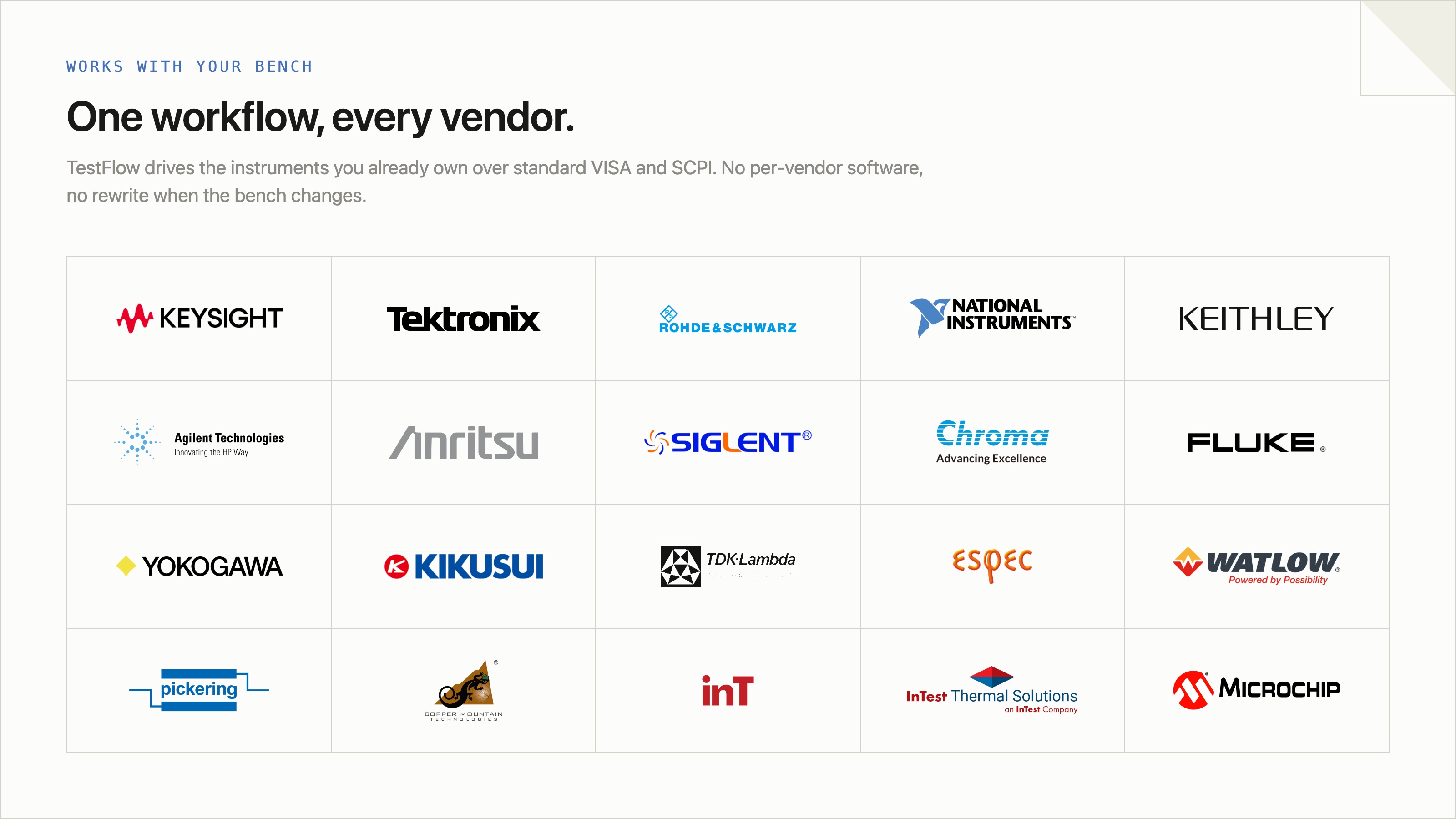
- Vendor-neutral by design. One workflow drives Keysight, Tektronix, Rohde & Schwarz, NI, Rigol, Keithley, Anritsu, and more over standard VISA and SCPI.
- Browser-based and shareable. Workflows live in your workspace, so a sequence built in one lab runs the same way in another.
- Free version to start. Sign in at app.testflowinc.com and build your first workflow today; plans and quotes are on the pricing page.
The step-by-step walkthrough, VISA address formats, and Test Planner prompts are all in the TestFlow product guide.
Frequently asked questions
Is OpenTAP free?
Yes. OpenTAP is open source under an OSI-approved licence with no licence fee and no deployment licences. Keysight originally developed it and continues to contribute, and it also underpins the commercial PathWave Test Automation product.
Can OpenTAP replace NI TestStand?
For the sequencing engine, yes for most workloads. The gaps are the operator interface maturity, the built-in step type library, and multi-UUT parallel models, where TestStand is ahead.
What language are OpenTAP plugins written in?
C# and .NET. This is the main practical barrier for teams whose engineers work in Python or LabVIEW, since every custom instrument or step type is a C# class.
Does OpenTAP have deployment licences?
No. You can run it on as many stations as you like at no cost. This is the single largest financial difference from TestStand, where every test station requires a paid deployment licence.
Is OpenTAP production ready?
Yes. It is used in production test at scale, and Keysight sells a commercial product built on the same engine. The open-source status is not a maturity indicator here.
How hard is it to migrate from TestStand to OpenTAP?
The sequences do not convert automatically. Expect to rewrite step types in C# and rebuild sequences. Effort scales with custom step count, not with sequence count, since sequences themselves are quick to rebuild once the steps exist.
Ready to automate your lab?
Connect your instruments, describe a test in plain English, and TestFlow builds and runs it in minutes.
Tags
Put it on your bench this week
A new way for testing, from specs to automated sequences, capture clean data, and accelerate your validation cycle.