 Ali Kamaly
MATLAB vs LabVIEW for Test Automation in 2026 (Which to Use When)
Where MATLAB genuinely beats LabVIEW, where it does not, what both cost, and the split that works for teams who already own licences for each.
MATLAB is an analysis environment that can control instruments. LabVIEW is an instrument control environment that can analyse. That sentence resolves most of this comparison, and the teams that get the best value from either are the ones that respect it rather than trying to make one tool do everything.
This post covers where each genuinely wins, what a realistic configuration costs, and the split that works when you own both.
Where MATLAB wins
Signal processing and maths. This is not close. Filter design, spectral analysis, curve fitting, statistics, control system design, and optimisation are all deeper, better documented, and better validated in MATLAB. If your validation involves any of these, MATLAB's toolboxes save weeks.
Algorithm development. Prototyping a measurement algorithm in MATLAB is faster than in LabVIEW, and the code is reviewable text. The path from a paper to working code is short.
Data handling at scale. Loading, reshaping, and analysing large result sets is natural. LabVIEW can do it and it is not what LabVIEW is for.
Reporting. MATLAB Report Generator produces genuinely good formatted documents from live analysis, comparable to what DIAdem does in the NI stack.
Text-based source. Diffs work. Code review works. Version control works properly rather than as a file-locking exercise.
Where LabVIEW wins
Instrument sequencing and driver ecosystem. The NI instrument driver network is the largest collection of ready-made instrument drivers anywhere. MATLAB's Instrument Control Toolbox supports VISA and IVI, and the ready-made coverage is thinner.
Operator interfaces. LabVIEW front panels are quick to build and look like instrument panels because that is what they were designed for. Building the equivalent in MATLAB App Designer is possible and slower.
Real-time and FPGA. LabVIEW Real-Time and LabVIEW FPGA have no MATLAB equivalent for this purpose. Simulink Coder generates code for targets, which is a different workflow aimed at control systems rather than test.
Parallel hardware I/O. Running several acquisition loops at different rates against different hardware is idiomatic in LabVIEW. In MATLAB it is work.
DAQ hardware integration. NI DAQ hardware is native in LabVIEW. MATLAB's Data Acquisition Toolbox supports it and is another licence.
Cost
Both are toolbox-driven, which makes headline prices misleading. A realistic comparison for a test automation seat:
| MATLAB configuration | LabVIEW configuration |
|---|---|
| MATLAB base | LabVIEW Full or Professional |
| Instrument Control Toolbox | Included |
| Data Acquisition Toolbox | Included (DAQmx) |
| Signal Processing Toolbox | Advanced analysis in Full and above |
| Report Generator | Report Generation Toolkit |
Both land in a similar range once configured for the same job, in the low-to-mid four figures per seat per year. Neither is meaningfully cheaper than the other, and both are considerably more expensive than the free option. See LabVIEW pricing and NI software licensing costs.
The practical difference: MATLAB licences are frequently already present in engineering organisations for other reasons, which changes the marginal cost to near zero. LabVIEW licences rarely are, outside test departments.
Instrument control side by side
The same measurement in each.
MATLAB:
dmm = visadev("USB0::0x2A8D::0x1301::MY57200001::INSTR");
dmm.Timeout = 10;

writeline(dmm, "*RST");
writeline(dmm, "CONF:VOLT:DC 10,0.00001");
writeline(dmm, "VOLT:DC:NPLC 10");

readings = zeros(1, 100);
for k = 1:100
    readings(k) = str2double(writeread(dmm, "READ?"));
end

fprintf("mean %.6f V, std %.6f V\n", mean(readings), std(readings));
[pxx, f] = pwelch(readings, [], [], [], 1);   % this is the MATLAB advantage
clear dmm
LabVIEW does the same with VISA Write and VISA Read VIs wired into a loop, which is more clicks and equally functional. The difference appears on the line after: pwelch is one call in MATLAB, and in LabVIEW it needs the advanced analysis library and more wiring.
That asymmetry is the whole comparison in miniature. Both control the instrument. One of them then analyses the result properly.
Comparison table
| MATLAB | LabVIEW | |
|---|---|---|
| Instrument control | Toolbox, VISA and IVI | Native, largest driver library |
| Ready-made drivers | Moderate | Extensive |
| Signal processing | Excellent | Good with Full and above |
| Statistics and fitting | Excellent | Basic |
| Operator UI | App Designer, slower | Front panels, fast |
| Real-time targets | Via Simulink Coder | Native |
| FPGA | Via HDL Coder | Native |
| Version control | Excellent, text | Poor, binary VIs |
| Hiring pool | Large, academic and industry | Shrinking |
| Reporting | Report Generator | Report Generation Toolkit |
| CI integration | Good | Awkward |
| Cost | Four figures per seat per year | Four figures per seat per year |
The split that works
For teams that own both, and many do, the division that produces the least friction:
- •LabVIEW or Python for acquisition and sequencing. Whatever drives the instruments, sequences the test, and writes raw data to disk.
- •MATLAB for analysis and reporting. Reads the raw data, applies the algorithms, produces the document.
- •A file format between them. CSV for simple results, TDMS or HDF5 for large or structured data. MATLAB reads TDMS through the Data Acquisition Toolbox, and
npTDMSreads it in Python.
The key property is that the handoff is a file, not a live link. Teams that try to call MATLAB from LabVIEW at runtime, or drive instruments directly from MATLAB inside a production sequence, end up with a system where a licence checkout failure stops a test. A file boundary means each side can be replaced independently, and it usually is, eventually.
Should you use either?
Worth asking honestly, because Python has changed the calculus.
Use MATLAB when the analysis is the hard part. Signal processing, control design, or algorithm validation where the toolboxes represent real, validated engineering you would otherwise reimplement. Also use it when licences already exist in the organisation.
Use LabVIEW when you need FPGA, real-time targets, or a production operator interface, or when you have a large existing LabVIEW codebase that works.
Use Python when neither of the above applies, which for bench validation is often. It is free, the hiring pool is far larger, scipy.signal covers most of what teams actually use from the Signal Processing Toolbox, and it runs in CI. See LabVIEW vs Python and migrating from LabVIEW to Python.
The strongest case for MATLAB is a specific toolbox doing specific validated work. The weakest is "we need to analyse some data", which Python does for free.
Calling one from the other
Teams that own both usually end up connecting them, and there are three ways with quite different failure modes.
MATLAB from LabVIEW, via the MATLAB script node or ActiveX. Convenient and it creates a runtime dependency: a MATLAB licence must be available whenever the test runs. On a production station this means a licence checkout failure stops testing.
LabVIEW from MATLAB, by building the VI into a DLL and calling it with loadlibrary. More robust, since the DLL has no licence requirement at runtime.
Neither, with a file boundary. LabVIEW writes TDMS or CSV, MATLAB reads it. No runtime coupling, no licence dependency, each side replaceable independently.
The third is almost always right. The first two create a system where two expensive licences must both be available for a test to run, and where debugging crosses a language boundary. The file boundary costs a few seconds of disk I/O and removes an entire category of production incident.
% MATLAB reading what the acquisition side wrote
data = tdmsread("soak_2026_08_14.tdms");
measurements = data{1};

[pxx, f] = pwelch(measurements.VOUT, [], [], [], measurements.Properties.SampleRate);
ripple_rms = rms(measurements.VOUT - mean(measurements.VOUT));

fprintf("ripple %.3f mVrms, peak spectral component at %.1f Hz\n", ...
        ripple_rms * 1000, f(pxx == max(pxx)));
What a MATLAB licence audit usually finds
Before deciding MATLAB is the answer or the problem, check what you are actually paying for. The pattern is consistent.
- •Toolboxes nobody uses. Bought for a project that ended. MATLAB reports usage, and procurement rarely asks.
- •Seats held by people who left. Network licences make this invisible until someone counts.
- •Base MATLAB used as a calculator. Genuine use, and not worth a seat if Python would do.
- •One toolbox doing the real work. Often Signal Processing or Control System, used by two people, entirely justifying itself.
That last group is the honest case for MATLAB and it is usually smaller than the licence count. The rest is either replaceable with numpy and scipy at no cost, or not used at all.
Run the same audit on the LabVIEW side, described in NI software licensing costs. The two audits together typically find more saving than any tool migration, and they require no technical change whatsoever.
The instrument-control gap, stated plainly
Both tools can drive instruments and neither is primarily an instrument-control tool. Knowing exactly where each one stops saves a wasted evaluation.
| Capability | MATLAB | LabVIEW |
|---|---|---|
| VISA session to a SCPI instrument | Instrument Control Toolbox, extra licence | Built in with NI-VISA |
| Vendor instrument drivers | Some, via IVI and vendor packages | Extensive, the deepest catalogue |
| NI DAQ hardware | Via Data Acquisition Toolbox, extra licence | Native, and excellent |
| Real-time deployment | Simulink Real-Time, separate product | LabVIEW Real-Time, separate module |
| Sequencing with limits and pass/fail | You build it | TestStand, separate product |
| Report generation | Report Generator, extra licence | You build it, or DIAdem |
The pattern in both columns is the same and it is the point: the base product is not the bill. MATLAB's toolboxes and LabVIEW's modules are separately licensed, and a realistic test station needs three or four of them. Price the configuration, never the base seat. The same arithmetic on the NI side is in NI software licensing costs and LabVIEW pricing.
When the answer is neither
Worth stating, because the head-to-head framing hides the most common good outcome.
Choose MATLAB when the hard part is the maths: model fitting, frequency-domain analysis, control design, or anything where the algorithm is the deliverable and the instruments are incidental.
Choose LabVIEW when the hard part is the hardware: NI DAQ channel counts, FPGA, real-time targets, or an existing estate of VIs that works.
Choose neither when the hard part is neither of those, which is most bench validation. Setting a supply, waiting, reading a meter, applying limits, and writing a report is not a maths problem and not a hardware-integration problem. It is a scripting problem, and it is served by pyVISA at zero licence cost, or by a tool that generates the sequence. See LabVIEW vs Python for that comparison directly.
The test: if you cannot name a specific MATLAB toolbox function or a specific LabVIEW hardware capability that your test requires, you are choosing between two expensive general-purpose environments for a job that needs neither.
Common mistakes
- •Comparing base licence prices. Both are toolbox and module businesses. Compare the configuration you would actually buy.
- •Assuming MATLAB code ports to Simulink for free. They are different execution models and the real-time path has its own constraints.
- •Choosing LabVIEW because "the drivers exist". The drivers are free, the seat is not, and most SCPI instruments need no driver at all.
- •Choosing MATLAB for instrument control alone. The Instrument Control Toolbox is a licence to do what pyVISA does free.
- •Running both and calling it a strategy. The split described above works when it is deliberate. When it happens by accident you get two half-maintained stacks and a data-handoff problem.
- •Ignoring who maintains it. Both produce artefacts that are hard for an outsider to pick up: binary VIs on one side, undocumented scripts on the other.
- •Forgetting the report. Neither produces a customer-ready document without additional licensed tooling. See automated test report generation.
Related reading
- •LabVIEW vs Python
- •LabVIEW alternatives
- •How to migrate from LabVIEW to Python
- •NI DIAdem alternatives, the analysis layer in the NI stack
- •Best test automation software
- •LabVIEW pricing, the seat and module maths
- •NI software licensing costs, the full stack
- •pyVISA tutorial, the zero-licence third option
- •Instrument control with VISA and SCPI, what both sit on
- •Automated test report generation, the output stage
- •Test sequencer comparison, the sequencing layer neither includes
- •Free instrument control software, the zero-cost stack
- •HIL testing software compared, if real-time is the requirement
- •Python instrument control libraries compared, if neither is the answer
- •NI TestStand alternatives, the sequencer neither product includes
Where TestFlow fits
The division of labour that works is analysis in the tool that is good at analysis, and instrument sequencing in something that does not charge per seat for it.
- 1
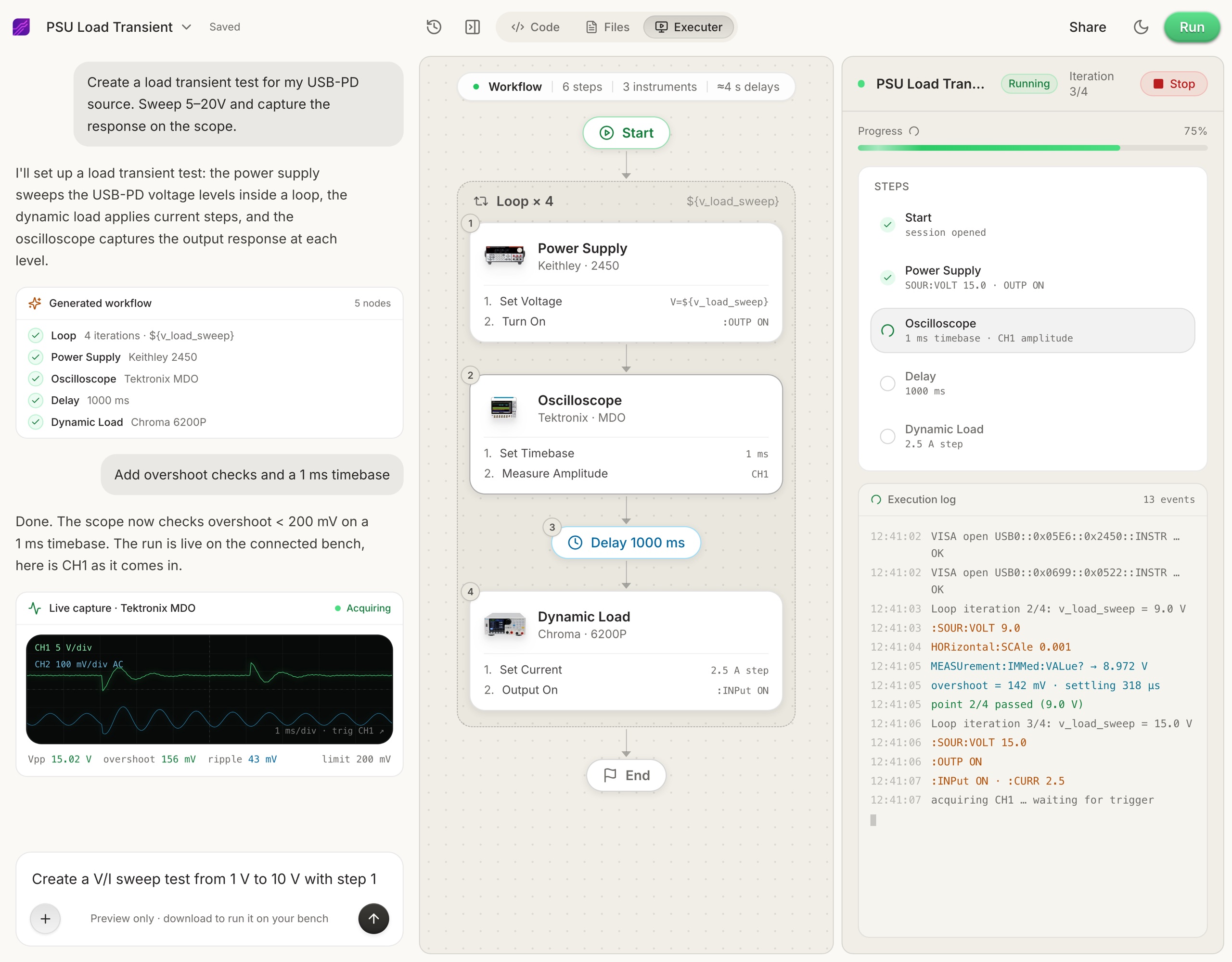
Connect your instruments. Pick the manufacturer and model, paste the VISA address (USB, LAN, GPIB, or serial), and the agent knows what is on your bench. No bench yet? Use a placeholder address, build the full automation, and swap in the real address when you are in the lab.
- 2
Tell the agent what to test, in plain English. For example, "run a VI sweep from 1 to 10 V in 1 V steps at 0.5 A load current," or "suggest the tests for a power-management device."
- 3
The agent builds the complete workflow in seconds. Instrument-aware automation appears on the canvas, with the generated scripts visible in a code panel you can inspect and edit.
- 4
Run it in your lab. Click Run and the status panel streams results step by step, with measured values inline (VOUT = 3.301 V, asserted 3.2 to 3.4 V, PASS). One click exports a structured PDF report, or the raw results as CSV.
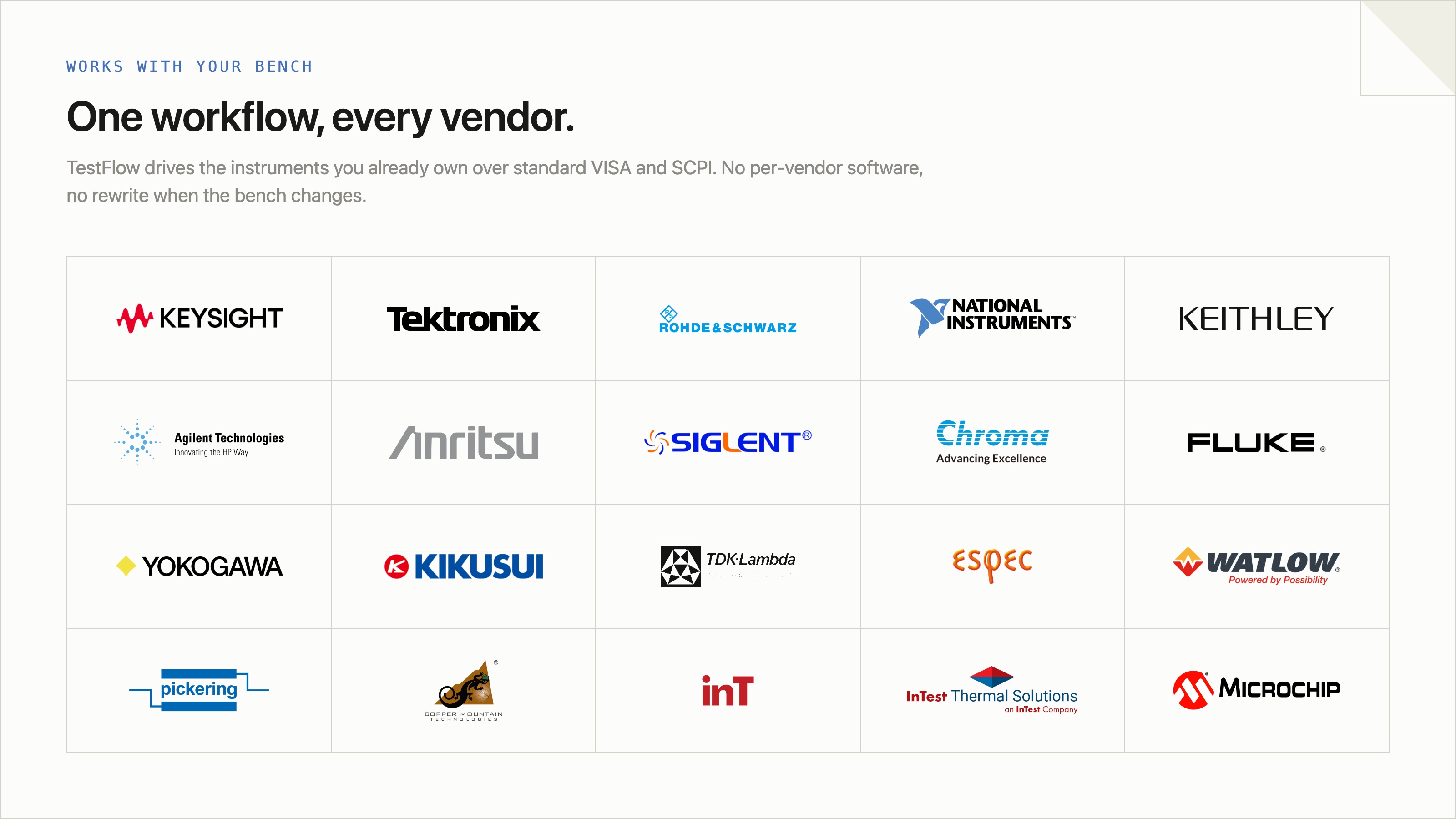
- Vendor-neutral by design. One workflow drives Keysight, Tektronix, Rohde & Schwarz, NI, Rigol, Keithley, Anritsu, and more over standard VISA and SCPI.
- Browser-based and shareable. Workflows live in your workspace, so a sequence built in one lab runs the same way in another.
- Free version to start. Sign in at app.testflowinc.com and build your first workflow today; plans and quotes are on the pricing page.
The step-by-step walkthrough, VISA address formats, and Test Planner prompts are all in the TestFlow product guide.
Frequently asked questions
Is MATLAB better than LabVIEW for test automation?
MATLAB is better for analysis, signal processing, and algorithm development. LabVIEW is better for instrument sequencing, operator interfaces, and real-time or FPGA targets. Many teams use both, splitting on that line.
Can MATLAB control lab instruments?
Yes, through the Instrument Control Toolbox, which provides VISA support for USB, LAN, GPIB, and serial, plus IVI driver support. It is a separately licensed toolbox on top of base MATLAB.
Which costs more, MATLAB or LabVIEW?
They are comparable and both are toolbox-driven, so the base price is misleading. A realistic MATLAB configuration with Instrument Control, Data Acquisition, and Signal Processing toolboxes lands in a similar range to LabVIEW Professional.
Can MATLAB replace LabVIEW entirely?
For bench instrument control and analysis, largely yes. For FPGA targets, real-time deterministic execution, and operator interfaces on a production floor, no. Those remain LabVIEW strengths.
Is Python better than both for test automation?
For instrument control and sequencing it is free, has a larger hiring pool, and integrates with CI. For deep signal processing MATLAB's toolboxes are still ahead, and for FPGA neither Python nor MATLAB replaces LabVIEW.
Do I need Simulink for test automation?
Not for bench test. Simulink matters when you are simulating a plant model, typically for HIL testing, where models are compiled to a real-time target.
Ready to automate your lab?
Connect your instruments, describe a test in plain English, and TestFlow builds and runs it in minutes.
Tags
Put it on your bench this week
A new way for testing, from specs to automated sequences, capture clean data, and accelerate your validation cycle.