TofuPilot vs TestStand in 2026: Python Platform vs NI Executive
TofuPilot pairs an MIT-licensed Python test framework with a hosted platform for yield, traceability, and station deployment. NI TestStand is a Windows test executive that sequences code in any language. What each one does, what each costs, and why many teams will run both. Every TofuPilot fact is from tofupilot.com and its docs, checked November 25, 2026.
TofuPilot and NI TestStand solve overlapping but different problems: TofuPilot is a hardware test platform that pairs an MIT-licensed Python framework with a hosted dashboard for yield, unit traceability, operator UIs, and Git-based deployment to stations, while TestStand is NI's Windows test executive, which sequences code modules in LabVIEW, C#, Python, or C and logs results to a database you run. TofuPilot is priced per seat and per station per month, with a free Lab plan and Pro at $50 a month for each. TestStand is priced per development seat at $2,428 a year on ni.com, plus a one-time license per deployed station. Because TofuPilot imports TestStand's native XML reports, the two are often complements rather than replacements.
This comparison is for test engineers and managers on a production line who are weighing a Python-first platform against the NI incumbent. Every TofuPilot fact below comes from tofupilot.com and its documentation, checked November 25, 2026, and every TestStand fact from ni.com. Where TofuPilot's docs are silent, this article says so rather than guessing. For the full TestStand field, see NI TestStand alternatives.
TofuPilot vs TestStand at a glance
| TofuPilot | NI TestStand | |
|---|---|---|
| What it is | Python test framework plus hosted test data platform | Test executive and sequencer |
| Test logic written in | Python phases, YAML procedure | Code modules in LabVIEW, C#, Python, C/C++, LabWindows/CVI |
| Execution engine | Rust engine, phases and slots in parallel | TestStand Engine, Sequential, Parallel, and Batch process models |
| Other runners supported | OpenHTF, pytest, Robot Framework | Any language through module adapters |
| Runs on | CLI for macOS, Linux, and Windows | Windows |
| Operator UI | Remote web UI and local kiosk UI | Example operator interfaces you customize |
| Users | Five built-in roles, Owner to Operator; SSO and SCIM on Enterprise | Operator, Technician, Developer, Administrator groups |
| Results store | Hosted dashboard; self-hosted on Enterprise | Your DBMS: SQL Server, Oracle, Access, Sybase, MySQL |
| Analytics | Yield, drift, unit traceability, alerts | Not included; reports and database rows |
| Deployment | Git push builds and deploys to stations | Installers built from the Development System |
| Open source | Framework and client SDKs MIT | No |
| Price | Lab free; Pro $50/month per paid seat and per station | $2,428/yr per seat; $857 or $3,252 per station once |
What TofuPilot is
TofuPilot's documentation calls it a platform for building, deploying, and scaling hardware tests from the lab to mass production. It has three parts.
The framework
The TofuPilot framework is open source under MIT. A central .yaml procedure file declares phases and plugs, each phase is a plain Python function, plugs are Python classes that connect instruments such as a power supply, and measurements carry validators such as >= and <= limits. A Rust engine runs phases and units in parallel to cut cycle time. The framework repository tagged v2.0.0 on October 27, 2026.
You can run a procedure locally with no account:
tofupilot init battery-test        # scaffold a procedure, phases, and a simulated plug
tofupilot run ./battery-test       # run it locally
tofupilot run ./battery-test --upload    # after tofupilot login and link, sync results
The platform
Runs sync to a dashboard for yield, drift, and unit traceability. Operators run tests from a remote web UI streamed to any browser or from a local kiosk UI built for touch screens at the bench. Station runs queue offline until the network returns. A connected Git repository can trigger a build and deploy on each push, with immutable builds per deployment and environments that auto-deploy by branch.
The SDKs and runners
The API and SDK docs list clients for Python, C#, Rust, C++, and MATLAB. The Python client, tofupilot 2.32.0, was published to PyPI on November 24, 2026 under MIT. The pricing page lists four supported test runners on every plan: TofuPilot's own framework, OpenHTF, pytest, and Robot Framework.
What TestStand is
TestStand does not measure anything by itself. It calls code modules through adapters, applies limits to what they return, and records the result. NI's module adapters page lists LabVIEW, LabWindows/CVI, C/C++ DLL, .NET, ActiveX/COM, HTBasic, Python, and Sequence adapters. Its process models run one UUT at a time (Sequential) or several at once (Parallel and Batch). Its User Manager ships four groups, and NI states plainly that it is not a security system. Its database logging supports SQL Server, Oracle, Microsoft Access, Sybase, and MySQL, with predefined schemas for each. The TestStand hub and the sequence file format guide cover the rest.
Pricing: TofuPilot plans vs TestStand licenses
TofuPilot prices from its pricing page, November 25, 2026:
| Plan | Price | Includes |
|---|---|---|
| Lab | Free | 1 paid seat, 1 station, 100 runs a month, 1 GB attachments; operators and viewers free and unlimited |
| Pro | $50 a month per paid seat and per station | 1,000 runs a month included, then $0.01 per run; only owners, admins, and developers billed |
| Enterprise | Custom | Self-hosting, dedicated cloud, SSO and SCIM, named contact and SLA |
TestStand prices are US list on ni.com as of November 2026, covered in full in TestStand pricing:
| License | Price |
|---|---|
| TestStand Development System | $2,428 a year, or $8,497 perpetual |
| Base Deployment Engine | $857 per station, one-time |
| Debug Deployment Environment | $3,252 per station, one-time |
Worked example: two developers, six stations, one year
| TofuPilot Pro | TestStand | |
|---|---|---|
| Developer seats | 2 × $50 × 12 = $1,200 | 2 × $2,428 = $4,856 |
| Stations | 6 × $50 × 12 = $3,600 | 6 × $857 = $5,142, once |
| Year one | $4,800 plus run overage | $9,998 |
| Year two onward | $4,800 a year plus run overage | $4,856 a year |
Two caveats keep this honest. First, TofuPilot's run overage depends on volume: at 10,000 runs a month, Pro's $0.01 rate on the 9,000 runs above the included 1,000 adds $90 a month. Second, the two columns do not buy the same thing. TofuPilot includes the hosted results platform; TestStand includes the executive but not the database server, the analytics, or the code-module language, which for LabVIEW teams adds seats described in LabVIEW pricing.
Data, traceability, and the TestStand import
This is where the comparison turns into a pairing. TofuPilot's import documentation lists structured formats it detects automatically: ATDF, ATML (IEEE ATML 2.02, 5.00, and 6.01), NI TestStand native XML, OpenHTF, STDF, WATS WSXF, and WSJF, plus CSV and Excel with a saved column mapping.
For TestStand native XML, TofuPilot documents this mapping:
| TestStand report | TofuPilot |
|---|---|
UUTResult | Run outcome |
UUT SerialNumber | Unit serial number |
PartNumber, BatchSerialNumber | Part and batch |
SequenceCall entries in ResultList | Phases |
| Numeric and pass-fail limit steps | Measurements with limits |
StationInfo > LoginName | Run operator |
The file must validate against the TestStand report schema, re-importing an identical file returns the existing run, and the API accepts up to 100 files per call. TofuPilot's docs also note that TestStand 2012 and later generate ATML reports by default, which TofuPilot imports through its ATML path.
The practical consequence: a TestStand line can keep its sequences and add cross-station yield and traceability without changing a step. TofuPilot's incremental migration guide describes exactly that order: start with file imports for legacy runs, move to SDK uploads from the legacy runner, then migrate procedures onto a supported framework.
Operator interface and user management
TestStand gives you example operator interfaces, which teams typically customize in LabVIEW or C#, and a User Manager with privilege groups. Operators can execute, terminate, and abort, but not edit or debug.
TofuPilot gives you the remote web UI and the local kiosk UI without frontend work, with per-phase operator input components declared in the framework. Its access docs describe five built-in roles from Owner down to Operator. The docs pages checked for this article name only Owner and Operator explicitly, so verify the middle roles before you design a privilege model around them. SSO and SCIM are Enterprise-only; passkeys are on every plan.
Neither tool replaces operating-system security on the station.
Five questions to settle before you switch
These decide the outcome more often than any feature row.
- 1
Where must the data live? TestStand writes to a database you own. TofuPilot's Lab and Pro plans store runs on its hosted platform, and self-hosting, which bundles PostgreSQL with Docker Compose or runs on Kubernetes, requires an Enterprise license key from TofuPilot sales. If a customer contract or export rule says results stay on-premises, price Enterprise before you compare anything else.
- 2
What does a station cost over its life? A TofuPilot Pro station is $50 a month, or $600 a year. A TestStand Base Deployment Engine is $857 once, so at list prices the subscription passes the one-time license after about 17 months. A line that runs the same station for five years pays $3,000 per station on Pro against $857 on TestStand, before seats, overage, or service renewals.
- 3
What language are your code modules in? Python code moves to TofuPilot phases directly. LabVIEW VIs do not, and rewriting a qualified VI library is often the largest single cost in a move off TestStand. LabVIEW to Python migration covers how to inventory one.
- 4
Who changes the test? In TofuPilot, a procedure change is a Git commit that deploys on push. In TestStand, it is a sequence edit by someone with a development seat. Pick the change process your quality system already accepts.
- 5
What happens if you leave? The TofuPilot framework is MIT and runs locally with
tofupilot runand no account, so procedures survive a cancelled subscription. Ask how run history is exported before you sign, because the pages checked for this article do not cover it. TestStand sequences keep running on perpetual deployment licenses, and the.seqfiles stay readable by any licensed seat.
When to pick TofuPilot, TestStand, or both
| Situation | Pick |
|---|---|
| Python team, new line, no NI licenses yet | TofuPilot |
| Existing LabVIEW or LabWindows/CVI code modules | TestStand |
| Several UUTs per fixture with batch synchronization | TestStand, or TofuPilot's parallel slots after a trial |
| Results must live in your own SQL Server or Oracle | TestStand, or TofuPilot Enterprise self-hosted |
| Yield and traceability across many stations and sites | TofuPilot |
| TestStand line that needs analytics without a rewrite | Both, through TestStand XML import |
| Stations must run without internet | TestStand, or TofuPilot with offline queueing |
If you are leaving NI altogether, also look at OpenTAP vs TestStand and the test sequencer comparison, and at Python hardware test frameworks for the open-source runners TofuPilot supports.
Where TestFlow fits next to TofuPilot and TestStand
TofuPilot and TestStand both run and record tests that someone already wrote. TestFlow is an AI agent for electronics testing: you describe the test, the agent builds the automation, drives the instruments over VISA and SCPI from any vendor, and writes the report from the measured results.
- •Authoring, not analytics. TestFlow does not compete with TofuPilot's yield dashboards. It writes the procedure.
- •TestStand import. TestFlow imports NI TestStand sequences with the sequences and calls preserved, which is useful when a validation bench needs to rerun part of a production sequence. It does not run LabVIEW VIs.
- •Python you keep. A workflow exports as a standalone Python package, ready to wrap as a phase in whatever framework your line uses.
The limits, plainly: TestFlow is not a full test executive, with no operator and user management and no database connectivity. Bench runs need the Windows desktop app. DAQ coverage is narrow: the NI USB-6001, USB-6501, and PCI-6515 through NI-DAQmx. The boundary with TestStand is drawn in TestFlow vs TestStand, the catalog is on the supported instruments page, and there is a free version to start on the pricing page.
Related reading
- •TestStand pricing, every license and a five-year example
- •NI software licensing costs, the rest of the NI bill
- •Automated test report generation, the fields a result row needs
- •NI software alternatives hub, the whole NI catalog
- •Compare test automation tools, every head-to-head on this site
Where TestFlow fits
TestFlow sits before both tools in this comparison. It builds and runs the bench test from a description, and its exported Python can feed the same data platform or executive you already use.
- 1
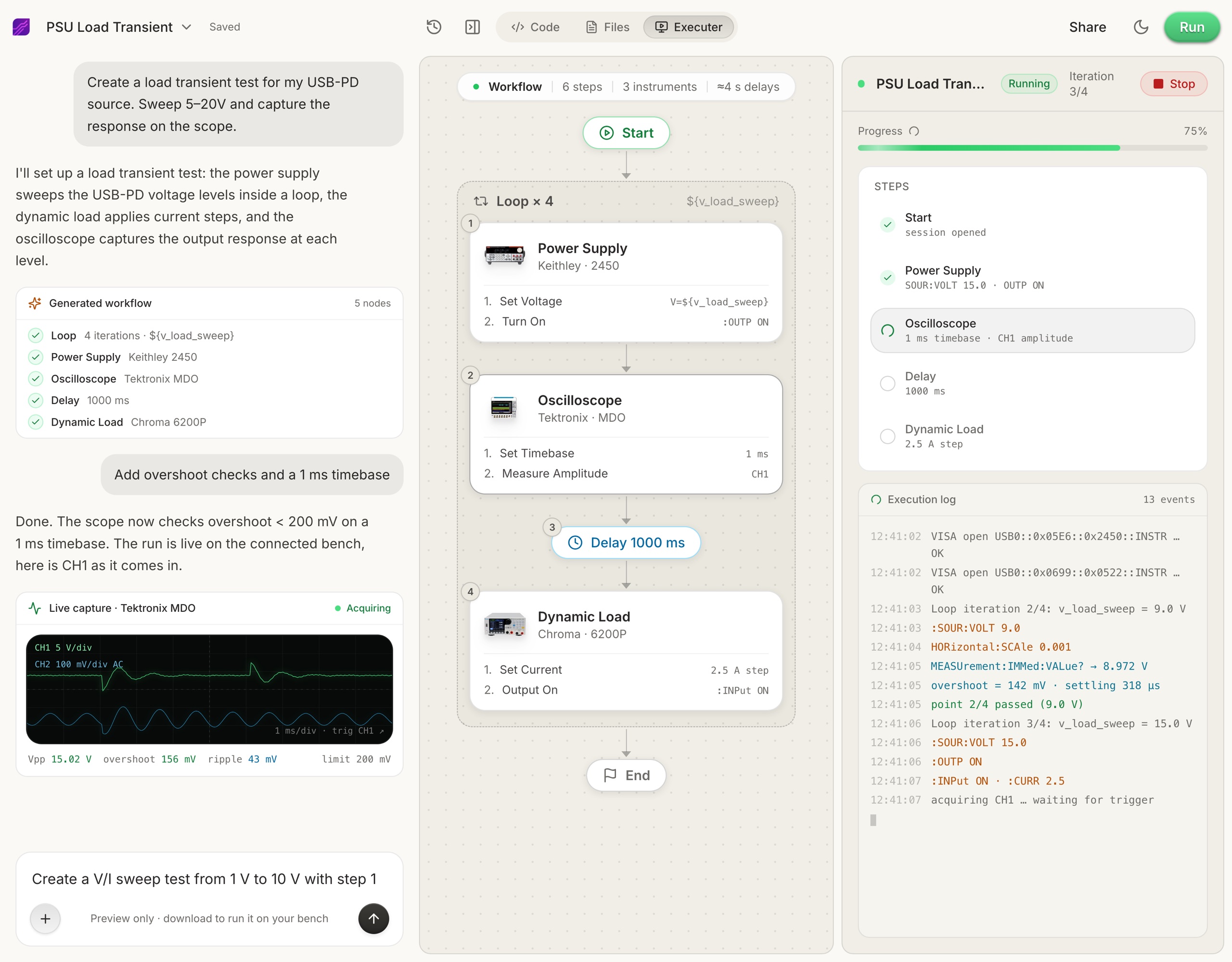
Connect your instruments. Pick the manufacturer and model, paste the VISA address (USB, LAN, GPIB, or serial), and the agent knows what is on your bench. No bench yet? Use a placeholder address, build the full automation, and swap in the real address when you are in the lab.
- 2
Tell the agent what to test. For example, "run a VI sweep from 1 to 10 V in 1 V steps at 0.5 A load current," or "suggest the tests for a power-management device."
- 3
The agent builds the complete workflow in seconds. Instrument-aware automation appears on the canvas, with the generated scripts visible in a code panel you can inspect and edit.
- 4
Run it in your lab. Click Run in the TestFlow desktop app for Windows and the status panel streams results step by step, with measured values inline (VOUT = 3.301 V, asserted 3.2 to 3.4 V, PASS). One click exports a structured PDF report, or the raw results as CSV.
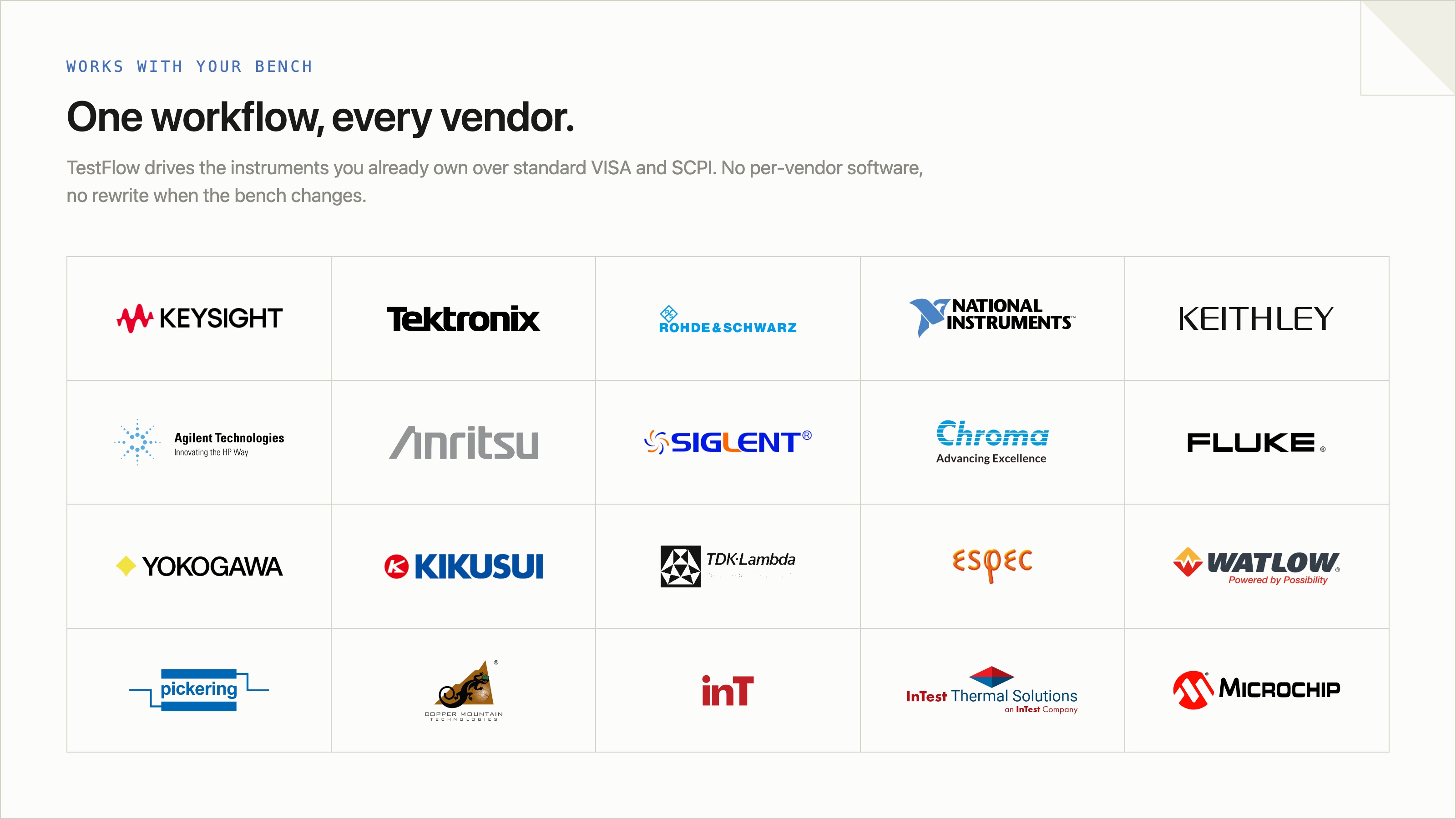
- Vendor-neutral by design. One workflow drives Keysight, Tektronix, Rohde & Schwarz, Rigol, Keithley, Anritsu, and any other SCPI instrument over standard VISA.
- Built in the browser, run on the bench. Workflows live in your workspace, so a sequence built in one lab runs the same way in another. Bench runs use the Windows desktop app.
- Free version to start. Sign in at app.testflowinc.com and build your first workflow today; teams can book a demo to scope a Bench Pilot.
The step-by-step walkthrough, VISA address formats, and Test Planner prompts are all in the TestFlow product guide.
Frequently asked questions
What is the difference between TofuPilot and TestStand?
TofuPilot is a hardware test platform: an MIT-licensed Python framework with a Rust execution engine and YAML procedures, plus a hosted dashboard for yield, unit traceability, operator UIs, and Git-based deployment to stations. NI TestStand is a Windows test executive that sequences code modules written in LabVIEW, C#, Python, or C, with process models for testing several units, a User Manager, and database logging to your own DBMS.
How much does TofuPilot cost compared with TestStand?
TofuPilot's Lab plan is free with one paid seat, one station, and 100 runs a month. Pro is $50 a month per paid seat and per station, with 1,000 runs included and $0.01 per run after that. TestStand lists at $2,428 a year per development seat on ni.com, plus a one-time $857 Base or $3,252 Debug deployment license per station, US list as of November 2026.
Can TofuPilot import NI TestStand results?
Yes. TofuPilot's import documentation lists NI TestStand native XML reports and ATML as structured formats. For TestStand XML it maps UUTResult to the run outcome, the UUT SerialNumber to the unit, SequenceCall entries to phases, numeric and pass-fail limit steps to measurements with limits, and the station LoginName to the operator.
Is TofuPilot free and open source?
The TofuPilot framework and its Python client are MIT licensed, and the framework runs locally with tofupilot run without an account. The hosted platform is commercial, with a free Lab plan. Self-hosting the dashboard requires a license key from TofuPilot sales and is listed only on the Enterprise plan.
Does TofuPilot have user management like TestStand?
TofuPilot documents five built-in roles from Owner down to Operator, with SSO and SCIM on Enterprise and passkeys on every plan. Only owners, admins, and developers are billed on Pro. TestStand ships Operator, Technician, Developer, and Administrator groups, and NI states its User Manager is not a security system.
Where does TestFlow fit next to TofuPilot and TestStand?
TestFlow builds the test rather than running one you wrote. It turns a description into a workflow, drives SCPI instruments through a Windows desktop app, writes the report from measured results, imports TestStand sequences, and exports Python. It is not a full test executive, with no operator and user management or database connectivity.
Automate every instrument in the lab,
Create test workflows in minutes
- 01Describe the testIn a sentence, the way you would tell a colleague.
- 02The agent builds itWorkflow and script for your instruments, any vendor.
- 03Run it, get the reportOn your bench, with the measured values.
Tags

Article by
Ali Kamaly
Ali Kamaly is the Co-Founder and CEO of TestFlow, an AI-native platform for electronics test automation. He writes about test automation, lab validation, and the infrastructure behind modern hardware engineering.
- NI TestStand Pricing 2026: License Cost per Seat ($2,428/yr)Every NI TestStand license type with its US list price on ni.com as of November 2026, the subscription versus perpetual break-even, and a worked five-year cost for a six-station test fleet.
- LabWindows/CVI 2026: Maintenance Mode, Cost, 5 AlternativesLabWindows/CVI is in maintenance mode with a four-figure seat price. Here are the realistic replacements for ANSI C test applications, and how to migrate without rewriting a decade of code at once.
- OpenTAP vs NI TestStand in 2026 (Free Open Source vs the Incumbent)A direct comparison of the free open-source sequencer and the production incumbent, on cost, capability, and the migration effort in each direction.
- Test Sequencer Software 2026: TestStand vs OpenTAP vs pytestWhat a test sequencer actually does, the five real options in 2026, and the four questions that decide which one fits, including the results question most teams ask too late.
- NI TestStand Alternatives 2026: Free, Open-Source & AI OptionsThe best NI TestStand alternatives in 2026: OpenTAP, pytest, Robot Framework, and AI-native TestFlow. Plus what TestStand does, how it works with LabVIEW, and what it costs.
Your next test, automated today
Describe the test. TestFlow builds the workflow, runs it on your instruments, and writes the report. See it on a bench like yours.