 Ali Kamaly
What Is LabVIEW? A Plain-English Guide for Test Engineers
What is LabVIEW? A clear explanation of NI's graphical programming language, what it is used for, how it works, and its cost and alternatives.
What is LabVIEW? LabVIEW (Laboratory Virtual Instrument Engineering Workbench) is a graphical programming environment from National Instruments, now part of Emerson. Engineers use it to acquire data, control instruments, and automate tests, all by wiring together blocks instead of writing text code.
If you work in a lab and someone hands you a ".vi" file, that is LabVIEW. This guide explains what it is, what it is used for, and how it actually works.
A simple definition of LabVIEW
To define LabVIEW in one line: it is a visual programming language and IDE built for measurement, test, and control. Programs are called Virtual Instruments (VIs) because they often replace physical bench instruments with software front panels.
A VI has two parts:
- •The front panel: the user interface, with knobs, graphs, and readouts.
- •The block diagram: the logic, built by wiring nodes together in a dataflow graph. This is LabVIEW graphical programming, also called the G language.
How LabVIEW works: dataflow and G
LabVIEW uses dataflow. A node runs when all its inputs have data, then passes results down the wires. There are no lines of text; you connect functions visually. This makes parallel operations and hardware timing intuitive, which is why it took hold in test and measurement.
What is LabVIEW used for?
- •Data acquisition (DAQ): reading sensors and signals, often through NI hardware. (See what a DAQ is.)
- •Instrument control: driving oscilloscopes, power supplies, and DMMs over VISA, GPIB, and serial.
- •Automated test: running repeatable test sequences on production lines and in validation labs.
- •Control and monitoring: real-time and FPGA applications on CompactRIO hardware.
Strengths and weaknesses
Strengths
- •Fast to build a working measurement GUI.
- •Excellent NI hardware integration.
- •Good for parallel, timing-sensitive tasks.
Weaknesses
- •Steep learning curve for engineers used to text code.
- •Hard to version-control and code-review.
- •Tied to the NI/Emerson ecosystem and hardware.
- •Recurring subscription cost. (See LabVIEW pricing.)
LabVIEW editions and cost
LabVIEW comes in Community (free, non-commercial), Base, Full, and Professional editions on annual subscription. If you want to try it, read how to download LabVIEW.
LabVIEW alternatives
Because of cost and lock-in, many teams compare LabVIEW with Python and with modern, AI-native platforms. Python handles much of the instrument control for free, and AI-native tools like TestFlow generate validation plans and scripts from a plain-English request, without requiring NI hardware.
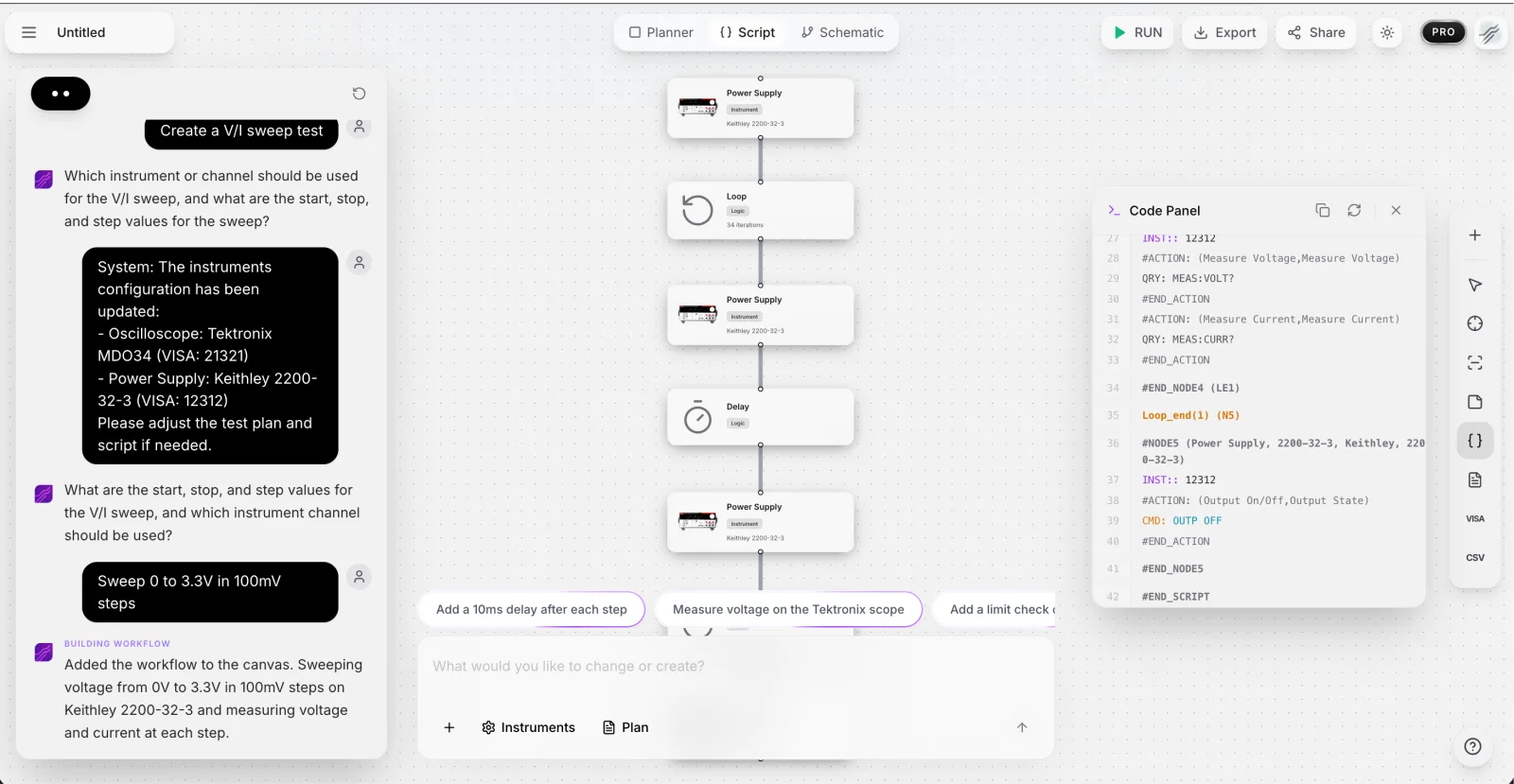
If you are deciding whether to invest time in G at all, our take on learning LabVIEW in 2026 covers when it still pays.
Frequently asked questions
What does LabVIEW stand for? Laboratory Virtual Instrument Engineering Workbench.
Is LabVIEW a programming language? Yes. It uses a graphical dataflow language called G, rather than text.
What is LabVIEW mainly used for? Data acquisition, instrument control, and automated test and measurement.
Who makes LabVIEW? National Instruments (NI), which Emerson acquired in 2023.
What happened to LabVIEW NXG? NI discontinued LabVIEW NXG in 2022 and folded development back into classic LabVIEW.
Ready to automate your lab?
Connect your instruments, describe a test in plain English, and TestFlow builds and runs it in minutes.
Tags
Put it on your bench this week
A new way for testing, from specs to automated sequences, capture clean data, and accelerate your validation cycle.