 Ali Kamaly
What Is a DAQ (Data Acquisition System)? The Complete 2026 Guide
DAQ explained: what data acquisition means, how a DAQ system works, the specs that matter, hardware types, sensors, and the software options including Python and AI-native tools.
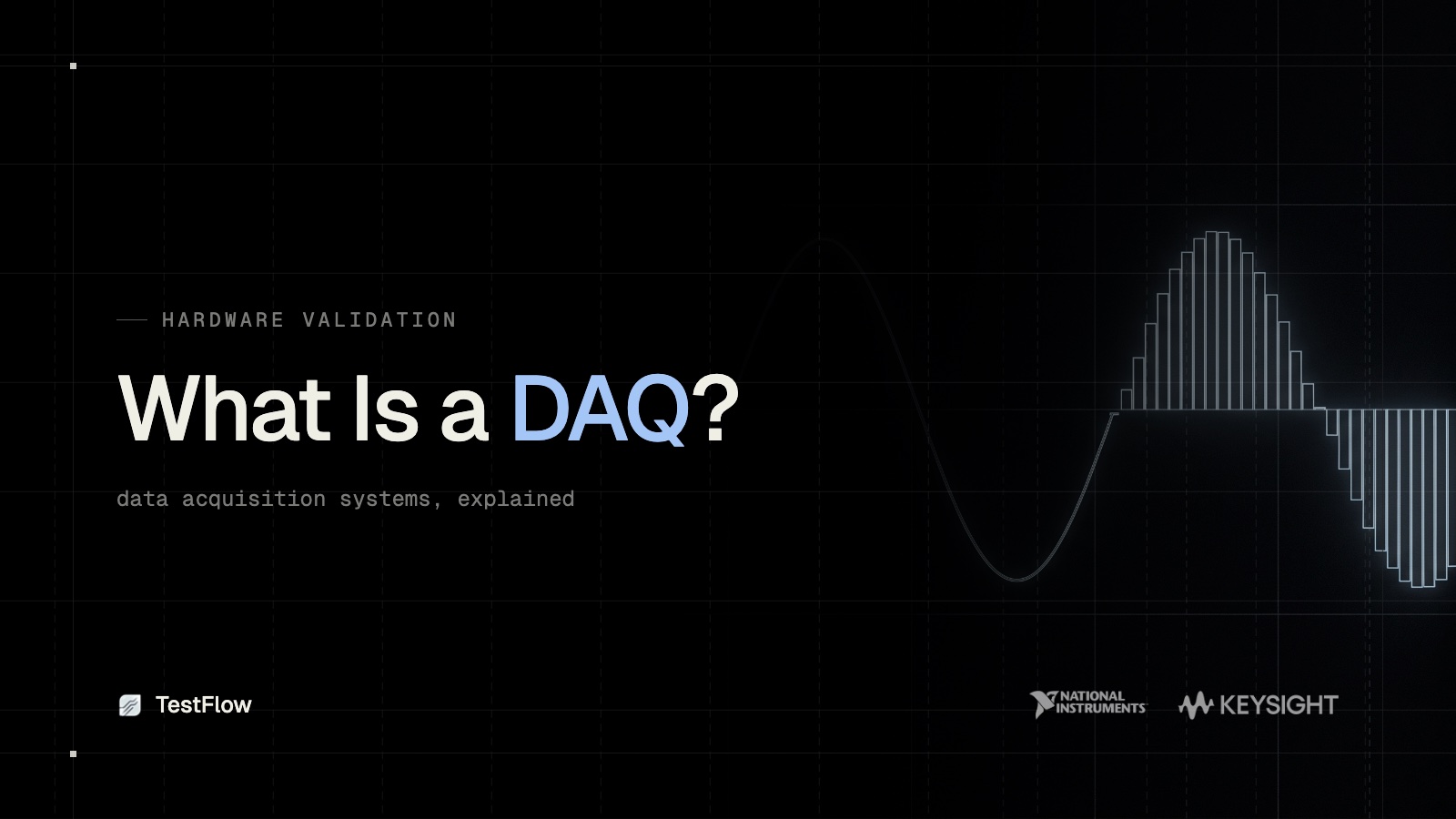
DAQ stands for data acquisition: the process of measuring real-world signals such as voltage, temperature, pressure, or vibration, and converting them into digital data a computer can store and analyze. A DAQ system is the chain that does this: sensor, signal conditioning, analog-to-digital converter (ADC), and software.
This guide gives a clear DAQ definition, explains how data acquisition works end to end, covers the specs that matter (sample rate, resolution, channels), the hardware types, and the software you need, including the free and AI-native options.
DAQ definition
To define DAQ simply: it is the chain that turns a physical phenomenon into numbers. DAQ means taking an analog signal from a sensor and producing digital samples through measurement hardware and driver software. When people write "data acq" or "DAQ data acquisition," they mean the same thing.
DAQ is not one product. It is a system role. A USB module, a PXI chassis, a benchtop multimeter scanning 20 channels, or a standalone data logger can each be the DAQ in a setup. What makes it a data acquisition system is the job: physical signal in, trustworthy digital data out.
The four parts of a data acquisition system
- 1
Sensor / transducer. Converts a physical quantity (temperature, force, light) into an electrical signal.
- 2
Signal conditioning. Amplifies, filters, and isolates the signal so it can be measured accurately. Thermocouples need cold-junction compensation, strain gauges need bridge excitation, and high voltages need attenuation and isolation.
- 3
Analog-to-digital converter (ADC). Samples the conditioned signal and turns it into digital values. Sample rate and resolution (bits) define quality.
- 4
Software and computer. Drivers, acquisition logic, display, logging, and analysis. This is where most DAQ projects succeed or stall.
How a DAQ system works, step by step
- 1
A sensor produces a small analog signal.
- 2
Signal conditioning cleans and scales it.
- 3
The ADC samples it at a fixed rate (for example, 1,000 samples/second).
- 4
A driver moves the samples to your computer.
- 5
Software displays, logs, and analyzes the data.
The three specs that actually matter
Sample rate is how often the ADC measures, in samples per second (S/s). The Nyquist theorem says you must sample at least 2x the highest frequency in the signal or you get aliasing: a fast signal masquerading as a slow one in your data. In practice, engineers sample 5x to 10x the signal frequency to preserve waveform shape. Temperature changes need a few samples per second; vibration analysis can need 50 kS/s or more.
Resolution is how finely the ADC divides its input range, in bits. Each extra bit doubles the number of steps:
| Resolution | Steps | Smallest step on a 10 V range |
|---|---|---|
| 8-bit | 256 | ~39 mV |
| 12-bit | 4,096 | ~2.4 mV |
| 16-bit | 65,536 | ~153 uV |
| 24-bit | 16.7M | ~0.6 uV |
A 16-bit DAQ is the practical default for general test work. Go 24-bit for small signals like thermocouples and strain gauges.
Channel count is how many signals you measure at once, and whether they are sampled simultaneously (one ADC per channel) or multiplexed (one ADC scanning across channels). Multiplexed is cheaper; simultaneous matters when phase relationships between channels matter.
DAQ hardware types
| Type | Typical use | Tradeoff |
|---|---|---|
| USB DAQ module | Bench measurements, prototypes, education | Cheap and simple, limited speed and channels |
| Benchtop instruments (DMM, scope, supply) | Labs that already own them | A 6.5-digit DMM with a scan card is a precision DAQ; needs software to automate |
| CompactDAQ / modular chassis | Mixed sensor types, 10 to 100+ channels | Flexible signal conditioning per slot, higher cost |
| PXI systems | High speed, high channel count, production test | Performance and sync, at the highest cost |
| Standalone data loggers | Long-duration recording without a PC | Self-contained but slower and less flexible |
National Instruments is the best-known DAQ vendor, but the concept is vendor-neutral: Keysight's DAQ970A family, dedicated loggers, and even a bench multimeter you already own can be the acquisition hardware. Pick hardware to match your signal types, speed, and channel count, not the other way around. For a deeper buying guide, see how to choose a data acquisition system.
Matching sensors to measurements
| Measurement | Typical sensor | What the DAQ must provide |
|---|---|---|
| Temperature | Thermocouple, RTD, thermistor | Cold-junction compensation, high resolution |
| Strain / force | Strain gauge bridge | Excitation voltage, bridge completion |
| Vibration | Accelerometer (IEPE) | Constant-current excitation, high sample rate |
| Voltage / current | Direct input, shunt, probe | Correct ranges, isolation for high voltage |
| Pressure / flow | 4-20 mA or voltage-output transducer | Current input or shunt resistor |
DAQ software: where the work lives
Hardware captures the data, but software decides whether the system is usable. The realistic options:
- •Vendor software / LabVIEW. LabVIEW is the traditional choice, with NI-DAQmx drivers. Powerful, but it carries license cost and ties you to the NI ecosystem. Keysight benches often use BenchVue, which has its own limits.
- •Python. With the
nidaqmxpackage andpyVISA, you can build data acquisition with Python for free, version-control it in Git, and run it anywhere. You write and maintain the code yourself. - •AI-native platforms. Tools like TestFlow let you connect your instruments, describe what you want to measure in plain English, and get the acquisition and validation workflow generated for you, using a vendor-agnostic scripting layer. Runs stream live values step by step, and results export as a structured PDF report or CSV. No NI hardware lock-in, and there is a free version to start. If you are weighing the options, the LabVIEW alternatives guide compares all eight.
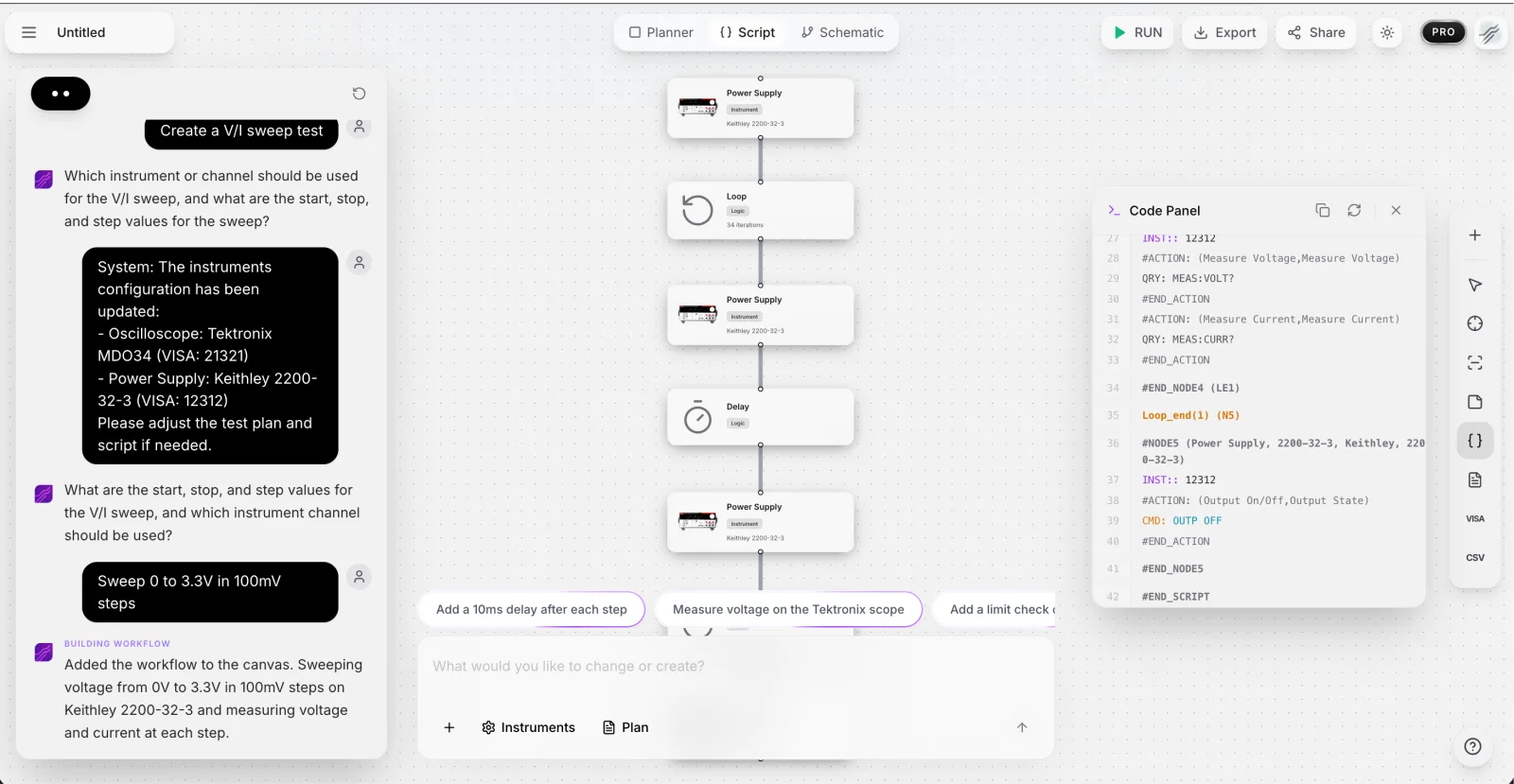
If you want logging without LabVIEW specifically, we wrote a dedicated guide to building a data logger without LabVIEW.
How to choose a DAQ system: a 5-question checklist
- 1
What signals, and how many channels? List every sensor type and count. This decides the signal conditioning you need.
- 2
How fast does the fastest signal change? Set your sample rate at 5x to 10x that frequency.
- 3
How small is the smallest change you care about? That sets resolution: 16-bit for general work, 24-bit for small signals.
- 4
Where does the data go? Live display, CSV files, a database, automated reports. Software effort here usually exceeds hardware setup.
- 5
Who maintains it? A coded solution needs a coder on staff. Vendor GUIs need license budget. AI-native tools generate and re-generate the automation as the bench changes.
Common uses of data acquisition
- •Product validation and reliability testing
- •Environmental and structural monitoring
- •Semiconductor and electronics characterization
- •Research labs and automated test benches
Frequently asked questions
What does DAQ stand for? Data acquisition: measuring real-world signals such as voltage, temperature, or vibration and converting them into digital data a computer can store and analyze.
What is a DAQ system? The combination of sensors, signal conditioning, an analog-to-digital converter, and software that converts physical signals into digital data.
What is the difference between a DAQ and a data logger? A data logger is a self-contained DAQ optimized for recording over long periods, usually at lower speed. A DAQ system is broader and often higher speed, tied to a computer.
Do I need LabVIEW for data acquisition? No. You can use Python with nidaqmx and pyVISA, vendor software, or an AI-native platform like TestFlow. LabVIEW is one option, not a requirement.
What sample rate do I need for a DAQ? At least 2x the highest frequency in your signal (the Nyquist rate). In practice engineers use 5x to 10x for clean waveform shape, so a 1 kHz signal is sampled at 5 to 10 kS/s.
How much does a DAQ system cost? From around $100 to $500 for basic USB DAQ modules, $1,000 to $5,000 for multi-channel benchtop or CompactDAQ setups, and well beyond that for high-speed PXI systems, plus software.
Automate the software half
The hardware half of DAQ is a catalog choice. The software half is where weeks disappear. TestFlow's approach: connect the instruments on your bench, tell the agent what to measure in plain English, and it generates the acquisition workflow, runs it, and reports the results.
Start free at app.testflowinc.com and turn your bench into an automated data acquisition system in minutes.
Ready to automate your lab?
Connect your instruments, describe a test in plain English, and TestFlow builds and runs it in minutes.
Tags
Put it on your bench this week
A new way for testing, from specs to automated sequences, capture clean data, and accelerate your validation cycle.