 Ali Kamaly
What Is Automated Test Equipment (ATE)? A 2026 Primer
Automated test equipment (ATE) explained: what it is, how ATE systems work, types, where it is used in semiconductor and electronics test, and the software layer.
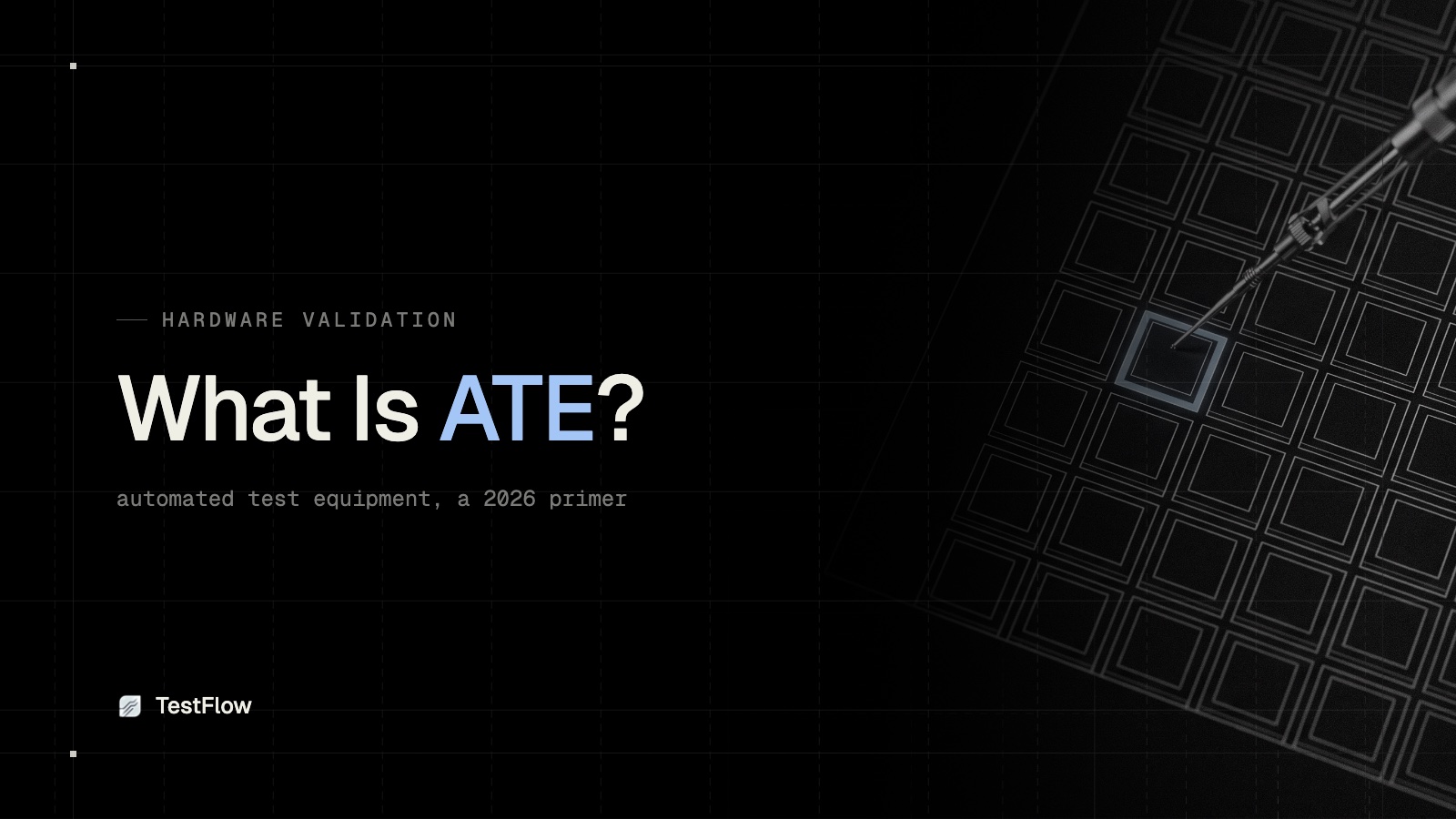
Automated test equipment (ATE) is hardware and software that automatically tests electronic devices, from individual semiconductor chips to fully assembled circuit boards, with little or no human intervention. An ATE tester measures whether a device meets its specification and sorts pass from fail, fast and repeatably.
This primer explains what ATE is, how an ATE system works, the main types, and where the software layer fits.
Why ATE exists
Modern electronics are too complex and too high-volume to test by hand. A chip can have thousands of pins and millions of parameters. ATE test equipment automates this so that every device is tested the same way, in seconds, at production scale. The goals are coverage (catch every defect), speed (keep up with the line), and repeatability (the same result every time).
How an ATE system works
- 1
Device under test (DUT): the chip, board, or module being tested.
- 2
Instrumentation: power supplies, digital pattern generators, and measurement instruments that stimulate and measure the DUT.
- 3
Handler or prober: mechanically presents each device to the tester.
- 4
Test program: the software sequence that applies stimuli, takes measurements, and decides pass/fail.
- 5
Results and binning: devices are sorted by result for yield analysis.
Types of automated test equipment
- •Semiconductor ATE: tests ICs at wafer and package level (the most demanding category). At wafer level this is wafer sort testing; the major ATE companies build the big iron here.
- •In-circuit test (ICT): checks components and connections on a populated PCB.
- •Functional test (FCT): verifies the board behaves correctly as a system.
- •Boundary scan (JTAG): tests interconnects without physical probes.
The software layer is where time is won or lost
The hardware gets attention, but the test program decides how fast you ship. Writing, sequencing, and maintaining test plans is the slow part of validation, and it is where teams lose weeks. This is the layer that traditional tools like LabVIEW and TestStand address, and where AI-native automation changes the math.
Where TestFlow fits
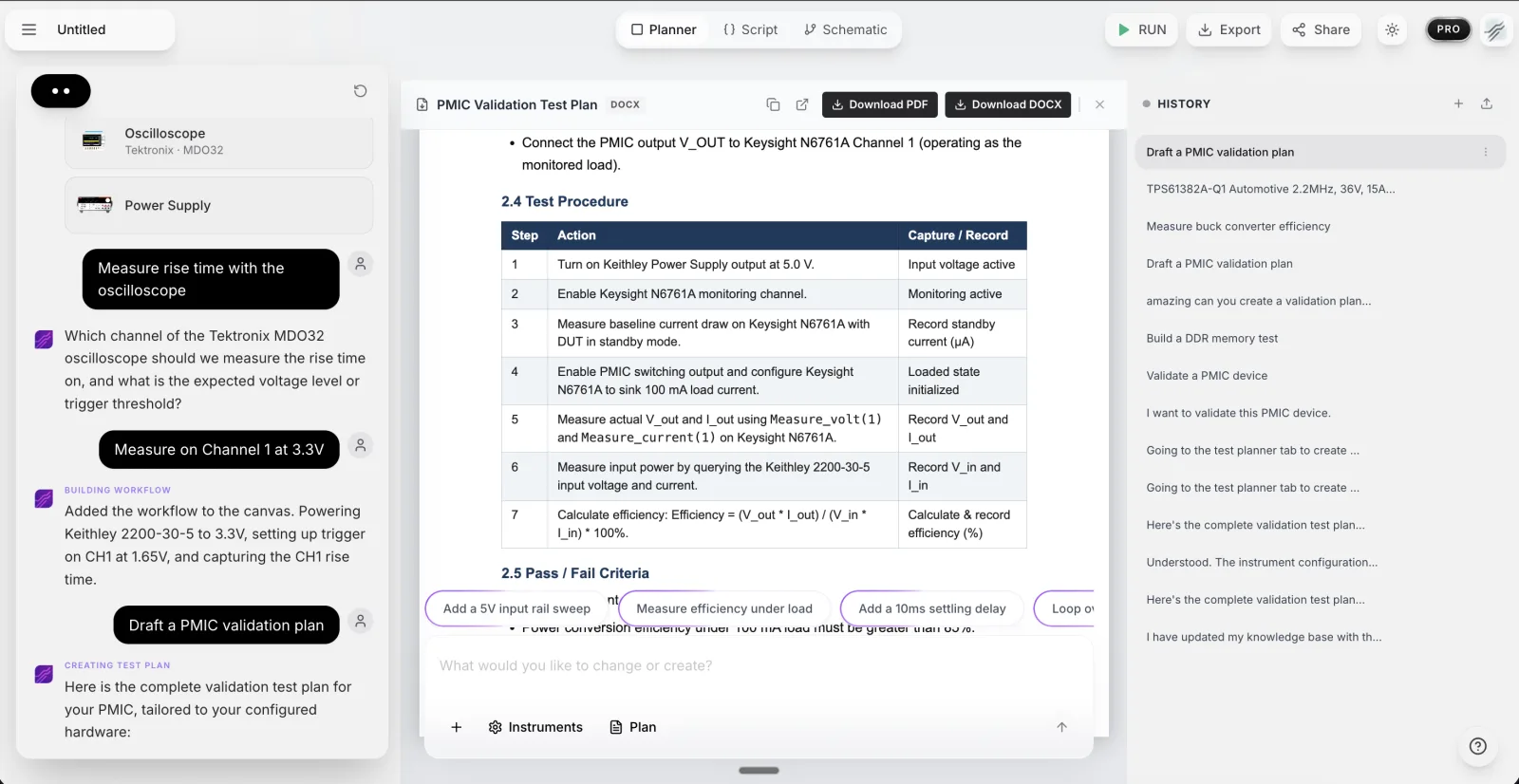
TestFlow is built for the validation and test-planning layer of this stack. You connect your instruments and describe the test in plain English, and AI generates a structured validation plan and the instrument scripts to run it, cutting the slowest part of ATE work from weeks to minutes. It is vendor-agnostic, so it does not lock you to one test platform.
The Test Planner is the part ATE engineers notice first: describe the DUT and conditions, and it drafts the document you would otherwise build in a spreadsheet, numbered test cases with purpose and setup, a measurement matrix with units and thresholds, and explicit pass/fail criteria. Review it, export PDF or DOCX, then tell the agent to build the workflow from the approved plan.
For semiconductor and electronics validation teams, the free version is the fastest way to see the difference.
Frequently asked questions
What does ATE stand for? Automated test equipment.
What is ATE used for? Automatically testing electronic devices, especially semiconductors and circuit boards, at production scale.
What is the difference between ATE and a data acquisition system? A DAQ measures signals for monitoring or analysis. ATE actively stimulates a device, measures its response, and makes pass/fail decisions to test it.
Ready to automate your lab?
Connect your instruments, describe a test in plain English, and TestFlow builds and runs it in minutes.
Tags
Put it on your bench this week
A new way for testing, from specs to automated sequences, capture clean data, and accelerate your validation cycle.