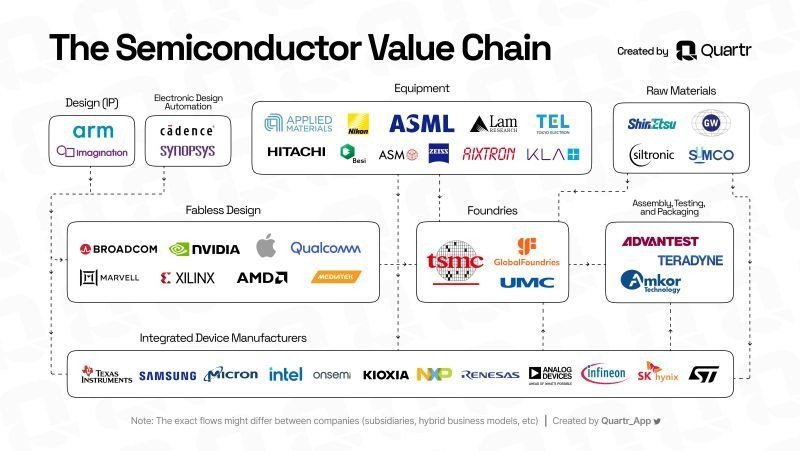
Chips don't come from a single company. They come from a global symphony of players—each mastering a step in the semiconductor value chain. Understanding this intricate ecosystem is essential for anyone working in hardware testing, chip validation, or semiconductor development.
Understanding the Semiconductor Value Chain
The semiconductor industry isn't one company—it's a global supply chain of extreme complexity. Each layer depends on specialized expertise, massive capital investments, and rigorous hardware testing protocols. Let's break down how this intricate ecosystem works, from design to deployment.
1. Design (IP) — The Blueprint Stage
These companies design instruction sets and microarchitectures used by almost every modern SoC. They create the fundamental building blocks that enable chip designers to build complex processors without starting from scratch.
Key Players
- • Arm: CPU cores powering 95% of mobile devices
- • Imagination: GPU architectures for graphics processing
2. EDA Tools — The Invisible Engines of Chip Creation and Testing
Electronic Design Automation tools are the invisible engines of chip creation and testing. Their sophisticated software platforms let engineers simulate, test, and tape-out billion-transistor chips with precision. This is where hardware testing begins—long before physical silicon exists.
Industry Leaders
- • Synopsys: Pre-silicon verification and simulation
- • Cadence: Design and verification tools
- • TestFlow: Post-silicon validation and hardware testing automation
3. Fabless Designers — Betting Everything on Innovation and Execution
These companies design chips but outsource manufacturing. They focus purely on creating the best possible chip designs while leveraging foundry expertise for production. Chip validation is critical at this stage to ensure designs meet specifications before tape-out.
Innovation Giants
- • NVIDIA: AI and GPU computing leaders
- • Apple: Custom silicon for mobile and desktop
- • Qualcomm: Mobile and wireless chipsets
- • AMD: High-performance computing processors
4. Foundries — The Ultra-Precise Builders
These are the ultra-precise factories that turn blueprints into working silicon. They operate some of the most advanced manufacturing facilities on Earth, building structures smaller than viruses with atomic precision.
Manufacturing Leaders
- • TSMC: 62% market share, leading-edge manufacturing
- • UMC: Mature process nodes
- • GlobalFoundries: Specialty technologies
5. Integrated Device Manufacturers (IDMs) — Vertical Integration at Massive Scale
They do it all—design, manufacture, package, and sell. Think vertical integration at massive scale. This approach provides complete control over the supply chain and enables tight integration between design and manufacturing.
Vertical Integration Leaders
- • Intel: x86 processors and foundry services
- • Samsung: Memory and mobile processors
- • Texas Instruments: Analog and embedded systems
6. Raw Materials — No Wafers, No Chips
These players supply the pure silicon and gases needed for fabrication. Without ultra-pure materials, semiconductor manufacturing would be impossible.
Material Suppliers
- • Shin-Etsu: Silicon wafer production
- • Siltronic: High-purity substrates
- • SUMCO: Wafer manufacturing
7. Equipment Vendors — Ultra-Complex Machines That Build Chips
These companies make the ultra-complex machines that build chips—like EUV scanners and etchers. They operate at the limits of physics and engineering to enable nanometer-scale manufacturing.
Equipment Leaders
- • ASML: EUV lithography monopoly
- • Applied Materials: Deposition and etching
- • Lam Research: Precision etching equipment
8. Testing & Packaging — Ensuring Reliability at Nanometer Scale
Before chips ship, they're packaged, tested, and binned. These firms ensure reliability at nanometer scale through rigorous hardware testing and chip validation protocols. This is the final quality gate before chips reach customers.
Testing & Packaging Leaders
- • Amkor: Advanced packaging solutions
- • Advantest: Automated test equipment
- • Teradyne: Semiconductor test systems
Key Takeaway: A Global Symphony of Extreme Complexity
The semiconductor world isn't one company—it's a global supply chain of extreme complexity. Each player masters their specific step in the value chain, from IP design to final testing. This specialization enables innovation but also creates critical dependencies.
"Disrupt one link, and the whole world feels it—from smartphones to AI servers. Understanding this ecosystem is essential for anyone working in chip design, hardware testing, or semiconductor validation."
The Critical Role of Hardware Testing and Chip Validation
Throughout the semiconductor value chain, hardware testing and chip validation play crucial roles at every stage:
Pre-Silicon Validation
EDA tools enable comprehensive simulation and verification before manufacturing. This catches design issues early when they're cheapest to fix.
- • Functional verification
- • Timing analysis
- • Power simulation
- • Design rule checking
Post-Silicon Testing
Once silicon arrives, comprehensive hardware testing validates that chips meet specifications and perform reliably in real-world conditions.
- • Wafer-level testing
- • Package-level validation
- • System-level integration
- • Reliability testing
How TestFlow Fits Into the Semiconductor Value Chain
TestFlow bridges a critical gap in the semiconductor value chain—the transition from design to validated silicon. While traditional EDA tools focus on pre-silicon verification, TestFlow specializes in post-silicon validation and hardware testing automation.
TestFlow's Position in the Value Chain
Accelerating Chip Validation
TestFlow automates the complex process of post-silicon validation, reducing time-to-market for fabless designers and IDMs. Our platform turns bench testing into reusable automation.
Enabling Hardware Testing at Scale
By providing AI-powered test generation and execution, TestFlow enables engineering teams to scale their hardware testing efforts without proportionally scaling headcount.
Bridging Design and Manufacturing
TestFlow connects the pre-silicon world of EDA tools with the post-silicon reality of manufactured chips, ensuring designs work correctly in production.
Why Understanding the Value Chain Matters
For engineers working in chip validation and hardware testing, understanding the semiconductor value chain is essential:
Conclusion: Mastering the Semiconductor Symphony
The semiconductor industry operates as a finely tuned global symphony, with each player mastering their specific instrument. From ARM's instruction sets to TSMC's foundries, from ASML's EUV scanners to Advantest's test equipment—every link in the chain is essential.
For those of us working in hardware testing and chip validation, understanding this ecosystem isn't just academic—it's essential for success. Whether you're validating a new SoC design, debugging a manufacturing issue, or scaling your test infrastructure, knowing how your work fits into the broader value chain enables better decisions and better outcomes.
As the industry continues to evolve with AI-native architectures, advanced packaging, and new computing paradigms, the companies that thrive will be those that understand and navigate this complexity while delivering reliable, high-performance semiconductors.