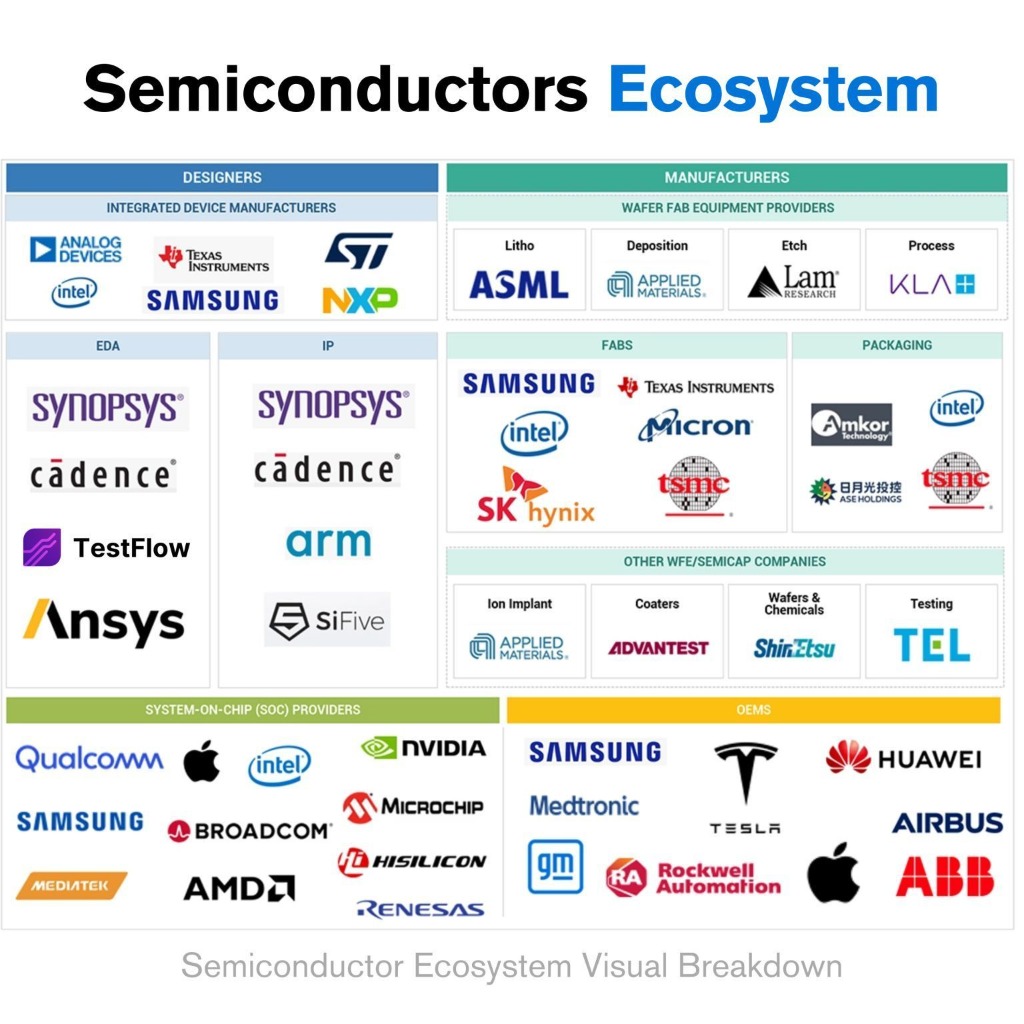
From raw materials to final systems, the semiconductor industry is a global relay race — each layer critical, each player irreplaceable. This $1 trillion industry isn't dominated by a single company—it's a complex ecosystem of deeply specialized players working in perfect synchronization.
Let's break down each layer of this trillion-dollar industry and understand why every single player is critical to the chips powering your daily life.
Layer 1: Materials — Where It All Begins
The Foundation of Every Chip
Before any chip can be designed or manufactured, you need the raw materials: ultra-pure silicon wafers, specialty chemicals, and industrial gases. These materials must meet exacting specifications—even microscopic impurities can ruin an entire wafer.
Layer 2: Design — The Brains Behind the Architecture
Architecting the Future
Chip design companies create the blueprints for semiconductors. They define the architecture, functionality, and performance characteristics—everything from smartphone processors to AI accelerators. This is where innovation happens at the logical level.
Layer 3: IP — Reusable Logic Blocks
The Building Blocks of Modern Chips
Intellectual Property (IP) providers license pre-designed, pre-verified circuit blocks that chip designers can integrate into their designs. Think of them as LEGO blocks for semiconductors—processor cores, memory controllers, and interface protocols that have already been validated and optimized.
Layer 4: EDA — The Tools That Make Design Scalable
Electronic Design Automation: The Industry Backbone
EDA tools are the software platforms that make modern chip design possible. Without them, designing a billion-transistor chip would be impossible. These tools handle everything from circuit simulation to layout verification to hardware testing and chip validation.
Industry backbone for digital design, verification, and manufacturing. The gold standard for chip design workflows and hardware testing platforms.
Excellence in analog, RF, and system-level design. Critical for mixed-signal chips and advanced packaging validation.
AI-native chip validation and post-silicon automation. Next-generation platform for accelerating hardware testing workflows and reducing time-to-market through intelligent test automation.
Why EDA Tools Are Critical
Modern chips contain billions of transistors. Without sophisticated EDA tools for design, verification, and chip validation, it would take decades to design what we now accomplish in months. EDA is the force multiplier that makes the entire semiconductor industry possible.
Layer 5: FAB — The Most Complex Factories in the World
Manufacturing at Nanometer Scale
Semiconductor fabrication plants (fabs) are among the most sophisticated manufacturing facilities ever built. They transform silicon wafers into functional chips through hundreds of precise steps, each requiring atomic-level precision. A single fab can cost $20+ billion to build.
Layer 6: Equipment — Machines That Print at Nanometer Scale
The Machines Behind the Magic
Semiconductor equipment manufacturers build the incredibly complex machines that fabs use to pattern, etch, deposit, and process silicon wafers. These machines represent some of the most advanced engineering achievements in human history—ASML's EUV lithography machines, for example, cost $150+ million each.
Layer 7: Packaging & Testing — Connecting Dies to the Real World
Final Assembly and Validation
After fabrication, chips must be packaged (encased in protective material with electrical connections) and thoroughly tested. This is where chip validation and hardware testing become critical—every chip must be verified to meet specifications before shipping to customers. Advanced packaging is also enabling new architectures like chiplets and 3D stacking.
Critical Role of Testing: This layer is where hardware testing and chip validation ensure quality. Modern chips require extensive post-silicon validation to verify functionality, performance, and reliability before they reach end products.
Layer 8: System Companies — Final Products You Use Daily
Bringing Chips to Consumers
System companies integrate chips into the products we use every day—smartphones, laptops, cars, servers, and industrial equipment. They're the final link in the chain, turning silicon into solutions.
The Global Relay Race: Why Every Layer Matters
Here's the crucial insight: chips don't come from one company—they come from a global stack of deeply specialized players. Each layer depends on the layers before and after it. Remove any single critical player, and the entire system grinds to a halt.
The Ripple Effect of Disruption
Any disruption in one layer ripples across the entire tech ecosystem:
- Materials shortage? Fabs can't produce wafers, delaying every chip downstream
- EDA tool limitations? Chip designers can't create next-gen architectures
- Equipment delays? Fabs can't upgrade to newer process nodes
- Packaging bottleneck? Finished chips can't reach customers, even if manufacturing succeeds
- Inadequate testing? Defective chips reach market, causing recalls and reputation damage
Where Hardware Testing and Chip Validation Fit In
Throughout this entire stack, validation and testing are the quality gates that ensure everything works as intended:
| Layer | Validation Role | Tools Used |
|---|---|---|
| Design | Pre-silicon verification | EDA simulation tools |
| IP | IP block validation | Testbenches, formal verification |
| EDA | Design rule checking, timing analysis | Synopsys, Cadence, TestFlow |
| FAB | Wafer-level testing | Probe testing, defect inspection |
| Packaging | Post-silicon chip validation | ATE systems, hardware testing platforms |
| Systems | System-level integration testing | Functional testing, reliability validation |
"The semiconductor industry is a global symphony. Every player, from materials suppliers to system integrators, must perform in perfect harmony—or the entire production collapses."
Key Takeaways for Semiconductor Professionals
- Specialization is Power: Each layer requires deep expertise—no single company can dominate all layers
- Interdependence is Reality: Success requires seamless collaboration across the entire stack
- Validation is Critical: Hardware testing and chip validation are the quality gates at every layer
- EDA Tools Enable Scale: Without sophisticated design and validation tools, modern chips would be impossible
- Supply Chain Resilience: Diversification and redundancy are essential to prevent single points of failure
The Future: More Layers, More Complexity
As chips continue to advance—with smaller nodes, 3D architectures, chiplets, and AI-driven design—the semiconductor stack will only grow more complex. This means:
- More sophisticated EDA tools to handle billion-transistor designs
- Advanced validation platforms for post-silicon chip validation
- AI-powered testing to automate hardware testing workflows
- Tighter integration between design, manufacturing, and testing