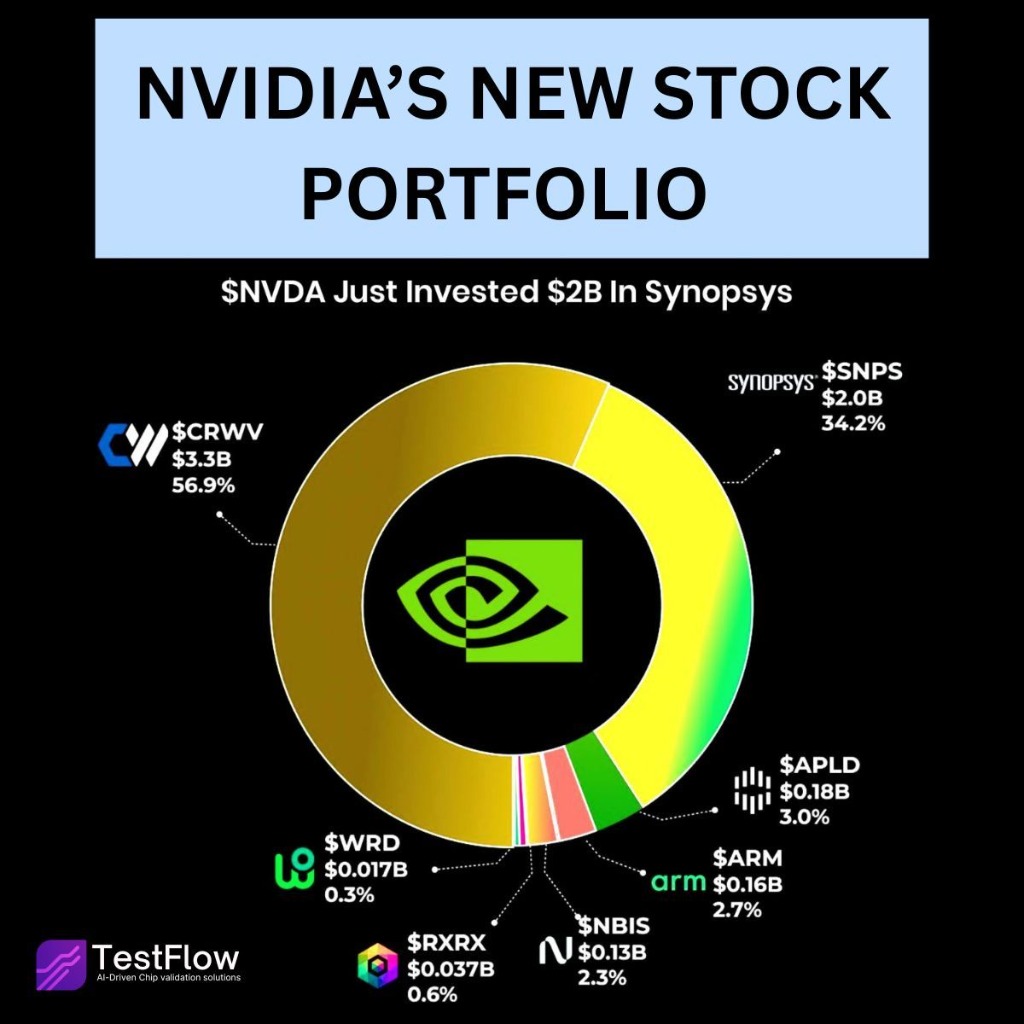
NVIDIA just revealed its real strategy — and it's way bigger than AI chips. Most people think NVIDIA only wins by building GPUs. But the real story? They're quietly buying influence across the *entire semiconductor stack*, from chip design tools to infrastructure orchestration.
The Portfolio That Tells the Real Story
NVIDIA's latest portfolio reveals a strategic masterclass in semiconductor dominance. This isn't just about building better GPUs—it's about controlling every layer of the chip development and deployment stack. Let's break down what each investment really means:
Synopsys ($SNPS) – $2.0B (34.2%)
The Real Bottleneck: EDA (Electronic Design Automation) is where chip innovation actually happens. By owning significant exposure to Synopsys, NVIDIA gains influence over the very tools used to design next-generation semiconductors. This is about owning the future of chip design itself—from verification to hardware testing and chip validation workflows.
CrowdStrike ($CRVW) – $3.3B (56.9%)
Infrastructure Play: This massive bet on infrastructure and compute efficiency shows NVIDIA understands that raw silicon alone isn't enough. Modern semiconductor validation requires robust infrastructure—from cloud-based hardware testing platforms to secure compute orchestration systems.
ARM Holdings ($ARM) – $0.16B (2.7%)
Ecosystem Control: Control the instruction set, control the ecosystem. ARM's architecture powers everything from mobile devices to data centers. NVIDIA's stake ensures they have a voice in the future direction of one of the most critical semiconductor architectures.
Nebius Group ($NBIS) – $0.13B (2.3%)
AI + Systems Optimization: This investment focuses on AI-driven systems optimization—exactly the kind of technology needed for advanced chip validation and automated hardware testing workflows that reduce time-to-market.
Applied Digital ($APLD) – $0.18B (3.0%)
Advanced Compute Infrastructure: Applied Digital provides data infrastructure and high-performance computing solutions—critical for running complex chip validation simulations and post-silicon verification at scale.
What This Really Means for the Semiconductor Industry
NVIDIA isn't just a chip company anymore. They're building strategic leverage across every critical layer of the semiconductor value chain:
The Chip Validation Connection
As semiconductors become more complex, hardware testing and chip validation are no longer afterthoughts—they're strategic bottlenecks. NVIDIA's investments in EDA tools and infrastructure reflect this reality. The companies that can validate chips faster and more thoroughly will win the race to market.
Vertical Integration Without the Fabs
This is the genius of NVIDIA's strategy. They're achieving vertical integration across the semiconductor stack without the massive capital expenditure of owning fabrication facilities. Instead, they're strategically positioning themselves at every critical chokepoint:
| Layer | Investment | Strategic Value |
|---|---|---|
| Design Tools | Synopsys | Control chip design workflows |
| Verification | Synopsys EDA | Influence hardware testing standards |
| Architecture | ARM | Shape instruction set evolution |
| Infrastructure | CRVW, APLD | Enable scalable validation infrastructure |
| AI Optimization | Nebius | Accelerate chip validation with AI |
The Future of Semiconductor Competition
NVIDIA's portfolio sends a clear message to the semiconductor industry: the next trillion-dollar companies won't win by silicon alone. They'll win by owning the full toolchain around silicon—from the EDA tools that design chips, to the validation platforms that test them, to the infrastructure that deploys them.
"The next trillion-dollar semiconductor companies won't win by silicon alone—they'll win by owning the full toolchain around silicon."
This strategy has profound implications for hardware testing and chip validation. As chips become more complex and time-to-market pressures intensify, the ability to rapidly validate designs becomes a competitive advantage. Companies that can streamline their validation workflows—whether through better EDA tools, AI-powered testing, or cloud-based infrastructure—will dominate their markets.
Key Takeaways for Semiconductor Engineers
- Validation is Strategic: NVIDIA's investments show that chip validation and hardware testing are no longer just technical necessities—they're strategic differentiators
- Toolchain Matters: The companies that control the design and verification tools will shape the future of semiconductors
- Infrastructure Enables Scale: Modern chip validation requires cloud-scale infrastructure to run complex simulations and post-silicon testing
- AI is the Accelerator: AI-powered validation tools will become essential for managing the complexity of next-generation chips
What This Means for Your Validation Workflow
If NVIDIA—one of the most successful semiconductor companies in history—is investing billions in the toolchain around silicon, what does that mean for your organization? It means that your chip validation and hardware testing workflows are more critical than ever.
The companies that can validate faster, test more thoroughly, and bring chips to market more quickly will win. This requires:
- Modern validation platforms that can handle complex chip architectures
- AI-powered testing to automate repetitive validation tasks
- Cloud-scale infrastructure for running massive simulation workloads
- Integrated workflows that connect design, verification, and post-silicon validation