 Ali Kamaly
The Best LabVIEW Alternative for Test Automation in 2026
Comparing TestFlow, LabVIEW, Python scripting, and manual testing, so you can stop guessing and start shipping.
If you're a validation engineer in 2026, you're probably drowning in test scripts, scattered Excel sheets, and instruments that don't talk to each other.
The pressure isn't new. But the tooling options have multiplied, and so has the cost of picking the wrong one.
Semiconductor teams that still rely on manual or semi-manual validation workflows spend an average of 6 to 10 weeks per chip validation cycle. Teams using structured automation platforms have compressed that to under two weeks.
This guide compares the top four approaches validation teams are using today: TestFlow, LabVIEW, Python scripting, and manual testing. We cover features, use cases, tradeoffs, and pricing, so you can make the right call for your lab.
Why This Matters in 2026
Tape-out windows are tighter. Customer programs ship in weeks, not quarters. The validation step, traditionally the slowest part of bringing a chip to market, is the bottleneck most fabless teams haven't fixed.
The tooling question isn't academic. The wrong stack costs you weeks of engineer time per chip, an unmaintainable codebase 12 months later, or a $50,000+ annual licensing bill for software your team can't fully use.
The Top 4 Hardware Validation Approaches in 2026
| Capability | TestFlow | LabVIEW | Python | Manual |
|---|---|---|---|---|
| Best For | Full validation workflow | Instrument control & DAQ | Custom automation | One-off bench tests |
| Setup Time | Minutes | Days to weeks | Days to weeks | Immediate |
| AI-Powered | Yes (native) | No | No | No |
| Instrument Support | Universal (VISA/SCPI) | Broad, NI preferred | Universal (PyVISA) | Manual only |
| Automated Reporting | Yes (professional PDF) | Limited | Custom-built | Manual |
| Test Reusability | High | Medium | Low to medium | None |
| Learning Curve | Low | Very high | Medium | None |
| Pricing | Contact TestFlow | $$$+ per seat + hardware | Free (build cost varies) | Free |
1. TestFlow
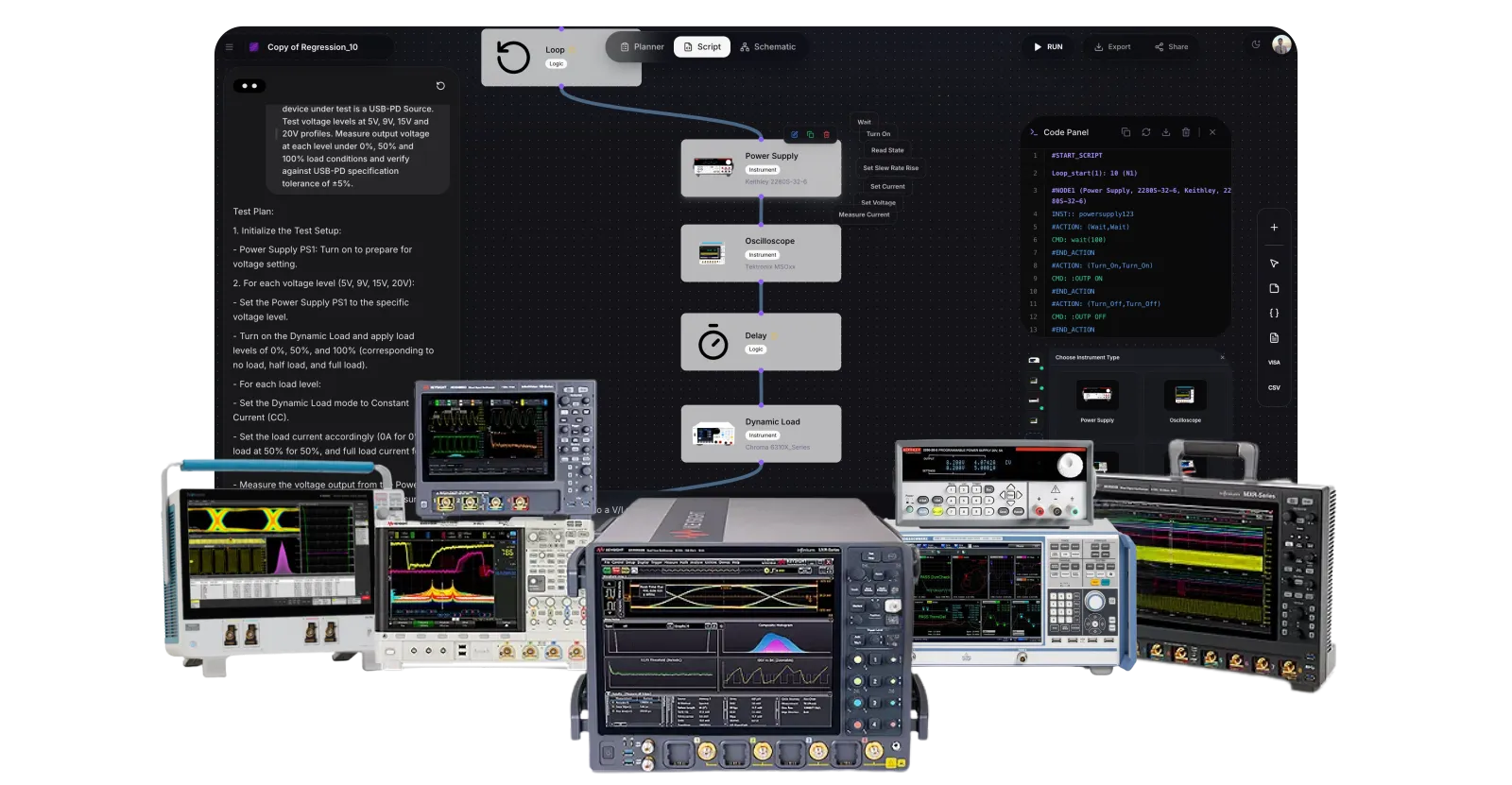
TestFlow is an AI-native validation automation platform built specifically for semiconductor post-silicon validation teams. It takes engineers from datasheet to automated test sequences in minutes, replacing the fragmented stack of scripts, spreadsheets, and disconnected instruments with a single structured platform.
The core problem TestFlow solves is not just instrument control. It's the entire validation workflow: structuring test plans, automating execution sequences, logging data cleanly, and generating professional validation reports, all without stitching together a dozen custom tools.
Proven result: Nexperia compressed a validation cycle from two months to eight days using TestFlow.
Pricing
Contact the TestFlow team for pricing: www.testflowinc.com
Key Features
- Workflow Automation Engine: Structured, repeatable validation flows from datasheets. Tests run sequentially, conditions branch, results log cleanly. No custom code per sequence.
- Universal Instrument Compatibility: Tektronix, Keysight, Rohde & Schwarz, NI, and any SCPI/VISA-compatible instrument. No vendor lock-in.
- AI Analytics Module: Upload raw CSV or Excel measurement data. TestFlow maps columns, runs analysis, generates a professional PDF validation report automatically.
- Platform Consolidation: Replaces the fragmented stack of LabVIEW licenses, Python scripts, Excel trackers, and Word templates with one platform.
- Datasheet to Test, Fast: Validation engineers go from reading a datasheet to running automated test sequences without writing instrument drivers or parsing SCPI by hand.
Use Cases
TestFlow targets post-silicon validation teams at fabless semiconductor companies, system application engineering groups, and hardware R&D labs running bring-up, characterization, and compliance workflows. It is particularly effective for:
- •Power management IC validation (voltage sequencing, load regulation, thermal profiling)
- •Mixed-signal device characterization
- •SoC bring-up automation
- •Production readiness testing with structured test coverage tracking
Integrations
TestFlow integrates with standard lab instruments via VISA/SCPI. Data export is compatible with CSV, JSON, and PDF. API access is available for enterprise teams.
2. LabVIEW
LabVIEW (Laboratory Virtual Instrument Engineering Workbench) is National Instruments' graphical programming environment. It has been the dominant instrument control and data acquisition platform in hardware labs for over three decades. If you've spent time in a semiconductor or electronics lab, you've almost certainly encountered it.
LabVIEW's graphical programming model (the "G" language) lets engineers build test sequences visually, which initially seems approachable. In practice, complex validation workflows result in dense, hard-to-read "wire diagrams" that become maintenance nightmares over time.
Pricing
LabVIEW pricing is multi-layered and expensive:
- LabVIEW Community Edition: Free (non-commercial only)
- LabVIEW Base: ~$1,500/year per seat
- LabVIEW Professional: ~$5,000 to $7,000/year per seat
- NI Hardware (DAQ, PXI): $2,000 to $50,000+ depending on configuration
- TestStand (sequencing add-on): Additional license cost
Enterprise deployments with full NI hardware stacks routinely exceed $50,000 in total tooling cost.
Key Features
- Graphical Programming (G): Visual dataflow model. Intuitive for simple tasks, unwieldy for complex multi-instrument workflows.
- NI Hardware Integration: Best-in-class for NI DAQ, PXI chassis, and NI instruments. Tighter than any other platform for NI hardware.
- VISA/GPIB/SCPI Support: Can control third-party instruments via standard protocols, though integration effort is higher than with NI-native hardware.
- TestStand Sequencer: Separate NI product for structured test sequencing and reporting. Adds significant cost.
- Large Community: Decades of forum answers, example code, and institutional knowledge.
Use Cases
LabVIEW excels when:
- •Your lab is already fully invested in NI hardware (PXI systems, NI DAQ)
- •You need high-speed data acquisition at the hardware level
- •Your team has dedicated LabVIEW developers, not validation engineers doing double duty
- •Regulatory compliance (aerospace, medical) requires LabVIEW-specific validation frameworks
It is a poor choice when your team needs rapid deployment, your instruments are multi-vendor, or your engineers shouldn't have to become software developers to run validation tests.
The Core LabVIEW Problem
The deeper issue with LabVIEW in 2026 is not capability, it's cost-to-value ratio and organizational dependency. When the LabVIEW expert leaves, the codebase often becomes unmaintainable. When your hardware stack evolves, you're locked into NI's upgrade cycle. When you need a report generated automatically, you're writing that integration yourself.
3. Python Scripting (PyVISA + Custom Frameworks)
Python has become the de facto language for validation automation at engineering-forward semiconductor companies. Libraries like PyVISA, pyvisa-py, and instrument-specific SDKs (Keysight's Python API, Tektronix's TekVISA) give engineers direct instrument control without LabVIEW's cost or graphical constraints.
Python scripting is genuinely powerful. It is also genuinely fragile as a validation infrastructure.
Pricing
Python itself is free. The real cost is engineering time:
- PyVISA: Free (open source)
- Instrument-specific SDKs: Free (vendor-provided)
- VISA backend (NI-VISA or pyvisa-py): Free
- Hidden cost: 2 to 8 weeks of engineer time per new instrument driver, test framework, or reporting pipeline built from scratch
For a team of 5 validation engineers spending 30% of their time maintaining scripts rather than validating chips, the annual labor cost of "free" Python scripting is significant.
Key Features
- Full Flexibility: Python can do anything. Control any instrument, process any data format, build any custom workflow.
- PyVISA for Instrument Control: Send SCPI commands to any VISA-compatible instrument. Works with Tektronix, Keysight, Rohde & Schwarz, and virtually any bench instrument with USB, GPIB, LAN, or RS-232.
- Rich Ecosystem: NumPy, pandas, Matplotlib, and SciPy for data analysis and visualization on top of raw measurements.
- Version Control Friendly: Unlike LabVIEW's binary VI files, Python scripts live cleanly in Git. Diffs are readable. Reviews are possible.
- Widely Known: Most validation engineers already know Python. Onboarding cost for new team members is lower than LabVIEW.
Use Cases
Python scripting is the right choice when:
- •You need a one-off automation for a specific instrument that isn't in your current toolchain
- •Your team has a dedicated software engineer, not just validation engineers
- •You're building a proof of concept before investing in a structured platform
- •Your workflow is simple enough that a few scripts cover 80% of cases
Python becomes a liability when:
- •Scripts multiply across engineers with no shared structure
- •Each new chip requires rewriting or adapting instrument drivers
- •Reports are generated manually from raw data files
- •There's no single place to see test coverage, pass/fail history, or validation status
The honest summary: Python gives you a floor, not a ceiling. What most teams discover is that they build 50+ scripts over 18 months and realize they've recreated LabVIEW's complexity without LabVIEW's structure, just with more Git commits.
"But we already have Python scripts."
This is the most common objection TestFlow hears from validation teams. TestFlow doesn't replace your Python scripts. It sits above them. The instrument control layer can stay in Python. What TestFlow adds is the workflow structure, sequencing logic, data aggregation, and automated reporting your Python scripts will never have, because building that infrastructure is not your job. Validating chips is.
4. Manual Testing
Manual testing means an engineer sitting at a bench, configuring instruments by hand, recording measurements in a notebook or Excel, and writing reports in Word or PowerPoint.
This is not a straw man. Many semiconductor teams, especially at startups, in early bring-up phases, or in small R&D groups, still do this for some or all of their validation work.
Pricing
Free. The cost is entirely human time and error rate.
Key Features
- Zero Setup: No software to install, no scripts to write, no licenses to buy. Pick up a probe and measure.
- Maximum Flexibility for Exploration: During early silicon bring-up, when you don't yet know what you're looking for, manual exploration is genuinely the right mode. You're debugging, not executing a test plan.
- Direct Instrument Interaction: Engineers develop intuition about instrument behavior and measurement artifacts that scripted automation can miss.
Use Cases
Manual testing makes sense in specific, bounded scenarios:
- •Day 0 bring-up: First power-on of a new chip. You're in exploration mode. Automation is premature.
- •Root cause debugging: Chasing a failure mode that doesn't fit your existing test coverage. Manual probing is faster than scripting a new test.
- •One-time measurements: A single characterization data point you'll never need again.
Manual testing is the wrong default for:
- •Regression testing across chip revisions
- •Characterization sweeps across temperature, voltage, and frequency corners
- •Any test that will be run more than three times
- •Any test that produces data you need in a report
The core problem with manual testing is not accuracy in a single measurement. It's repeatability, scalability, and traceability. When the chip revision changes, you run the tests again, manually, from memory. When the report is due, you compile data from five engineer notebooks. When the test failed, you try to remember exactly what conditions were set. Validation is a systematic discipline. Manual testing is the absence of system.
How to Choose the Right Approach
The right answer depends on where your team is:
Choose Manual Testing
If you're in day-0 bring-up or debugging a one-time failure mode. Otherwise, start building toward automation immediately.
Choose Python Scripting
If your team has a dedicated software engineer, your workflow is simple enough for 5 to 10 scripts, and you have bandwidth to maintain the codebase as it grows. Accept that you're building infrastructure, not just tests.
Choose LabVIEW
If your lab is fully committed to NI hardware, you have dedicated LabVIEW developers, and your regulatory environment requires it. Do not choose LabVIEW because it's what you've always used.
Choose TestFlow
If you need your validation engineers running structured, repeatable, automated test workflows without becoming software developers, and you need to compress validation cycles from weeks to days without rebuilding your instrument stack.
What TestFlow Replaces in Your Stack
Instead of a graphical wire diagram, a folder of Python scripts, or a stack of engineer notebooks, you get a validation workspace where the entire bench, the test plan, the execution, and the reporting live in one place. Here is what that looks like in practice.
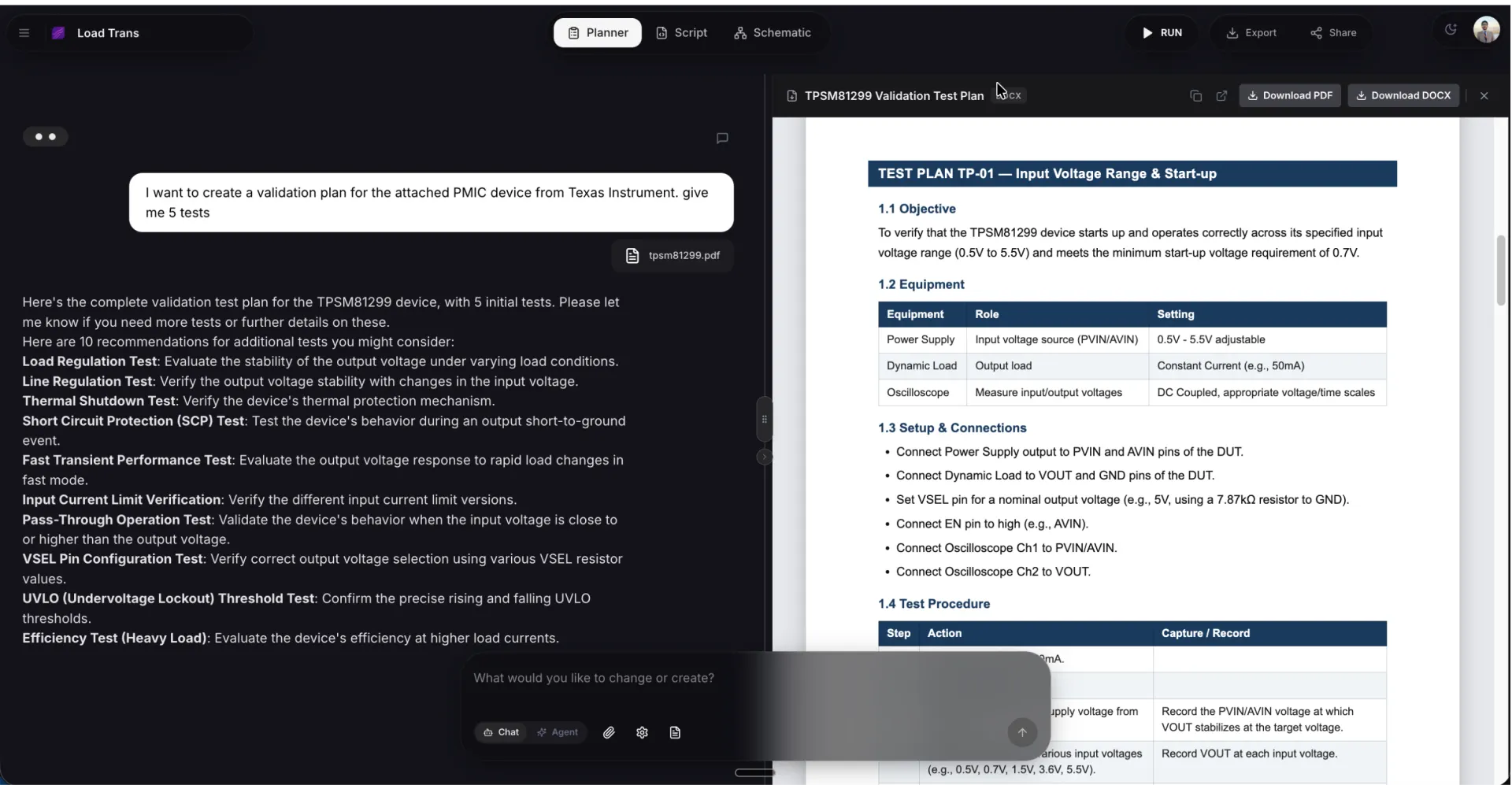
From datasheet to test plan
Upload a chip datasheet and TestFlow generates the full structured test plan, parameters, limits, and instrument requirements included. No more building 1,500-line LabVIEW VIs or Python scripts by hand.
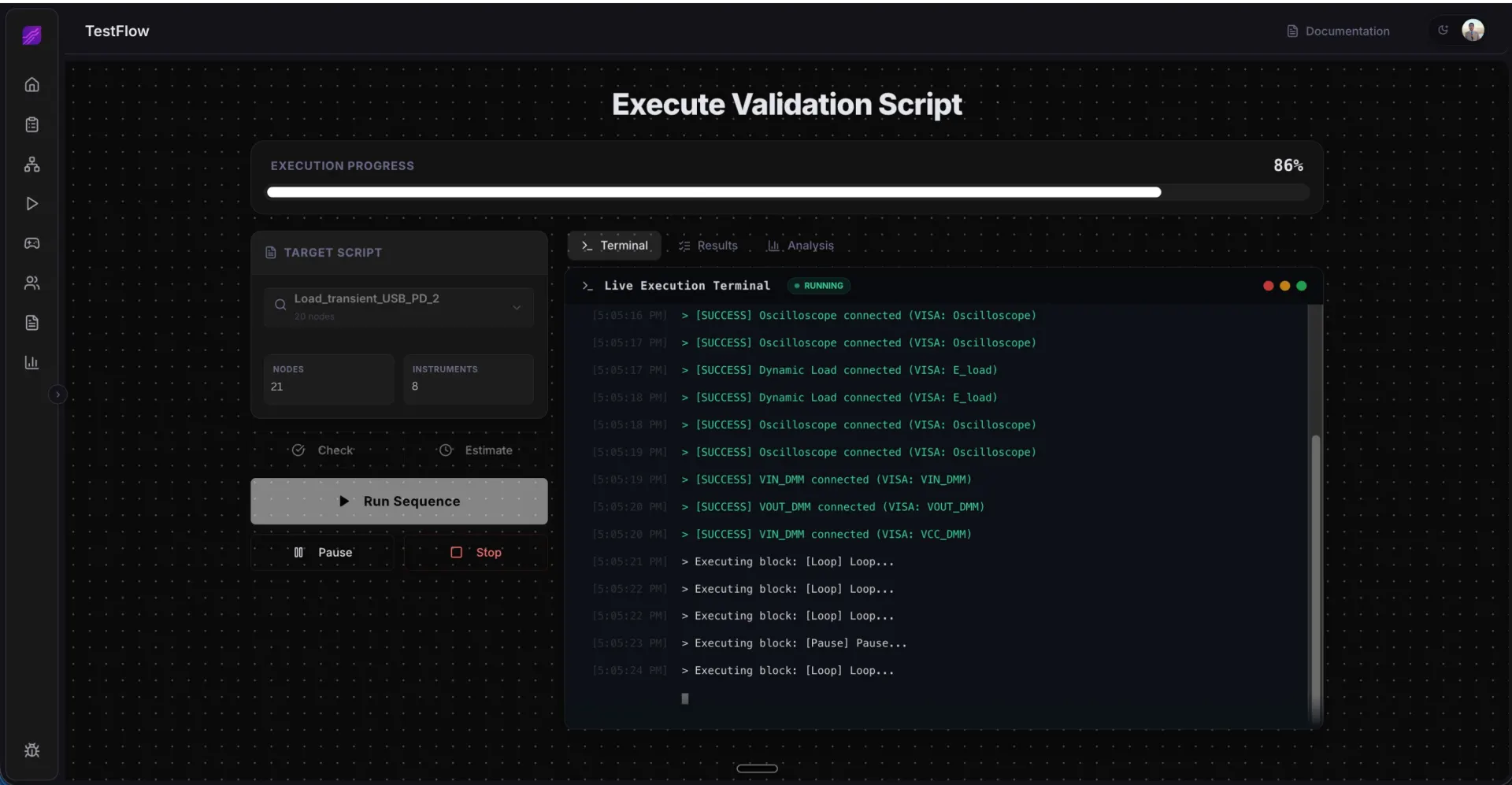
Multi-instrument sequencing
Your scope, power supply, signal generator, DMM, and load run together as one sequence. Pass/fail logic, retries, and limits applied to every measurement, not just stored in CSVs or NI TestStand profiles.
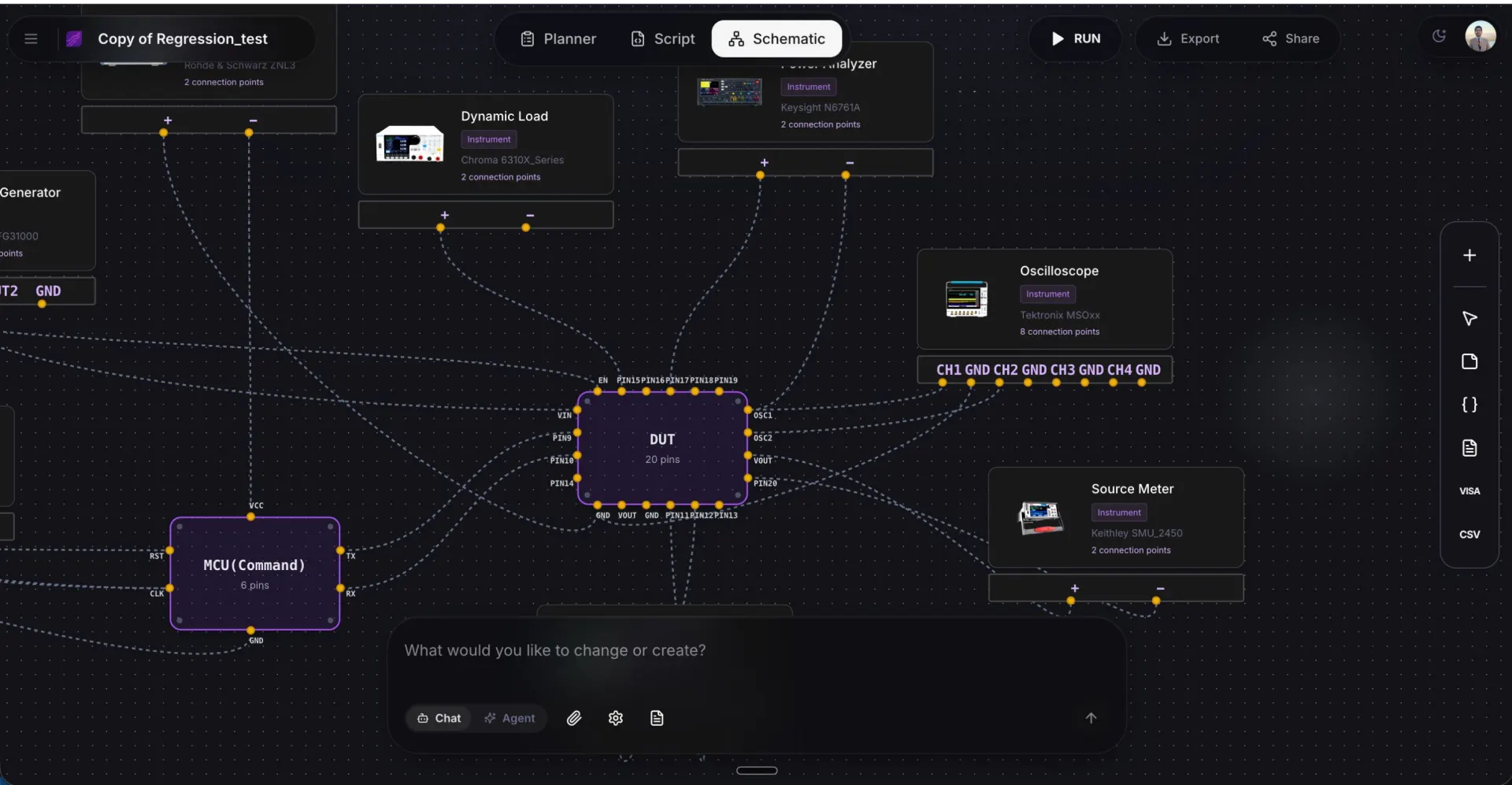
Wire the bench, not the script
Define your bench setup visually. TestFlow handles the SCPI wiring underneath, no LabVIEW wire diagram required.
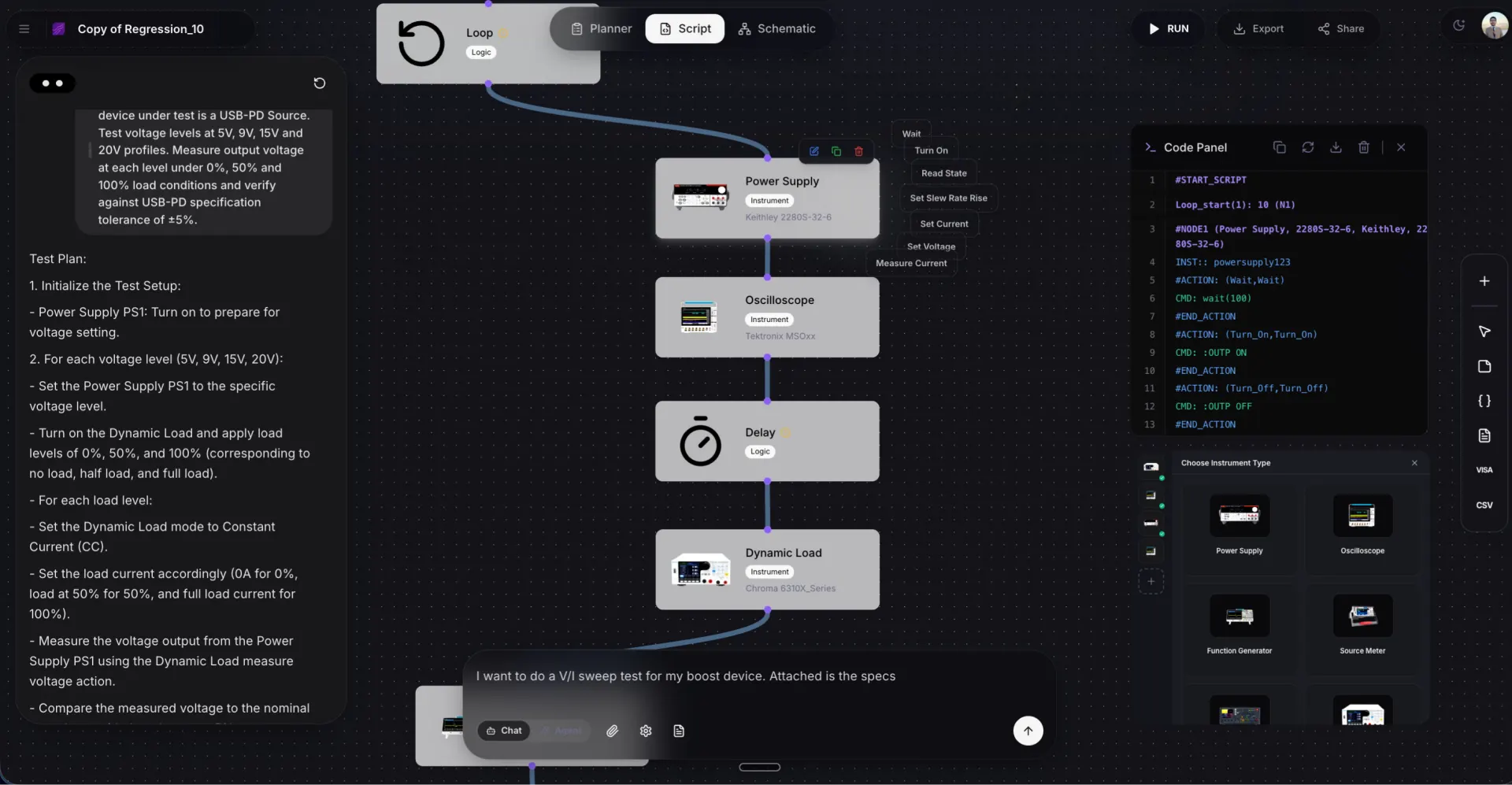
Direct SCPI, without the boilerplate
Interactive instrument control for debugging, the part you used PyVISA for, built in.
Professional reports, generated
Every run produces a structured validation report with charts, pass/fail summaries, and data lineage. No Word, no manual assembly, no TestStand executive add-on.
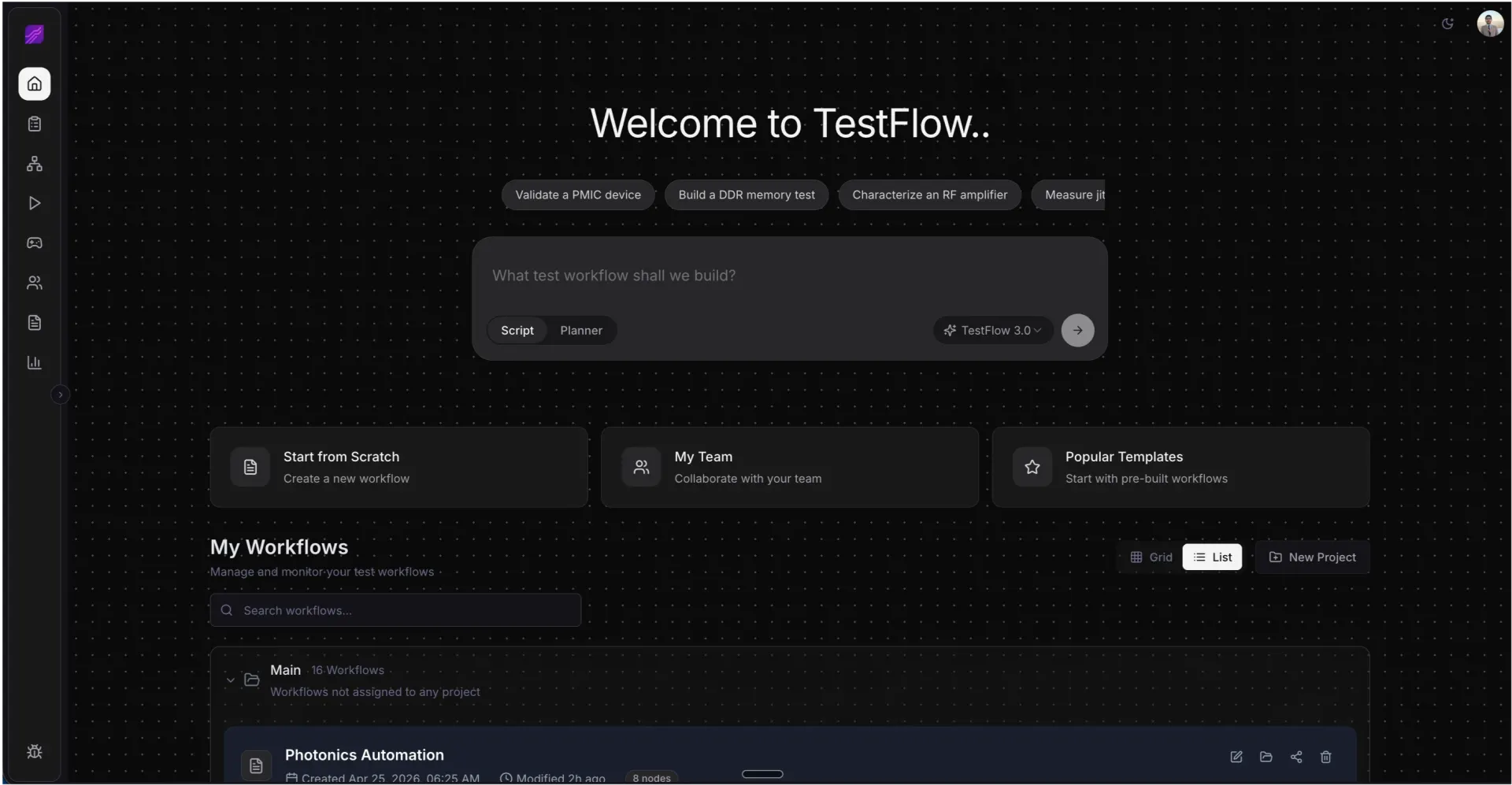
Ready to move past LabVIEW?
See how validation teams replace LabVIEW licenses, Python scripts, and Excel trackers with one structured platform.
The Real Question
The semiconductor industry's time-to-market pressure is not decreasing. Validation cycles that take two months are not a competitive option when your customer's tapeout schedule expects results in two weeks.
The tooling question is not "which approach is technically capable." All four approaches above can produce a passing or failing measurement. The question is: which approach gives your team repeatable, traceable, reportable validation workflows at the speed your customers require?
That's what TestFlow is built for.
Summary
LabVIEW is a 30-year-old graphical platform that still works well for NI-locked labs but carries high licensing costs, a steep learning curve, and an organizational dependency on dedicated LabVIEW developers. Python scripting gives you flexibility and a low floor but never delivers the workflow structure, sequencing, or reporting that real validation programs need. Manual testing is fine for day-0 exploration and bad for everything else.
TestFlow is the AI-native alternative built for the validation workflow itself, not just instrument control. If your goal is compressing validation cycles from weeks to days without rebuilding your instrument stack, that's the category we built.