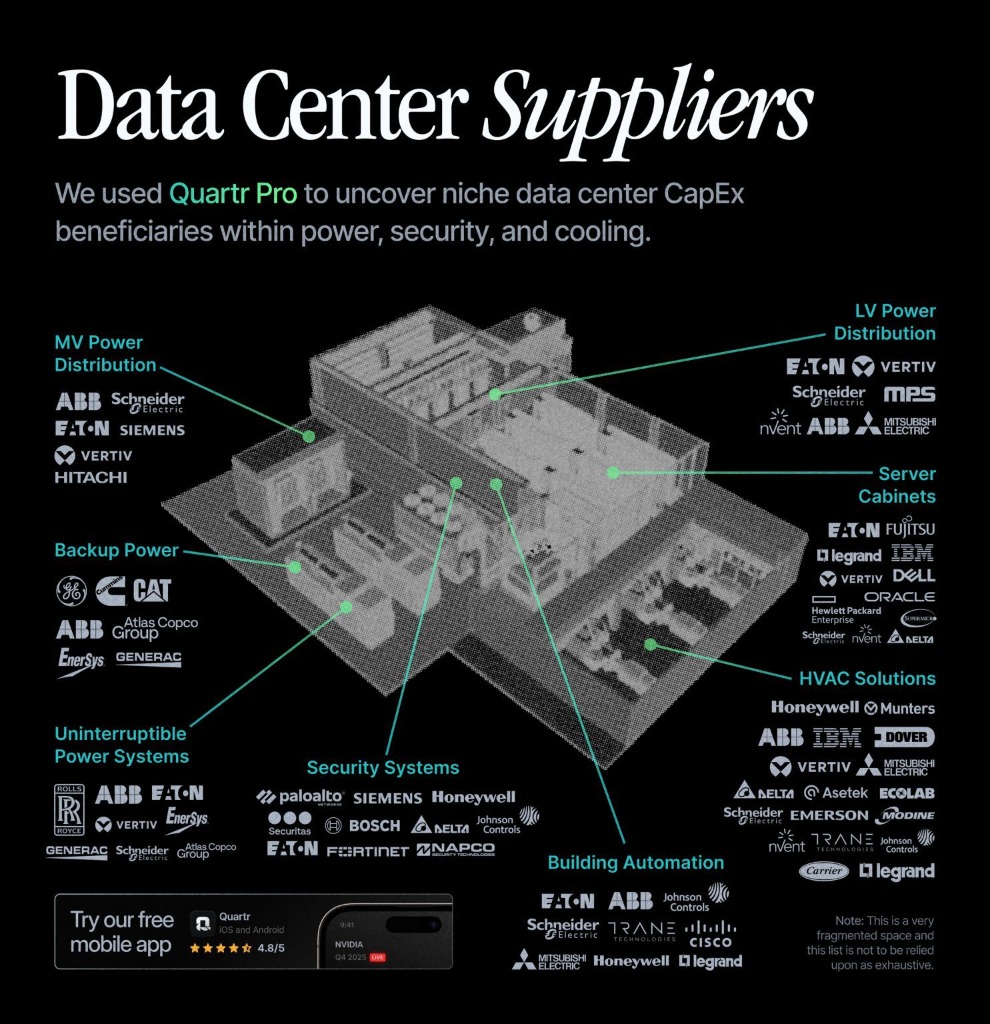
Everyone talks about GPUs, TPUs, HBM, and advanced nodes. But AI data centers are massive, tightly engineered systems where infrastructure decides what performance is actually achievable. The constraints aren't just in the silicon—they're in the power, cooling, and physical security that keep the silicon alive.
The Invisible Stack Behind AI Scale
While NVIDIA grabs the headlines, an entire ecosystem of industrial giants is building the physical reality that allows AI to exist. Without these layers, an H100 GPU is just a dormant piece of silicon. Here is the infrastructure stack that actually powers AI at scale.
1. Power Distribution: The Backbone
AI facilities run extreme loads 24/7. It starts with Medium Voltage (MV) Power Distribution delivering massive, stable power from the grid. It ends with Low Voltage (LV) Power Distribution safely delivering that power to every rack and server.
Key Players
Eaton, Schneider Electric, ABB, Siemens, Vertiv
2. Reliability: UPS & Backup Power
AI models taking weeks to train cannot afford a microsecond of downtime. Uninterruptible Power Systems (UPS) provide millisecond-level protection against crashes, while massive Backup Generators keep the facility running during grid outages.
The Stakes
A power flicker in a standard data center means a reboot. In an AI training cluster, it can mean the loss of weeks of training progress and millions of dollars in compute time.
3. HVAC & Thermal Management
AI racks generate extreme heat density—far beyond traditional web servers. Cooling is now one of the hardest engineering challenges in the data center, moving from air cooling to liquid cooling and immersion technologies.
Key Players
Vertiv, Trane, Carrier, Munters, Stulz
4. Server Cabinets & Automation
High-density Server Cabinets are designed for massive airflow and cable management. Meanwhile, Building Automation provides real-time control of every environmental variable—airflow, temperature, and humidity—to optimize efficiency.
- Optimized for fast deployment
- Software-defined facility management
5. Security Systems
These facilities house some of the most valuable intellectual property and hardware assets on Earth.Physical and Digital Security layers ensure that access is strictly controlled and monitored.
Key Players
Honeywell, Johnson Controls, Bosch, Siemens
Why Validation Matters for Infrastructure Chips
It's not just the GPUs that need validation. The control systems, power management ICs (PMICs), and environmental sensors that run this massive infrastructure are all powered by semiconductors. In these critical systems, a chip failure doesn't just mean a glitch—it can mean a power outage or a cooling failure for millions of dollars of hardware.
At TestFlow, we see the ripple effect of AI demand not just in high-performance compute chips, but in the industrial and automotive-grade chips that power the infrastructure itself. Reliability here is non-negotiable.
"AI is not just a semiconductor story. It's an infrastructure story. Power, cooling, automation, and reliability are what turn silicon into real-world AI capability."
The Next Bottleneck?
As chip performance grows exponentially, the limits of physics in power delivery and heat dissipation are being tested. The next big bottleneck for AI scaling might not be wafer supply or HBM yield—it might be finding enough power and cooling capacity to turn those chips on.